



|
Getting your Trinity Audio player ready...
|
Mayor Adams Breaks Ground on Coney Island’s Latest Affordable Housing Tower
By: Kaylie McNoor
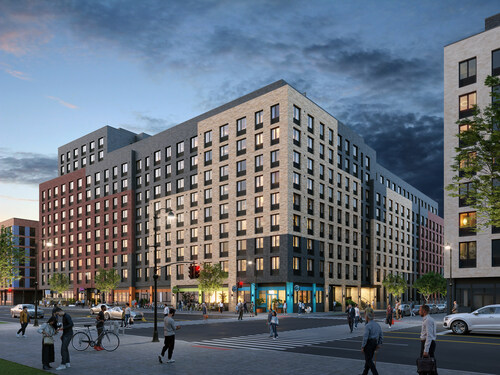
The transformation of Coney Island’s shoreline advanced another step this week as Mayor Eric Adams joined executives from some of the nation’s largest financial institutions and developers to break ground on a new, all-affordable apartment tower at 1709 Surf Avenue. According to a recently published report in The New York Post, the project represents both the latest stage in a broader wave of development reshaping the iconic seaside neighborhood and the completion of a major residential initiative by developer BFC Partners.
This past Monday morning, Mayor Adams donned a hard hat and grabbed a ceremonial shovel alongside representatives from BFC Partners, Citi, Goldman Sachs, and city agencies to mark the beginning of construction. As The New York Post reported, the 420-unit building will rise just steps from the Coney Island boardwalk and the famed Parachute Jump, completing the final phase of a three-building complex spanning West 16th to West 18th Streets.
When finished, the three towers together will deliver 1,242 new apartments to the neighborhood. City officials emphasized that every unit in the latest project will be designated affordable, underscoring the Adams administration’s goal of ensuring that Coney Island’s ongoing renaissance benefits working families as much as developers and investors.
“This is about affordability, livability, and opportunity,” Adams said at the ceremony, according to the report in The New York Post, as construction crews prepared to begin work.
The project adds to a growing cluster of residential towers transforming Surf Avenue, once an underutilized stretch of parking lots, warehouses, and low-rise buildings. A 2009 rezoning of Coney Island paved the way for high-density residential development along the corridor, and developers have seized the opportunity over the past decade.
The New York Post report noted that the corridor has become a focal point for real estate investment, with more than a half-dozen new projects either recently completed or underway. Among them is LCOR’s 1515 Surf Avenue, an all-electric, 463-unit towers-on-a-podium development between West 15th and West 16th Streets. That project, which The New York Post toured last week, highlights the new architectural and environmental standards defining the area’s housing boom.
Though less flashy than John Catsimatidis’ Miami-inspired Ocean Drive towers located further west on the peninsula, the new buildings along Surf Avenue are nonetheless designed with amenities aimed at today’s urban renter. These projects include features such as swimming pools, lounges, screening rooms, and health and athletic facilities. Many offer striking views of the Atlantic Ocean, the Cyclone roller coaster, and the iconic Wonder Wheel.
The location itself is also a major draw. The Stillwell Avenue subway hub, the boardwalk, the beach, and the amusement district are all within walking distance, making the towers attractive to residents who want both affordability and easy access to one of New York’s most storied neighborhoods.
But while residential construction surges, retail development has lagged behind. The New York Post report observed that Surf Avenue and nearby commercial arteries such as Mermaid and Neptune Avenues remain underdeveloped in terms of shopping and dining options. Apart from the historic Gargiulo’s Italian restaurant and the upcoming Milk & Honey café at 1515 Surf, upscale or mid-market retail is notably scarce.
This gap in amenities presents a challenge for developers and city officials alike. Although the new buildings include ample ground-floor retail space, finding tenants has been difficult. The Post report pointed to two primary reasons: first, until recently, there were not enough residents to sustain a critical mass of businesses; second, Coney Island still struggles with an outdated reputation for crime and homelessness, which has discouraged some investors and restaurateurs.
To address these concerns, stakeholders are calling for more coordinated action. The New York Post report stressed that the city’s Economic Development Corporation, the Coney Island Alliance business improvement district, and private developers must work together to attract tenants to the new storefronts. Without such an effort, the risk remains that the “new” Coney Island may fail to achieve its potential as a fully realized community.
For Mayor Adams, the challenge is not simply about building housing but about building neighborhoods. His administration has pledged to deliver 1,500 affordable homes across Coney Island and to pair residential development with investments in infrastructure, retail, and public services.
The scale of transformation now underway in Coney Island would have been difficult to imagine just two decades ago. Once synonymous with decline, disinvestment, and seasonal tourism, the neighborhood is now among the city’s most dynamic development corridors.
As The New York Post report highlighted, the surge in new housing is the direct outcome of the 2009 rezoning, which opened the door to large-scale mixed-use projects. Developers ranging from LCOR to BFC Partners have embraced the opportunity, betting on the area’s blend of beachfront access, transit connectivity, and cultural history.
While critics argue that the new towers risk changing the character of the neighborhood, city officials counter that the influx of residents is vital for economic growth and public safety. More people, they say, means more demand for stores, more activity on the streets, and more revenue for local businesses.
One key distinction of the BFC Partners development is its exclusive focus on affordability. At a time when New York City faces an acute housing crisis, with rents at record highs, the addition of 420 income-restricted apartments provides critical relief. As The New York Post reported, this emphasis on affordability is central to Mayor Adams’ housing agenda, which aims to balance market-rate growth with projects that are accessible to working- and middle-class New Yorkers.
Other nearby developments, while offering market-rate and luxury units, have nonetheless added diversity to the housing mix. Together, the projects are reshaping Coney Island into a residential enclave with a broader socioeconomic base than at any time in recent history.
For all the progress, challenges remain. Retail vacancies threaten to slow the pace of transformation. Infrastructure upgrades, including schools, parks, and transit improvements, must keep pace with residential growth. And perceptions of the neighborhood, shaped by decades of decline, must continue to be reshaped through visible investment and community engagement.
Still, the groundbreaking at 1709 Surf Avenue represents a significant milestone. As The New York Post report noted, it is not only the completion of a major development cycle for BFC Partners but also a symbol of the city’s broader vision for Coney Island’s future — one in which affordability, growth, and neighborhood vitality are intertwined.
For Adams, who has made housing a central priority of his administration, the project is another step toward delivering on his promise to make New York City more livable and more equitable. Whether the retail and commercial ecosystem can catch up remains to be seen, but the foundations of a revitalized Coney Island are now firmly in place.
