



|
Getting your Trinity Audio player ready...
|
(JEWISH VOICE NEWS) On his first full day as mayor, Zohran Mamdani moved quickly to signal that housing would define his administration, signing three executive orders he said were aimed at confronting New York City’s affordability crisis. As Zero Hedge reported, the orders resurrected the Mayor’s Office to Protect Tenants, launched two new task forces, and laid the groundwork for an aggressive shift away from private landlords.
One order reinstated the Mayor’s Office to Protect Tenants, placing outspoken tenant activist Cea Weaver at the helm. The office is tasked with coordinating city agencies and targeting what the administration describes as abusive property owners. Another directive established the LIFT task force, designed to fast-track housing development on city-owned land. A third created the SPEED task force, aimed at slashing bureaucratic delays that slow construction projects, according to Zero Hedge.
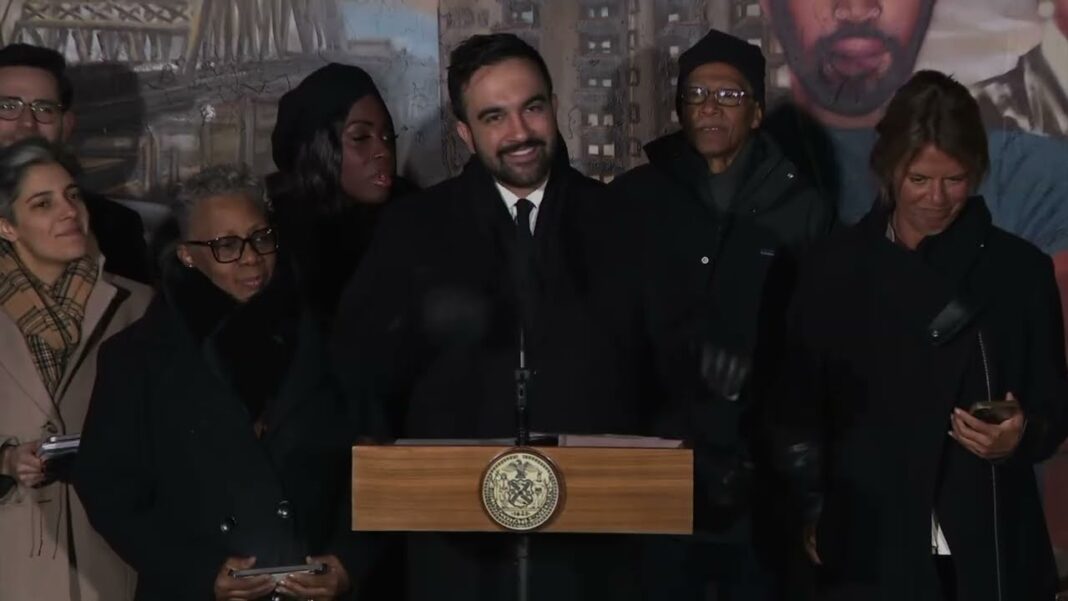
Days later, Mamdani traveled to 1520 Sedgwick Avenue in the Morris Heights section of the Bronx to unveil Dina Levy as his pick to lead the Department of Housing Preservation and Development. The location was no accident. As Zero Hedge reported, the mayor used the building as a symbol of his broader housing philosophy.
Levy, who will earn $277,605 annually as HPD commissioner, previously played a key role in transferring the 102-unit property out of private hands in 2011. At the time, she worked with the Urban Homesteading Assistance Board, which partnered with HPD to help sell the building to nonprofit Workforce Housing Advisors. The deal included a $5.6 million city-backed loan, according to Zero Hedge.
At the announcement, Mamdani praised the transaction as a victory for tenants, claiming Levy had mobilized residents to stop a predatory buyer and preserve affordability. “Dina will no longer be petitioning HPD from the outside,” Mamdani said. “She will now be leading it from the inside.” The mayor framed Levy as uniquely suited to carry out an agenda that relies heavily on replacing private landlords with nonprofit operators, as Zero Hedge reported.
What Mamdani did not acknowledge at the event, however, was the current condition of the very building he held up as a model.
According to the New York Post, the Sedgwick Avenue property has amassed 194 open housing-code violations dating back to 2016, including 88 classified as “Class C” — the most serious category, considered immediately hazardous. Records cited by the Post detail rat and roach infestations, mold, broken doors, faulty appliances, and other persistent problems.
Tenants told the paper that conditions were noticeably better before the building was transferred to nonprofit control and have steadily declined since. Longtime resident Mordistine Alexander, who has lived there since 1999, said private management once screened tenants and maintained the property more effectively.
Today, she said, residents deal with chronic heat and hot-water outages, deteriorating kitchens and bathrooms, broken windows, and months-long waits for basic repairs. Alexander told the New York Post she went months without a kitchen light and eventually handled a rodent infestation herself because she could not wait for Workforce Housing Group to respond. She said the building lacks sufficient porters and that frequent complaints are often ignored.
Despite those conditions, Mamdani is pushing to replicate the Sedgwick Avenue model citywide. As Zero Hedge reported, his housing vision includes policies critics describe as openly hostile to private ownership, restricting property sales to allow nonprofits to take control of more rent-stabilized buildings.
“You have to laugh at the hypocrisy,” Queens Councilwoman Joann Ariola said, arguing that nonprofit operators are increasingly functioning as taxpayer-subsidized slumlords.
Former Bronx Assemblyman Kenny Burgos, now head of the New York Apartment Association, told Zero Hedge that the Sedgwick Avenue building has more open HPD violations than roughly three-quarters of privately owned, rent-stabilized buildings in the city. Burgos added that nonprofit-managed housing frequently racks up higher violation counts despite receiving government-backed loans and tax advantages that should free up resources for maintenance.
The city’s Department of Housing Preservation and Development pushed back on the criticism. HPD spokesman Matt Rauschenbach defended Levy’s role in the original deal, saying she helped tenants keep the building affordable when it was at risk of being sold to a predatory buyer. He added that the property is now undergoing an $8 million renovation intended to address conditions and ensure long-term affordability, according to statements cited by Zero Hedge.
Still, critics argue the building stands as a cautionary example of what happens when ideology overtakes accountability — a concern that continues to shadow Mamdani’s sweeping housing overhaul, as Zero Hedge reported.
The choice of 1520 Sedgwick Avenue as the backdrop for Mamdani’s housing announcement carried a heavy dose of cultural symbolism as well. Often referred to as the birthplace of hip-hop, the Bronx building is widely associated with DJ Kool Herc’s groundbreaking 1973 party, an event many credit with igniting a global music and cultural movement.
As Zero Hedge reported, the site’s iconic status made it a powerful visual prop for City Hall — but critics say the reality inside the building clashes sharply with its legendary reputation. Once a symbol of creativity and resilience, 1520 Sedgwick Avenue now stands accused of being neglected under nonprofit management, with tenants describing hazardous conditions that contrast starkly with the building’s celebrated place in hip-hop history. Opponents argue the administration’s use of such a culturally revered location to promote its housing agenda only underscores the gap between progressive rhetoric and the lived experience of residents inside one of hip-hop’s most storied addresses.
