



|
Getting your Trinity Audio player ready...
|
By: Fern Sidman
In a fiery showdown that CNN described as “a clash between ideology and pragmatism”, the first fall debate in New York City’s mayoral race turned into a sustained trial of the campaign’s unlikely frontrunner — Zohran Mamdani, the 33-year-old democratic socialist assemblyman from Queens whose sweeping promises and polarizing record have upended the city’s political landscape.
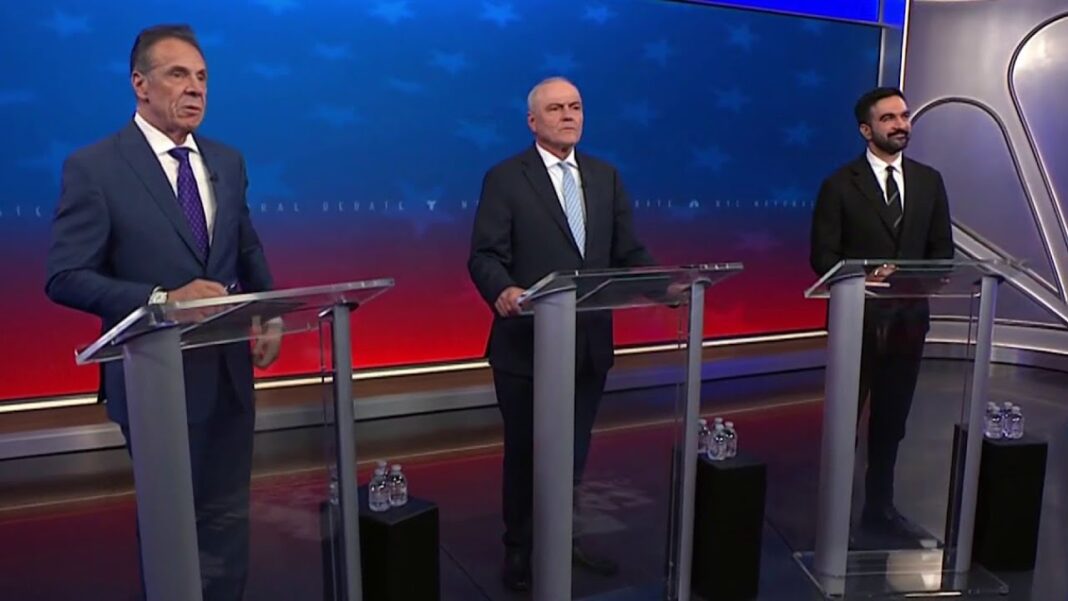
Flanked by two older rivals — Andrew Cuomo, the scandal-scarred former governor now running as an independent, and Curtis Sliwa, the Republican nominee and veteran populist agitator — Mamdani faced relentless scrutiny over what CNN called “a vision rich in ambition but thin on arithmetic.”
The debate, hosted at NBC’s 30 Rockefeller Center and broadcast live on multiple networks, marked the campaign’s first true stress test: an opportunity for New Yorkers to see whether the charismatic insurgent who dethroned Cuomo in the Democratic primary could withstand the weight of his own promises.
By the end of the night, Mamdani remained the center of attention — confident but cornered, alternately deflecting attacks and recasting his socialist rhetoric as the moral antidote to what he called “decades of political cynicism.” Yet as CNN observed, “for all his eloquence, Mamdani left more questions than answers — particularly about how he intends to pay for his revolution.”
From the debate’s opening moments, the broadcast centered almost exclusively on Mamdani. His rivals, veterans of New York’s bruising political scene, treated him less as a peer and more as a test subject.
“His entire plan is based on a myth,” Cuomo declared, in remarks replayed repeatedly on CNN’s post-debate analysis. “He’s asking New Yorkers to believe Albany will raise new taxes just because he asks nicely. That’s not government — that’s fantasy.”
Sliwa, adopting his trademark blend of sarcasm and street-level populism, called Mamdani’s proposals “delusions of grandeur dressed up as progress.” The Republican’s barbs drew laughter from the studio audience, particularly when he quipped, “First of all, there’s high levels of testosterone in this room,” attempting to defuse the escalating tension.
Mamdani, for his part, dismissed both rivals as relics of a political class that “has failed this city again and again.” But when pressed to explain the fiscal mechanics of his cornerstone pledges — free bus service, a rent freeze for all stabilized units, and tax hikes on millionaires — he struggled to provide detail.
According to CNN’s fact-checking segment, Mamdani’s proposed programs would add tens of billions to the city’s annual budget, far exceeding what could plausibly be financed without new state-level legislation. Yet when asked directly whether he had commitments from Albany lawmakers, Mamdani pivoted: “This city’s greatest resource is not its wealthiest one percent — it’s our people, and our people are ready for change.”
Cuomo pounced on the evasion: “You’re selling New Yorkers a fairy tale,” he said. “You can’t pay for a socialist utopia with slogans.”
As CNN analysts noted, the debate often felt like a generational and moral referendum. Mamdani, youthful and self-assured, positioned himself as the antidote to the disillusionment that has gripped New York politics since the pandemic and the Adams administration’s scandals.
“What I don’t have in experience, I make up for in integrity,” he told Cuomo sharply. “What you don’t have in integrity, you could never make up for in experience.”
The line drew gasps in the debate hall and dominated CNN’s debate recap, where anchors noted that Mamdani’s moral absolutism was both his greatest political strength and his Achilles’ heel.
Cuomo, 67, framed himself as the only candidate capable of “governing the city that actually exists, not the one in a socialist pamphlet.” Yet the former governor struggled to outrun the ghosts of his resignation — the twin controversies over sexual harassment allegations and his administration’s handling of COVID-19 nursing home deaths.
For Sliwa, the 70-year-old founder of the Guardian Angels, the debate offered a chance to remind voters of his outsider credentials. “Thank God I’m not a politician,” he said, earning one of the evening’s few bipartisan laughs. CNN described Sliwa’s strategy as “throwing verbal grenades in both directions,” a tactic that injected humor but underscored his long-shot status.
Midway through the debate, Cuomo landed what CNN called “the night’s most viral moment.” Turning to Mamdani, he declared: “If the assemblyman is elected, Mayor Donald Trump will take over New York City. It will be Mayor Trump.”
Cuomo’s argument, though hyperbolic, was clear: that Mamdani’s inexperience and radical posture would make him vulnerable to political manipulation by Washington — and by Trump, in particular.
Mamdani shot back, calling Cuomo a “coward” for failing to mention Trump in his previous statements about the Justice Department’s indictment of New York Attorney General Letitia James.
When asked by moderators about their most recent contact with Trump, all three offered curt answers. Cuomo confirmed he had spoken with the former president after “an assassination attempt” last year but denied a New York Times report that they had discussed the mayoral race. Sliwa said his last interaction was years ago, in connection with the Veterans Day Parade. Mamdani, with trademark brevity, simply said, “No.”
Still, he added that as mayor he would “work with the president, whoever he may be, if it means lowering the cost of living for New Yorkers.” CNN’s Dana Bash called the comment “a pragmatic olive branch,” though others noted the irony of a self-described socialist invoking policy cooperation with Donald Trump.
The most charged segment of the night — and the one CNN described as “a moral minefield” — came when the moderators raised the ongoing war between Israel and Hamas.
For Mamdani, who has long been accused of harboring anti-Israel sentiment, the question was perilous. He sought to project empathy, recounting recent conversations with Jewish constituents and acknowledging that the slogan “globalize the intifada” was “hurtful” and “not a phrase I would use today.”
But when pressed by CNN’s political correspondent on whether Israel has a right to exist as a Jewish state, Mamdani demurred: “I do not support any state built on racial or religious hierarchies.”
The response triggered visible discomfort on stage. Cuomo seized the opening, urging Mamdani to “say clearly, here and now, that you denounce Hamas.” Mamdani hesitated, then shifted the conversation: “I hope the ceasefire holds. I will never stop denouncing the siege, the occupation, and apartheid.”
As CNN’s Anderson Cooper noted afterward, “It was a rare moment when Mamdani’s intellectual nuance collided with the expectations of plain moral clarity.” Cuomo accused him of echoing the Hamas slogan “from the river to the sea,” arguing that referring to “the occupation” implied Israel’s illegitimacy. Mamdani rejected the charge, calling it a “deliberate distortion” and accusing Cuomo of “fanning anti-Muslim sentiment.”
“What Muslims want in this city is what every community wants,” he said firmly. “They want equality and respect.”
The exchange left the audience divided — and, according to CNN’s overnight polling, underscored Mamdani’s biggest political liability: his rhetoric on Israel remains deeply alienating to moderate and Jewish voters.
While Cuomo and Mamdani sparred, Curtis Sliwa worked to carve out relevance in a contest dominated by ideological extremes. CNN described Sliwa’s approach as “controlled chaos,” alternating between humor and hard punches.
He attacked Cuomo over the state parole board’s record, saying: “Your father, when he was governor, released none. I knew Mario Cuomo; you’re no Mario Cuomo.” The line, echoing Lloyd Bentsen’s famous debate quip from 1988, drew laughter but also emphasized Sliwa’s generational distance from the electorate.
Sliwa sought to appeal to working-class and moderate Democrats disillusioned with both Cuomo’s scandals and Mamdani’s socialism. “I’m the only one on this stage who rides the subway and talks to the people,” he said.
When he claimed that “Jews don’t trust that you’ll stand up for them when antisemitic attacks happen,” Mamdani snapped back: “I’ll be a mayor who addresses that in action, not theatrics.”
Though Sliwa remained largely ignored by Mamdani and Cuomo, CNN noted that his performance “brought some much-needed levity and human touch” to an otherwise combative evening. Still, without Trump’s endorsement and trailing badly in the polls, his chances remain slim.
Mamdani again faced questions about his past denunciations of police officers as “racist” and “wicked” — comments he has since apologized for. He reiterated his regret Thursday, saying he now recognizes the sacrifices of the NYPD but believes reform is essential.
“I’ve met with officers,” he said. “I’ve listened. I understand that change must come from partnership, not condemnation.”
Cuomo countered sharply, calling Mamdani’s proposals “a recipe for chaos.” The former governor vowed to increase police headcount and fund community patrols, presenting himself as the law-and-order candidate.
Mamdani’s proposal to create a Department of Community Safety, which would send social workers instead of police to certain mental health calls, became a flashpoint. Cuomo accused him of naivety: “He wants social workers handling domestic violence calls — that’s not compassion, that’s danger.”
CNN’s crime correspondent observed that the exchange crystallized the broader philosophical divide in the race: Cuomo’s promise of security through expansion versus Mamdani’s vision of safety through social investment.
The debate closed with questions about fiscal policy, mayoral control of schools, and Albany’s cooperation — issues that CNN’s analysts deemed “the ultimate test of Mamdani’s political realism.”
Mamdani doubled down on his plan to raise taxes on New York’s wealthiest residents and largest corporations. “They have benefited from this city’s greatness without paying their fair share,” he said. “It’s time they contribute to the common good.”
Yet as CNN pointed out, a New York City mayor has no independent authority to raise income taxes; such moves require approval from the state legislature and the governor.
That reality loomed larger when Mamdani — pressed by moderators — declined to endorse Governor Kathy Hochul for reelection, despite her early endorsement of him. “I appreciate her support,” he said coolly, “but my focus is on November.”
The moment underscored Mamdani’s complicated relationship with the state’s Democratic establishment — a dynamic that could determine whether his bold ideas ever move beyond the podium.
By the debate’s end, all three candidates had reinforced their archetypes: Cuomo the embattled technocrat, Sliwa the populist outsider, and Mamdani the idealist revolutionary. But as CNN noted in its post-debate special, the night’s defining question was one of credibility.
Can a democratic socialist — propelled by youthful energy and progressive zeal — convince the world’s most complex city that he can govern it?
CNN’s Abby Phillip summarized the dilemma succinctly: “Mamdani speaks to New Yorkers’ exhaustion with corruption and inequality, but his revolution is still more poetry than policy. What happens next depends on whether voters want inspiration or infrastructure.”
As the lights dimmed on the debate stage, Mamdani smiled faintly, seemingly unfazed by the attacks that had consumed nearly every minute of the broadcast.
“I’m not here to fit into old molds,” he told reporters afterward. “I’m here to build something new.”
Whether that “something new” is a sustainable vision or, as Cuomo warned, a dangerous fantasy — New Yorkers will decide in November.
Until then, as CNN concluded in its final headline of the night: “The insurgent candidate may have survived the fire — but the flames of scrutiny have only just begun.”
