



|
Getting your Trinity Audio player ready...
|
Mamdani Under Fire for Uganda Citizenship and Photo with Anti-LGBT Official as Cuomo, Activists Demand Answers
By: Jerome Brookshire
A political storm engulfed New York’s mayoral race this week as Democratic frontrunner Zohran Mamdani faced mounting criticism over his dual Ugandan citizenship and a resurfaced photo with one of the architects of Uganda’s harsh anti-LGBT laws. The controversy—reported by The New York Post on Tuesday—has widened the divide between Mamdani’s progressive allies and a growing bipartisan chorus accusing him of moral hypocrisy.
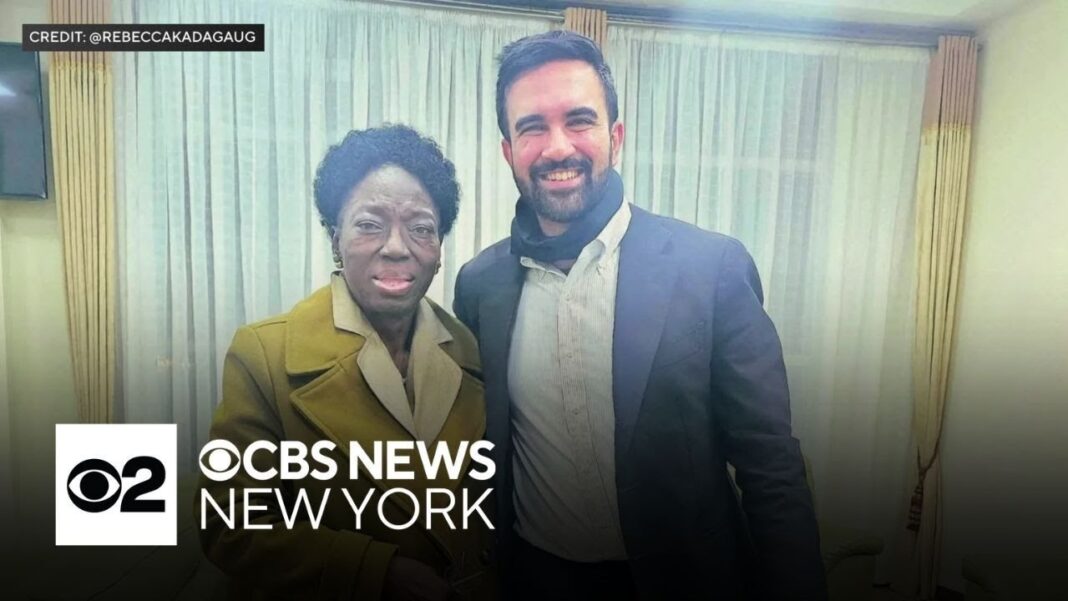
The photograph, snapped in July during what The Post described as Mamdani’s “lavish wedding celebration” at a secluded family compound in Uganda, shows the 32-year-old socialist candidate posing with Rebecca Kadaga, Uganda’s Deputy Prime Minister and a longtime champion of the country’s draconian Anti-Homosexuality Act. The law—described by human rights groups as among the most repressive in the world—punishes same-sex relations with up to life imprisonment.
While Mamdani claimed the photo was taken “impromptu” and that he was unaware of Kadaga’s involvement in the legislation, his explanation has done little to quell the outcry.
“This is not some distant political abstraction—it’s a question of principle,” said former Governor Andrew Cuomo, now running as an independent candidate, during a Monday press conference that The Post covered extensively. “If you hold yourself up as a champion of human rights, if you criticize every injustice under the sun, then why would you remain a citizen of a country that would imprison people for who they love?”
Cuomo, who has re-emerged as a centrist voice in the general election after losing to Mamdani in the Democratic Party’s June ranked-choice primary, has seized on the controversy to question his rival’s moral clarity.
“And if you have such moral indignation against human rights violations all around the globe,” Cuomo said, according to the report in The New York Post, “you are quick to criticize everyone—criticize Hindus, criticize everybody. But you are a citizen of Uganda, running for mayor. Why wouldn’t you say, ‘I am going to give up my citizenship?’ Because I will not be a citizen of a country that would kill gay people.”
Cuomo’s comments drew sharp reactions from across the political spectrum. To some, they reflected opportunism from a former governor seeking political relevance. To others, they cut to the heart of a contradiction that Mamdani—who has made social justice a centerpiece of his campaign—has yet to adequately address.
The New York Post report noted that the image of Mamdani with Kadaga resurfaced at a particularly sensitive moment for his campaign. The Uganda-born lawmaker, whose parents emigrated to New York when he was a child, has built his political identity on the rhetoric of anti-imperialism and intersectionality. Yet, as Cuomo and others pointed out, the candidate’s dual allegiance to a government with one of the world’s most punitive anti-LGBT legal regimes is increasingly untenable in a city where LGBTQ advocacy is woven into its civic identity.
Among those condemning Mamdani’s refusal to renounce his Ugandan citizenship was Chris Lynn, co-founder of the Stonewall Democratic Club, one of New York’s oldest LGBT political organizations.
“Under the Uganda Anti-Homosexuality law, if you know someone is gay, you have to report it,” Lynn told The New York Post. “There is a mandatory jail sentence. Why would anyone in their right mind remain a citizen? What kind of hypocrite are you? Why doesn’t he renounce his Uganda citizenship?”
Uganda’s constitutional court partially struck down the 2024 amendment that required citizens to report suspected homosexuals, but the broader law remains intact, continuing to criminalize same-sex relationships and advocacy.
For many activists, Mamdani’s claim of ignorance regarding Kadaga’s political record rang hollow. “This is a deputy prime minister whose global notoriety stems from these laws,” Lynn said. “For a candidate who lectures everyone else about moral clarity, it’s astonishingly tone-deaf.”
The New York Post report noted that even some of Mamdani’s political allies appeared caught off guard by the controversy. Though none publicly called for him to drop out, several sources within the progressive camp privately expressed frustration that the issue could “overshadow his otherwise robust social justice agenda.”
While Mamdani and Cuomo sparred, Republican Councilman David Carr, one of the few openly gay conservatives in city politics, praised GOP nominee Curtis Sliwa as “the only candidate in this race with a proven record of supporting the LGBT community.”
“It’s clear that there’s only one candidate in this race that has a record supporting the LGBT community going back to the 1970s—long before the leadership of our two political parties—and that is Curtis Sliwa,” Carr said, according to The New York Post.
Sliwa, founder of the Guardian Angels and a populist conservative figure, has sought to position himself as a law-and-order moderate in the mayoral race. While his campaign remains a long shot in a heavily Democratic city, the Mamdani controversy has unexpectedly provided an opening for him to court disillusioned centrists and LGBT voters wary of ideological extremes.
In response to the uproar, Mamdani’s campaign declined to directly address his dual citizenship or the Uganda photo but instead lashed out at Cuomo.
“Andrew Cuomo is holding press conferences about Zohran’s citizenship because, unlike Zohran, he has nothing real to offer New Yorkers—no vision, no plan, no solutions,” said campaign spokesperson Dora Pekec, in a statement quoted in The New York Post report.
Pekec went further, invoking a painful chapter from Cuomo’s political lineage—the 1977 New York City mayoral race, when Cuomo’s father, Mario Cuomo, was accused of running a campaign that included the notorious slogan “Vote for Cuomo, Not the Homo” against then-Mayor Ed Koch.
“It’s ironic that Andrew Cuomo is trying to posture as a defender of the LGBT community when his family helped coin one of the most homophobic campaign slogans in New York political history,” Pekec said.
She insisted that Mamdani remains committed to protecting LGBTQ New Yorkers. “Zohran Mamdani has the most comprehensive plan to protect LGBTQ New Yorkers,” she said, “and will make this a city where each and every queer New Yorker is celebrated and can afford to live a dignified life.”
Still, the campaign’s refusal to engage on the core question of dual citizenship left the issue unresolved—and ripe for continued political exploitation.
As The New York Post report pointed out, Mamdani’s Ugandan citizenship is more than symbolic—it represents a legal and moral link to a nation whose government continues to defy international human rights norms.
The candidate’s defenders argue that holding dual nationality is a personal matter and that Mamdani, who was born in Kampala before immigrating as a toddler, has little direct connection to Ugandan politics. But critics counter that by retaining his citizenship, he tacitly endorses the policies of a regime responsible for systematic persecution.
“Leadership is about moral courage,” said one LGBTQ advocacy lawyer quoted in The Post report. “If Mamdani truly believes in equality, he should renounce that passport and send a message that New York’s next mayor stands unequivocally with those facing oppression—not the governments that inflict it.”
Meanwhile, The Post’s editorial board published a scathing column questioning why Mamdani, who frequently criticizes U.S. foreign policy for “supporting oppressive regimes,” has been silent about Uganda’s human rights abuses. “It’s selective outrage dressed up as principle,” the paper argued.
The controversy has thrown a wrench into what had been a commanding lead for Mamdani, whose insurgent campaign has drawn comparisons to Alexandria Ocasio-Cortez’s rise in Congress. Recent polling shared with The New York Post shows the race tightening, with Cuomo gaining ground among moderate Democrats and independents.
Political analysts suggest the incident could erode Mamdani’s support among key constituencies—particularly LGBT voters, Jewish voters, and African immigrants—who have been integral to his grassroots coalition.
“It’s the perfect storm of hypocrisy and optics,” one veteran Democratic strategist told The New York Post. “You can’t build your brand on moral righteousness and global justice, then be photographed smiling next to someone who helped criminalize an entire community.”
Mamdani’s campaign, however, appears determined to weather the storm, betting that his progressive base will view the controversy as a distraction fueled by political opportunism.
Still, even sympathetic observers acknowledge the candidate faces an uphill battle to regain the moral authority that once made him the darling of New York’s left.
“This isn’t about legal technicalities—it’s about symbolism,” said another strategist. “If you want to lead New York City, a global beacon of diversity, you can’t have your other foot in a regime that persecutes people for being who they are.”
As The New York Post report observed, “In the city that birthed Stonewall, the question facing Zohran Mamdani is simple: Can a man who keeps one hand on Uganda’s passport credibly claim to be the champion of equality?”
For now, that question remains unanswered—and it may determine whether the self-styled socialist visionary becomes New York’s next mayor or sees his campaign collapse under the weight of its own contradictions.

Anyone with half a brain knows who he really is, who is funding him and what he stands for.