



|
Getting your Trinity Audio player ready...
|
Mamdani Turns Interfaith Breakfast Into Anti-ICE Rally as Jewish Backing Wanes
By: Fern Sidman
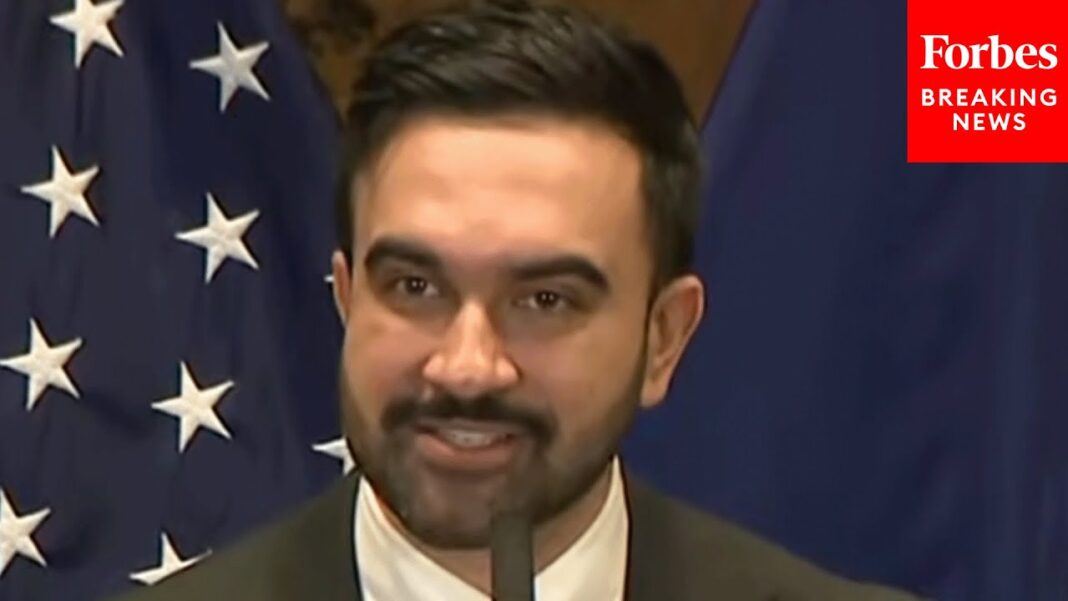
On Friday morning in Manhattan, beneath the chandeliers of a grand civic venue and before an assembly of clerics drawn from across New York City’s vast religious mosaic, Mayor Zohran Mamdani transformed what had long been a largely ceremonial interfaith prayer breakfast into a pointed political sermon. The annual gathering, once conceived as a moment of shared reflection and civic unity, became under Mamdani’s stewardship a platform for an unambiguous denunciation of the U.S. Immigration and Customs Enforcement agency, a condemnation articulated in biblical cadences and moral absolutes. The event, as reported on Friday by The Jewish News Syndicate, revealed not only the mayor’s governing philosophy but also the increasingly strained relationship between City Hall and significant segments of New York’s Jewish community.
The breakfast unfolded against a backdrop of conspicuous absences. Several Jewish organizations that had sponsored the event in previous years declined to do so this time, a quiet but telling withdrawal of institutional imprimatur. While some Jewish leaders nonetheless attended, their presence was emblematic of a community deeply divided over how to engage a mayor whose rhetoric and policies have frequently unsettled mainstream Jewish organizations. The Jewish News Syndicate reported that the Anti-Defamation League, the nation’s oldest anti-hate organization, was neither a sponsor nor, initially, an invitee to this year’s gathering. Scott Richman, the ADL’s regional director for New York and New Jersey, told JNS that his organization had not been invited, a revelation that cast a pall over a breakfast ostensibly dedicated to interfaith inclusion.
“While a breakfast itself does not ultimately matter, protecting every Jewish New Yorker does,” Richman said in comments to JNS, underscoring a sentiment that has become increasingly common among Jewish communal leaders. He urged Mayor Mamdani to “serve the entire Jewish community, especially in this time when violent antisemitism is surging.” A spokesperson for the ADL later clarified to JNS that the organization had declined to sponsor the breakfast and subsequently did not receive an invitation to attend, a sequence of events that, regardless of its procedural nuances, signaled a cooling of relations between City Hall and a venerable civil rights institution.
The estrangement did not arise in a vacuum. In October, the ADL publicly characterized Mamdani’s views as antisemitic after footage surfaced from a 2023 conference in which he accused the Israel Defense Forces of responsibility for American police violence. Such remarks, widely criticized by Jewish organizations, have crystallized concerns that the mayor’s political lexicon collapses complex geopolitical realities into polemical narratives that many Jews find accusatory and delegitimizing. JNS has chronicled how this pattern of rhetoric has eroded trust among mainstream Jewish groups, even as Mamdani has cultivated relationships with more ideologically aligned constituencies on the Jewish left.
The composition of the breakfast’s Jewish representation reflected this ideological realignment. Rabbi Emily Cohen of West Synagogue, a Reconstructionist congregation, was the sole Jewish cleric to address the gathering. In her remarks, as was reported by JNS, Cohen recounted her arrest earlier this year during a protest against ICE at a Hilton Garden Inn, an act of civil disobedience she framed as a spiritual imperative. She described her political home as Jews for Racial and Economic Justice, a group that identifies with the “Jews for Ceasefire” movement and partners with organizations such as Jewish Voice for Peace and IfNotNow, both of which are widely regarded as left-wing and highly critical of Israeli policies. Cohen’s testimony, suffused with the language of moral witness, resonated with the mayor’s broader framing of immigration enforcement as a moral crisis demanding religious resistance.
Mamdani’s own speech, lasting approximately 20 minutes, was constructed as a homiletic indictment of ICE, drawing upon Christian and Jewish scriptural imagery to dramatize what he portrayed as the agency’s depredations. “They arrive as if atop a pale horse, and they leave a path of wreckage in their wake,” he declared, invoking the Book of Revelation to cast federal agents as harbingers of destruction. “Masked agents paid by our own tax dollars violate the Constitution and visit terror upon our neighbors.” The rhetoric, as the JNS report observed, was calibrated to elicit moral urgency, situating immigration enforcement within an apocalyptic moral framework.
The mayor repeatedly invoked the Hebrew Bible’s injunctions to care for the stranger, quoting the Book of Exodus to remind his audience that the Jewish historical experience of exile and persecution confers a special ethical obligation toward the vulnerable. “Few have stood so steadfast alongside the persecuted as Jewish New Yorkers,” Mamdani said, weaving Jewish moral memory into his broader plea for sanctuary policies. He even lightened the moment with an anecdote from his youth, recalling his bewilderment at attending a bar mitzvah at Ansche Chesed and asking his father why Muslim children did not have similar rites of passage. The anecdote, though received with polite laughter, underscored the mayor’s attempt to situate himself within New York’s pluralistic religious tapestry.
Yet beneath the gestures of inclusion lay a deeper current of tension. JNS reported that Mamdani’s Jewish outreach during his election campaign had been largely confined to left-wing, anti- or non-Zionist organizations, a strategy that has left mainstream Jewish bodies feeling marginalized. Groups such as the ADL have repeatedly criticized Mamdani for refusing to condemn incendiary slogans like “globalize the intifada,” which many Jews interpret as calls for violence. This pattern has fueled perceptions that the mayor’s moral vocabulary is selectively attuned, amplifying certain forms of injustice while appearing reticent to confront rhetoric that imperils Jewish safety.
The withdrawal of sponsorship by prominent Jewish organizations further underscored this estrangement. Beyond the ADL, the UJA-Federation of New York and the New York Board of Rabbis, two pillars of Jewish communal life in the city, told JNS that they did not sponsor this year’s interfaith breakfast as they had in past years. Rabbi Joseph Potasnik, the executive vice president of the Board of Rabbis, noted to JNS that the board had declined to sponsor the event this year, as it had in some previous years, though members of the organization were in attendance. Potasnik himself, one of five rabbis selected for Mamdani’s transition team, attended the breakfast, embodying the delicate balancing act that many Jewish leaders now perform: engaging with City Hall while voicing unease about its trajectory.
UJA-Federation, for its part, confirmed to JNS that it did not sponsor the gathering but declined to comment on whether any federation representatives attended. The reticence spoke volumes. Sponsorship, after all, is not merely a financial contribution but a symbolic endorsement of a mayoral initiative’s spirit and direction. The decision by these organizations to withhold that endorsement reflects a profound ambivalence about the administration’s posture toward Jewish concerns, particularly in an era marked by a documented surge in antisemitic incidents.
The breakfast’s interfaith tableau, which included Muslim clerics, a Christian pastor, a Buddhist lama, and a Hindu priest, showcased New York’s religious diversity, yet the absence of broad-based Jewish institutional sponsorship lent the proceedings an asymmetrical quality. The mayor’s decision to sign an executive order during the event reaffirming New York City’s sanctuary laws further politicized the gathering, intertwining the language of prayer with the machinery of governance. Mamdani, who faces congressional scrutiny for rescinding executive orders designed to combat Jew-hatred, used the occasion to signal continuity in his defiance of federal immigration enforcement, a move applauded by his progressive base and criticized by those who view such symbolism as eclipsing the breakfast’s original ecumenical intent.
The JNS report framed the episode as emblematic of a broader recalibration in New York’s civic-religious discourse. Interfaith rituals that once functioned as bridges across difference are increasingly becoming stages upon which contested political theologies are performed. For Mamdani, the interfaith breakfast offered an opportunity to fuse sanctuary-city advocacy with religious moral authority. For many Jewish leaders, the event crystallized anxieties that the administration’s embrace of certain progressive coalitions has come at the expense of attentiveness to mainstream Jewish concerns about antisemitism and communal security.
The fracture is not merely institutional but philosophical. At its core lies a divergence over how Jewish ethical traditions should be mobilized in contemporary politics. Mamdani’s invocation of Exodus to defend undocumented immigrants resonates with a prophetic strand of Jewish social ethics. Yet, as JNS has documented, many Jewish organizations contend that such appeals ring hollow when the administration declines to confront rhetoric and movements that Jews experience as existentially threatening. The resulting dissonance has left New York’s Jewish community negotiating its relationship with City Hall in a climate of guarded engagement and public dissent.
As the chandeliers dimmed and clergy dispersed back into the city’s teeming streets, the interfaith breakfast left behind a tableau of unresolved tensions. The mayor had spoken eloquently of strangers and sanctuary, of shared moral memory and pluralistic belonging. Yet the empty seats of absent sponsors and the cautious statements relayed to JNS told another story: one of a civic compact under strain, in which gestures of inclusion are weighed against patterns of exclusion, and in which the language of faith is enlisted in battles over the moral architecture of the city itself.

As I listened to his speech, especially the part about Islam and Mohammad as they relate to these “strangers” I felt in my gut…..this man is dangerous. Watch out NY…..sharia law could be his next step.