



|
Getting your Trinity Audio player ready...
|
By: Tzirel Rosenblatt
Democratic socialist mayoral candidate Zohran Mamdani refused to answer repeated questions Sunday about his relationship with Imam Siraj Wahhaj, a controversial Brooklyn cleric long shadowed by allegations of extremism and homophobia. His silence — and signature grin — has only intensified scrutiny of the rising political star, whose candidacy has already polarized New York City’s electorate.
According to a report on Sunday in The New York Post, Mamdani smiled and waved at reporters but declined to speak when pressed about his meeting last week with the imam, who has been linked to extremist figures and incendiary rhetoric.
“Mr. Mamdani, anything to say about the imam? He said some nasty stuff, does it bug you?” one New York Post reporter asked as the 34-year-old socialist climbed into the back of a waiting SUV.
“Anything?”
Mamdani responded only with a smirk, declining to offer a single word.
Later in the day, when The New York Post caught up with him again, the candidate once more dodged questions, grinning as he walked past reporters without comment — even as the controversy around his meeting with Wahhaj continued to spread across the city’s political circles.
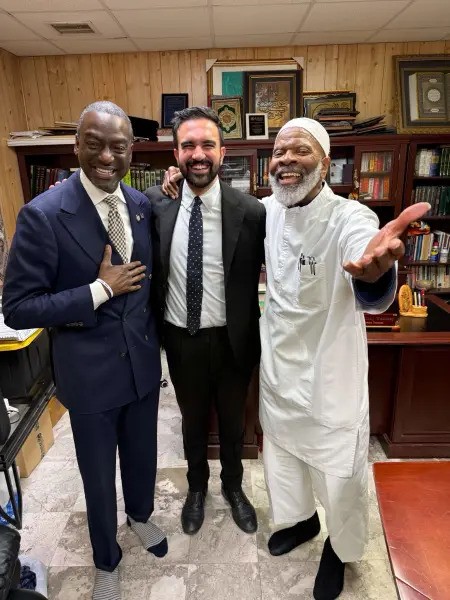
The uproar began on Friday, when Mamdani posted a photo on X (formerly Twitter) celebrating his visit to Masjid At-Taqwa in Bedford-Stuyvesant, where he met Wahhaj.
“Today at Masjid At-Taqwa, I had the pleasure of meeting with Imam Siraj Wahhaj, one of the nation’s foremost Muslim leaders and a pillar of the Bed-Stuy community for nearly half a century,” Mamdani wrote.
The post, which The New York Post report described as “effusively complimentary,” ignited immediate backlash — not because of the mosque itself, but because of Wahhaj’s long and controversial history.
Critics swiftly pointed out that Wahhaj was once named by federal prosecutors as an “unindicted co-conspirator” in the 1993 World Trade Center bombing, which killed six people and injured more than a thousand. As The New York Post reported, prosecutors at the time cited the imam’s connection to several men convicted in the attack, all of whom had attended his mosque.
Though Wahhaj was never charged, he later defended those behind the bombing and accused American intelligence agencies — the FBI and CIA — of being the “real terrorists.”
Adding to the unease, Wahhaj’s own son — also named Siraj Wahhaj Jr. — was arrested in 2018 and later sentenced to life in prison after being convicted of running a makeshift terror camp in New Mexico.
According to the information provided in The New York Post report, the younger Wahhaj had gathered a group of teenagers in squalid desert conditions and was allegedly training them to carry out attacks across the United States. Federal agents described the site as a “terror compound.”
Wahhaj Sr. admitted he had personally homeschooled his son but insisted he was the one who alerted law enforcement after realizing his son was “mentally unwell.” Nevertheless, his family’s proximity to extremist ideology continues to cast a shadow over his reputation — and, by extension, over those who associate with him.
Beyond the terror allegations, Wahhaj has also been criticized for his public comments about homosexuality. The New York Post has reported that the imam has quoted Islamic scripture calling for the death of gay men and delivered sermons instructing his followers to make members of the LGBTQ community “feel uncomfortable.”
Although he has also urged followers not to commit acts of physical violence, Wahhaj has long promoted what he calls “moral confrontation” — urging his congregants to pressure gay individuals to abandon their “sinful lifestyle.”
Civil rights advocates have condemned such statements as dangerous and dehumanizing, particularly in a city that prides itself on diversity and inclusion. “There is no moral justification for language that incites shame or hostility toward any group of people,” one LGBTQ activist told The New York Post. “For a mayoral candidate to praise such a figure is unconscionable.”
The backlash against Mamdani has been swift — and bipartisan. His opponents in the November mayoral race, former Governor Andrew Cuomo and Republican nominee Curtis Sliwa, both blasted the Queens Assemblyman for what they described as an egregious lapse in judgment.
“New York needs a mayor who protects New Yorkers from terrorism, not embraces terrorists,” Sliwa told The New York Post.
Cuomo’s campaign issued a similarly blistering statement, accusing Mamdani of “courting radicals for political convenience” and calling the meeting “disqualifying for anyone who aspires to lead the city.”
Even some within Mamdani’s own progressive ranks have expressed discomfort. Privately, several Democratic Party strategists told The New York Post that his refusal to condemn Wahhaj’s record could alienate moderate voters who might otherwise be sympathetic to his housing and economic reform agenda.
“It’s not just who you meet with — it’s who you refuse to disavow,” one Democratic consultant told the paper. “Mamdani had a chance to distance himself, and instead he doubled down with a smile. That’s not courage — that’s arrogance.”
Mamdani’s silence has become a defining feature of the controversy. His refusal to engage on the subject has led critics to accuse him of evasiveness — or worse, tacit approval.
As The New York Post report noted, this is not the first time the 34-year-old socialist has courted controversy through omission. In recent months, he has avoided direct comment on a number of politically sensitive topics, including Israel’s right to defend itself, NYPD funding, and his past remarks supporting the Boycott, Divestment, and Sanctions (BDS) movement.
To some observers, the pattern suggests a deliberate strategy: project moral certainty on issues that energize his progressive base while sidestepping questions that could expose ideological extremism.
“Every time he’s asked a hard question, he smiles and moves on,” said one Brooklyn Democratic insider quoted in The New York Post report. “It’s like he’s running a campaign built on performance art — not leadership.”
The episode has also raised broader concerns about the influence of radical activism in New York City politics. The New York Post has frequently chronicled Mamdani’s close alignment with the Democratic Socialists of America (DSA), a group that has drawn controversy for its anti-Israel rhetoric and calls to defund law enforcement.
Wahhaj, meanwhile, has been a fixture in radical circles for decades — from his association with the militant cleric Omar Abdel-Rahman, the “Blind Sheikh” convicted in the 1993 bombing plot, to his inflammatory remarks about Western society.
By choosing to publicly praise Wahhaj — and refusing to backtrack when confronted — Mamdani has positioned himself in the crosshairs of a cultural and political firestorm that could reshape the trajectory of his campaign.
Despite the storm of criticism, Mamdani has shown no sign of retreat. As The New York Post reported, his social media accounts have remained silent on the controversy, and his campaign declined to respond to multiple requests for comment.
Political observers note that Mamdani’s approach — ignoring the furor rather than confronting it — might resonate with a small but vocal contingent of voters who view any criticism from the press or political establishment as validation of his outsider status.
Still, for many New Yorkers, his silence is deafening. “A mayor has to lead every community, not just the one that cheers the loudest,” wrote The New York Post in a sharply worded editorial. “By refusing to condemn hate and extremism, Mamdani has failed that basic test.”
As the race enters its final stretch, the question now facing voters is not only whether Zohran Mamdani can lead New York — but whether he even understands the gravity of what leadership requires.
For now, the socialist hopeful remains behind closed car doors, smiling but speechless — while the city he hopes to govern waits for an answer that never comes.
