



|
Getting your Trinity Audio player ready...
|
By: Fern Sidman
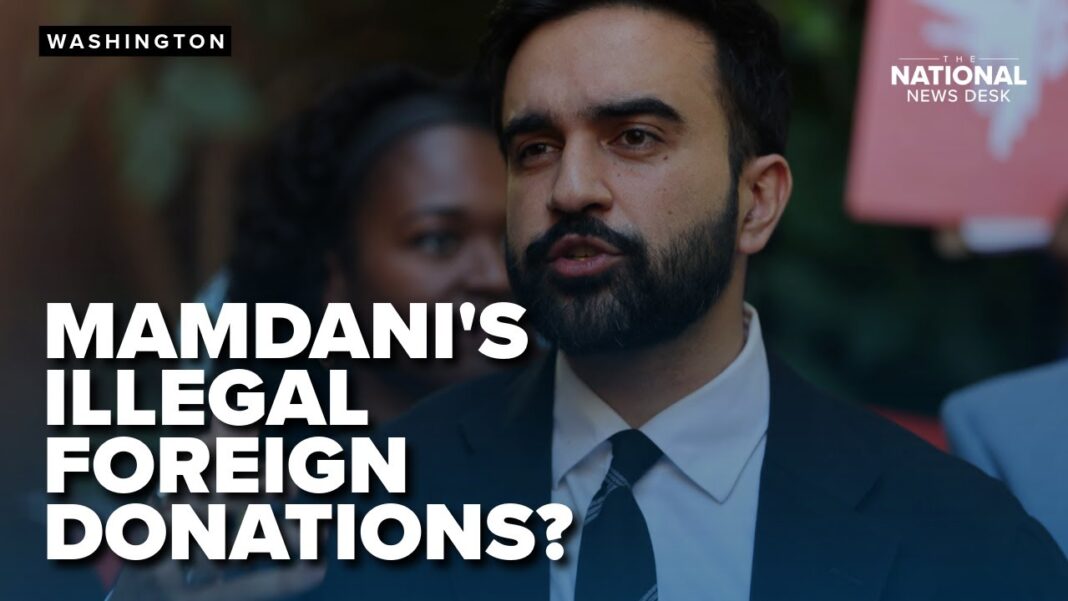
New York City’s mayoral frontrunner, Zohran Mamdani, finds himself at the center of a deepening campaign finance scandal that threatens to upend his once-commanding lead in the race for City Hall. As reported by The New York Post on Tuesday, the Coolidge Reagan Foundation, a prominent campaign finance watchdog group, filed two criminal referrals Tuesday accusing Mamdani of accepting illegal foreign donations—a violation of both federal and state election laws.
The filings, sent to the Department of Justice’s Criminal Division and Manhattan District Attorney Alvin Bragg’s office, allege that Mamdani’s campaign knowingly accepted thousands of dollars in contributions from foreign nationals—money that, if proven, could constitute serious breaches of the Federal Election Campaign Act (FECA) and New York’s own election code.
According to the information provided in The New York Post report, the referrals follow revelations that Mamdani’s campaign collected nearly $13,000 in donations from 170 individuals with addresses outside the United States—including one contribution from his mother-in-law in Dubai. The allegations paint a picture of a campaign either dangerously negligent or willfully complicit in breaking laws that forbid foreign interference in American elections.
“These are not isolated incidents or clerical errors,” said Dan Backer, a national campaign finance expert and president of the Coolidge Reagan Foundation, in a statement to The Post. “This was a sustained pattern of foreign money flowing into a New York City mayoral race, which is a clear violation of both federal law and New York City campaign finance rules.”
Backer, whose organization has previously pursued complaints against political heavyweights such as Rep. Alexandria Ocasio-Cortez, Hillary Clinton’s presidential campaign, and the Democratic National Committee, said the scale and persistence of these questionable contributions merit immediate investigation. “Mamdani’s campaign was on notice for months that it was accepting illegal foreign contributions,” he told The New York Post, “and yet it did nothing meaningful to stop it.”
The Coolidge Reagan Foundation’s complaint underscores what it describes as a “systematic failure to comply” with campaign finance laws. Federal law clearly prohibits candidates at every level—federal, state, and local—from soliciting, accepting, or receiving any contributions from foreign nationals. Violators, if found to have done so knowingly, can face hefty fines and possible imprisonment.
“The law is crystal clear that foreign nationals may not participate in American elections,” Backer explained to The New York Post, “and that includes making contributions. Yet Mamdani’s campaign repeatedly accepted donations from individuals abroad—some even tied to regions and individuals openly sympathetic to hostile actors.”
The foundation alleges that donations came from individuals residing in Australia, Turkey, France, Canada, and Germany, among other countries. While some contributions have reportedly been refunded, records show at least 88 donations totaling $7,190 have not been returned, according to data reviewed by The Post.
“Whether through negligence or intent,” Backer added, “this conduct undermines the integrity of the democratic process.”
The Mamdani campaign, which has raised about $4 million in private donations and an additional $12.7 million in public matching funds, was quick to issue a statement seeking to downplay the controversy.
In comments to Fox News Digital, campaign spokesperson Dora Pekec suggested that the contributions may have originated from American citizens or lawful permanent residents living abroad, who are permitted to donate under U.S. law.
“All U.S. citizens and permanent residents, including those who live outside the U.S., are legally permitted to donate to New York City mayoral campaigns under federal campaign finance law and New York State and City law,” Pekec said.
She further insisted that the campaign has a “rigorous compliance process” designed to verify donor eligibility, adding that any donations determined to be impermissible will be “promptly refunded.”
However, The New York Post report noted that the timing of these refunds, as well as the campaign’s apparent failure to act after being notified months ago of potential violations, could complicate Mamdani’s defense. The watchdog group contends that even if some funds were eventually returned, the campaign’s pattern of acceptance and delay reflects, at best, reckless indifference to the law.
The scandal could not come at a more precarious time for Mamdani, whose Democratic Socialist platform has already alienated moderate voters and alarmed segments of New York’s Jewish community. As The New York Post has repeatedly reported, the Queens Assemblyman has faced sustained criticism for his anti-Israel rhetoric, his refusal to denounce inflammatory slogans such as “Globalize the Intifada,” and his stated intent to “arrest Israeli Prime Minister Benjamin Netanyahu” should the Israeli leader visit New York.
Those positions, combined with his long-standing affiliations with far-left organizations such as the Democratic Socialists of America and Students for Justice in Palestine, have made him a polarizing figure even within his own party.
Now, with the Coolidge Reagan Foundation’s complaint gaining traction, Mamdani’s political vulnerabilities have become legal liabilities. The accusations of foreign financial influence—particularly in a campaign already defined by global ideological entanglements—have fueled concerns that his candidacy represents not just a political risk, but a constitutional one.
As The New York Post report indicated, the case against Mamdani reflects broader anxieties about foreign money in U.S. elections, particularly when it intersects with candidates espousing extremist or anti-American viewpoints.
In its referral, the Coolidge Reagan Foundation warned that foreign nationals sympathetic to anti-Israel or anti-Western ideologies could exploit the online donation ecosystem to subvert campaign finance safeguards. The group highlighted several contributions linked to individuals with digital footprints endorsing extremist political movements abroad, raising fears that these networks could channel ideological support into financial influence.
Campaign finance experts cited in The Post report have called for tougher enforcement mechanisms. “The ease with which foreign donors can contribute through digital platforms is alarming,” said one former Federal Election Commission attorney. “This isn’t just a violation of the law—it’s a national security concern.”
If prosecutors pursue the case, the outcome could hinge on whether Mamdani’s campaign knowingly accepted the foreign contributions. Under FECA, intent is key: while inadvertent errors may result in civil penalties, knowing violations carry criminal consequences.
In its filing, the Coolidge Reagan Foundation cited internal correspondence between the Mamdani campaign and New York City’s Campaign Finance Board, suggesting that the campaign had been alerted multiple times to the presence of foreign donors but failed to take adequate action.
“The campaign was repeatedly warned,” Backer told The New York Post, “and those warnings were ignored. That’s not a mistake—that’s misconduct.”
While the Department of Justice and DA Alvin Bragg’s office have not yet issued statements, the referral places both under pressure to demonstrate impartiality. Bragg, whose tenure has been marked by accusations of selective prosecution and political bias, now faces a test of credibility: whether he will investigate a far-left candidate with the same rigor applied to his political opponents.
The timing of the revelations—just a week before Election Day—could reshape the dynamics of a race that had, until recently, seemed firmly tilted in Mamdani’s favor. The New York Post reported that the frontrunner currently holds a narrow lead in most public polls, with independents and moderate Democrats expressing unease over his radical positions but still divided over his opponents, former Governor Andrew Cuomo and Republican Curtis Sliwa.
Now, the specter of criminal referrals and potential indictments may accelerate voter realignment. Several Democratic strategists told The Post that the accusations, coupled with Mamdani’s ideological extremism, could trigger defections among suburban and Jewish voters—a critical bloc in Manhattan and Queens.
“This could be a tipping point,” one campaign consultant said. “Voters may tolerate ideological differences, but not legal scandals tied to foreign money.”
Beyond the immediate electoral implications, the scandal has reopened a broader debate about the influence of far-left ideologues in New York politics. As The New York Post report observed, Mamdani’s rise from state assemblyman to mayoral frontrunner mirrored the trajectory of a growing socialist movement emboldened by lightning rod figures such as Alexandria Ocasio-Cortez.
But the same ideological fervor that energized his base may now prove his undoing. The alleged acceptance of foreign donations—from nations like Turkey and France, and from individuals possibly aligned with anti-Western movements—reinforces the narrative that Mamdani’s campaign blurs the line between domestic politics and international activism.
Political analysts quoted in The Post report suggested that this controversy could mark a turning point in New York’s political landscape, forcing the Democratic establishment to reckon with the excesses of its radical wing. “It’s not just about illegal donations,” one strategist said. “It’s about whether New York wants a mayor whose campaign is funded, in part, by foreign nationals while he preaches socialism and vilifies Israel.”
Ultimately, the Mamdani scandal is not just a question of law—it is a question of trust. In a city still reeling from rising crime, economic strain, and social division, voters are being asked to decide whether the man who aspires to lead New York embodies the values of transparency and accountability.
As The New York Post report noted, “The allegations against Zohran Mamdani go beyond campaign finance violations—they strike at the heart of democratic integrity.”
For a candidate who built his brand on moral certitude and progressive zeal, the irony is profound. As investigators weigh the evidence and voters weigh their choices, one thing has become clear: the socialist crusader now faces a reckoning not in ideology, but in law.
“Rocked”? Is that the best you can do?