



|
Getting your Trinity Audio player ready...
|
By: Ariella Haviv
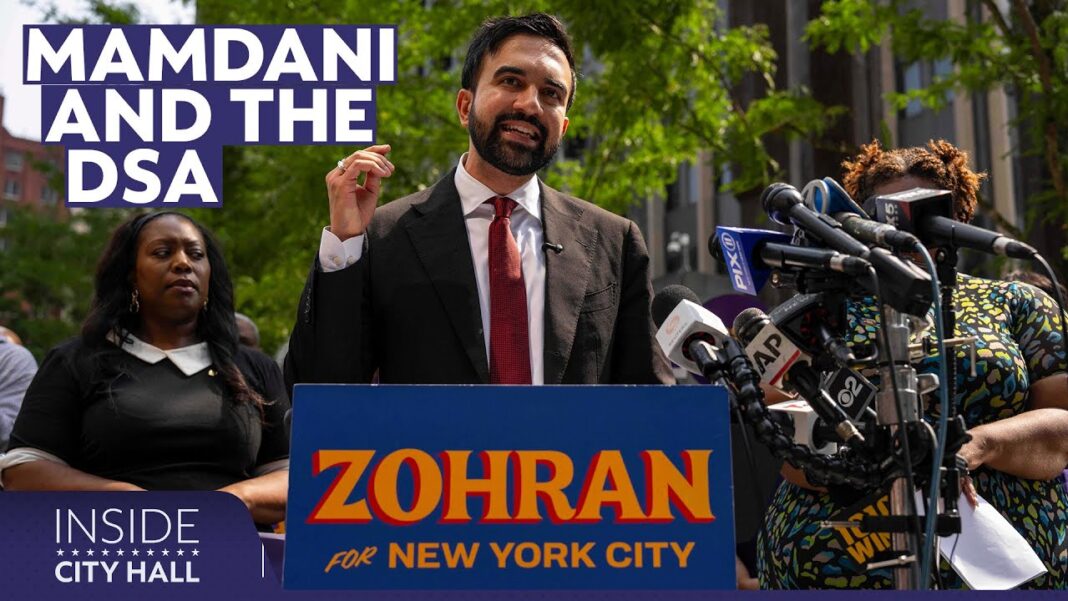
New York City mayor-elect Zohran Mamdani unveiled an expansive and unprecedented transition team on Monday, appointing nearly 400 advisers across 17 committees in what VIN News describes in a report on Tuesday as one of the most sprawling—and ideologically charged—mayoral transitions in the city’s modern history. The announcement, delivered in East Harlem before hundreds of supporters, marks a dramatic effort to translate Mamdani’s insurgent victory into a governing structure defined by grassroots activism, socialist influence, and sweeping policy ambition.
The sheer scale of the transition apparatus reflects the mayor-elect’s pledge to “reimagine the way City Hall operates,” as Mamdani declared, and to shift the locus of policymaking away from the traditional technocratic elite toward the city’s activist left. For critics and supporters alike, the scope of the team suggests that Mamdani intends not merely to adjust the city’s political direction but to reengineer its policy infrastructure at the root.
As VIN News reported, the composition of the transition team prominently features leaders from the Democratic Socialists of America, a development that confirms fears among some civic leaders that the incoming administration will be heavily shaped by ideological interests rather than managerial expertise. Two senior DSA organizers—Gustavo Gordillo and Grace Mausser—were appointed to high-impact committees, shaping economic development, workforce strategy, and small business policy.
Gordillo, a forceful advocate of anti-capitalist economic restructuring, will help guide the city’s economic development agenda—a role that places him at the center of decisions regarding job growth, commercial revitalization, and investment strategy. Mausser, known for her organizing around socialist small business platforms, will influence policy affecting minority-owned enterprises and local entrepreneurship. According to VIN News, both activists have heralded Mamdani’s rise as a mandate for the city to embrace robust socialist interventions in housing, labor protections, and economic planning.
Their imprint on the transition structure unmistakably signals that Mamdani views his mayoralty not as a continuation of Democratic governance but as a rupture—a pronounced shift toward the ideological frameworks that helped propel him to power.
While the transition is dominated by organizers and progressive policy advocates, Mamdani has included several high-profile public administrators and technocrats—names that may reassure New Yorkers uneasy about the ideological tilt. As VIN News observed, the list includes:
Former FDNY Commissioner Laura Kavanagh, joining the government operations committee
Former NYPD Chief and Suffolk County Police Commissioner Rodney Harrison, advising on public safety
Dr. Oxiris Barbot, former city Health Commissioner, contributing to health and medical policy
Kathryn Wylde, CEO of the Partnership for New York City, helping shape workforce and economic development
Jed Walentas, real estate executive and chair of the Real Estate Board of New York (REBNY), advising on housing
Christine Marinoni, education advocate, leading work on youth and schools
Perhaps most notable is the presence of Annemarie Gray, the director of Open New York, a pro-housing group supportive of aggressive residential development. Gray served in the de Blasio administration and has been a vocal supporter of zoning reforms aimed at dramatically expanding the city’s housing stock. As VIN News reported, she praised Mamdani for “embracing a comprehensive approach” to the city’s housing crisis—one that attempts to balance tenant protections with large-scale development.
This mixture of movement activists and technocrats creates an ideological mosaic that could either sharpen policy coherence or, as some analysts fear, generate internal contradictions that hinder decision-making.
In a break from longstanding mayoral transition structures, Mamdani introduced two committees that are explicitly political in character: a worker justice committee and a community organizing committee. These bodies reflect the influence of labor organizers, tenant unions, and neighborhood activist circles that have long criticized prior administrations—both Democratic and Republican—for technocratic approaches that, in their view, left working-class communities behind.
As the VIN News report noted, these committees include representatives from some of the loudest progressive voices in the city: labor coalitions, grassroots tenant movements, and academic experts in socialist theory. They also include high-profile figures such as Ai-jen Poo, the MacArthur Fellow and leader of the National Domestic Workers Alliance, whose national stature brings considerable visibility to Mamdani’s worker-centered approach.
The emphasis on organizing—not merely policy—signals that Mamdani envisions an administration built not just on governmental levers but on sustained pressure generated by outside movements. It is a continuation of the strategy that helped him win office: mobilizing activist energy to shift the city’s political center of gravity.
Mamdani emphasized that more than 70,000 New Yorkers applied to work in his administration, a statistic that VIN News emphasized as a symbol of the new mayor’s magnetic appeal among progressive constituencies. The sheer number dwarfs prior mayoral transitions and reflects an unusual level of public engagement, particularly among young voters, social justice organizations, and left-wing policy groups.
But the deluge of applications has also raised practical concerns. Some civic leaders quoted by VIN News noted that the early days of a new administration require clarity, discipline, and tight organizational protocol—qualities that may be undermined by a sprawling, diffuse transition team.
One neighborhood leader compared the situation to a major building overhaul: “When something major changes, people need accessible guidance and a real point of contact. Otherwise, everyone ends up confused and chasing answers.”
This metaphor has resonated across circles concerned about governance logistics. In the view of these observers, a transition team with 400 people and overlapping mandates risks information bottlenecks, contradictory recommendations, and a diffusion of responsibility.
The scale of Mamdani’s transition—17 committees, 400 members, dozens of overlapping missions—has raised deep concerns among longstanding civic planners and municipal analysts, many of whom spoke to VIN News. The central question they raise is not whether a large committee can produce creative ideas, but whether such an unwieldy apparatus can function efficiently in a city that requires rapid, decisive action.
Housing, policing, sanitation, mental health, and business regulations—these are areas where delays have real consequences. A weeks-long lag in coordinating agency directives or approving operational changes can compound into crises, particularly in neighborhoods that already struggle with underinvestment and fragile infrastructure.
The anxiety is simple:
The larger the committees, the slower the decisions.
The more ideological the leadership, the more likely it is to prioritize symbolic victories over practical solutions.
This view is not universal—progressive activists argue that inclusive processes produce stronger policy outcomes—but the operational question remains front and center.
Mamdani has dismissed concerns about inefficiency or ideological imbalance, framing his transition process as an intentional antidote to what he views as City Hall’s chronic detachment from ordinary residents. “For too long,” he said, “what City Hall intends and what New Yorkers experience have been miles apart.”
As the report at VIN News noted, Mamdani articulated his vision clearly: his goal is not simply to reshape policy but to reshape how policy is made, grounding it in the lived realities of workers, tenants, caregivers, students, and community leaders. Whether this vision translates into effective governance—or devolves into a bureaucratic maze—remains an open question.
When Mamdani takes office on January 1, he will govern a city facing immense challenges: a housing crisis, an affordability crisis, an overstretched mental health system, declining public confidence in safety, and uneasy business communities. The VIN News report observed that the incoming mayor’s transition team is less a conventional advisory body and more a political coalition—one designed to institutionalize the activist forces that brought him to power.
Supporters hail it as the dawn of a new political era.
Critics fear it will entrench ideological rigidity and operational chaos.
Observers across the city agree on one point: New York has never seen a mayor-elect assemble a transition quite like this.
Whether Mamdani’s ambitious experiment succeeds will determine the city’s direction for years to come—and reshape the balance of political power not only in New York, but across America’s urban landscape.