



|
Getting your Trinity Audio player ready...
|
By: Fern Sidman – Jewish Voice News
In a case that has shocked Jewish communities across Long Island and raised serious questions about the integrity of hate-crime sentencing in New York State, a 75-year-old man who admitted to terrorizing Montauk with Nazi and antisemitic graffiti ultimately served no jail time, despite pleading guilty to felony hate-crime charges. According to a report that appeared in The New York Post on Tuesday, the outcome has left residents dismayed and Jewish advocacy organizations alarmed at the perceived trivialization of violent bigotry.
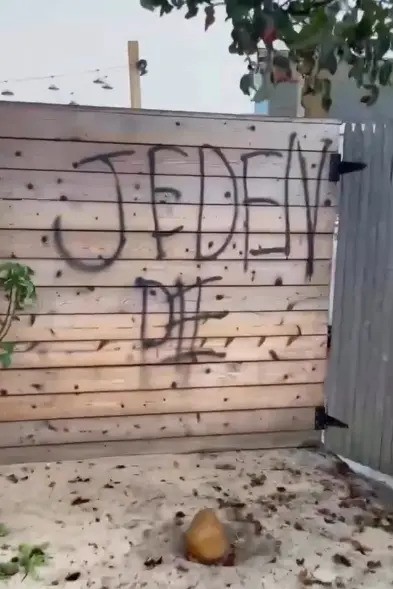
The offender, Michael Nicholoulias, confessed openly and unequivocally to defacing multiple properties with swastikas and blood-curdling antisemitic phrases—including “Jews Die” and “Jews Burn”—across Montauk between October and December 2023. These acts were not random expressions of vandalism but carefully targeted attacks on homes and businesses owned by Jewish residents, as Nicholoulias himself acknowledged in court. According to the information provided in the The New York Post report, prosecutors described the spree as a campaign of intimidation that left residents frightened and outraged.
Yet despite the gravity and the explicitly hateful motive behind the crimes, Nicholoulias’ sentence—five days in Suffolk County jail—evaporated almost as soon as it was handed down.
Montauk, renowned for its coastal calm and understated charm, was jolted by a series of increasingly brazen antisemitic symbols and slogans sprayed on public and private property. Swastikas appeared on park benches, walls, and storefronts; hateful declarations were scrawled across public spaces; and residents, particularly Jewish homeowners, began to fear that a violent extremist was operating freely in their midst.
Police investigators, as reported by The New York Post, eventually cracked the case by placing a GPS tracker on Nicholoulias’ car—a 2004 Chrysler PT Cruiser—after identifying him as a likely suspect. The decision proved pivotal. On December 4, 2023, the device led officers directly to Ditch Plains, where they caught the octogenarian in the act, spray-painting yet another swastika beside a beach bathroom.
By that time, much of the Montauk community was already recoiling from the spread of the hateful messages. The imagery, unmistakably tied to the genocidal antisemitism of the Third Reich, was particularly chilling given the sharp rise in antisemitic incidents nationwide. Local Jewish residents told The New York Post that they felt “watched,” “hunted,” and “targeted for who we are.”
After his arrest, Nicholoulias offered no resistance to the charges. In fact, he confessed plainly, telling prosecutors—according to 27East and cited in follow-up reporting by The New York Post—that he was “guilty of everything.” He also acknowledged that he deliberately selected properties belonging to Jewish individuals because of their identity, fulfilling the criteria for a hate-crime designation.
Prosecutors secured a plea deal: two felony hate-crime convictions and a sentence of five days in county jail, a punishment many already viewed as lenient.
But what followed defied expectations entirely.
As The New York Post reported, Suffolk County’s jail-credit system contains a quirk. Because Nicholoulias had been on “good behavior” during the single day he spent in custody after his arrest—and because the court sentenced him on a Friday—he automatically received enough time-credit to nullify the entire five-day term.
In effect, the 75-year-old hate-crime convict walked out of the courthouse with probation only, despite the judge’s intent that he serve jail time.
Jewish leaders told The New York Post that the outcome amounted to a “slap in the face” to the community, particularly at a moment when antisemitic crimes in New York City and across the region have spiked dramatically since the Hamas attacks of October 7, 2023.
The lenient resolution has sparked outrage among those who believe state and county officials are failing to take antisemitic hate crimes seriously. Given that Nicholoulias had targeted Jewish residents explicitly, many expected a stronger sentence as a deterrent—not only for Montauk but across a state where antisemitic threats and attacks are at a historic high.
“This is not just harmless vandalism,” one community member told The New York Post. “This is someone calling for Jews to die. This is someone painting swastikas on people’s homes. And the system tells him to go home and behave? What message does that send?”
Legal experts quoted by The New York Post note that Suffolk County has long struggled with jail-time accounting practices that allow for rapid “good-time” credits. Critics argue that the system fails to reflect the emotional and psychological damage inflicted by hate crimes, especially those aimed at a specific minority.
Just as concerning is how this case fits into broader trends. According to the information contained in The New York Post report, New York State has recorded thousands of antisemitic incidents since 2023, ranging from hateful graffiti to violent assaults. Synagogues have been surrounded by aggressive protests; Jewish teachers and students have been forced into hiding; and vandals from Manhattan to the Hamptons have felt increasingly emboldened.
Against this backdrop, many see Nicholoulias’ non-sentence as part of a disturbing pattern in which offenders face minimal consequences, further emboldening extremists.
“Probation for ‘Jews Burn’?” one Jewish leader told The New York Post. “It’s outrageous. It’s dangerous. And it’s humiliating for the victims.”
Inquiries by The New York Post to Suffolk County District Attorney Ray Tierney and Nicholoulias’ Legal Aid attorney went unanswered. This silence has only amplified criticism from community leaders demanding transparency and accountability.
Several elected officials on Long Island have also raised concerns over the case, with some planning to introduce legislation to tighten sentencing loopholes in hate-crime cases.
For Montauk’s residents—especially its Jewish families—the ordeal has left lasting wounds.
Graffiti can be scrubbed clean. Swastikas can be painted over. But, as several residents told The New York Post, the psychological impact remains.
“What he wrote stays with you,” said one woman whose property was defaced. “You start checking your locks twice. You look over your shoulder. You wonder who else is out there.”
Community advocates warn that unless authorities demonstrate a strong commitment to punishing hate crimes, more attackers may follow Nicholoulias’ path, believing they too will walk free.
The resolution of the Nicholoulias case highlights a painful contradiction: while New York leaders speak often about combating hate, the mechanisms of justice frequently fail to match the urgency of the crisis. As The New York Post report observed, antisemitic hatred is not an abstract threat—it is a daily reality for many New Yorkers.
For Montauk’s Jewish community, the message from the justice system was unmistakable: even when a perpetrator confesses outright and admits to malicious targeting, the consequences may amount to nothing more than probation.
In a moment when Jewish communities feel under siege—from the city’s synagogues to its schools to its suburbs—the decision not to impose jail time on a confessed hate-crime offender is not just disappointing. It is dangerous.
And it raises a chilling question that Jewish New Yorkers are now forced to confront: If this is how the system handles brazen, antisemitic terror against an entire community, what happens next?