



|
Getting your Trinity Audio player ready...
|
Loehmann’s Set for Pop-Up Comeback in NY, Reviving a Century-Old Jewish Retail Legacy
By: Carl Schwartzbaum
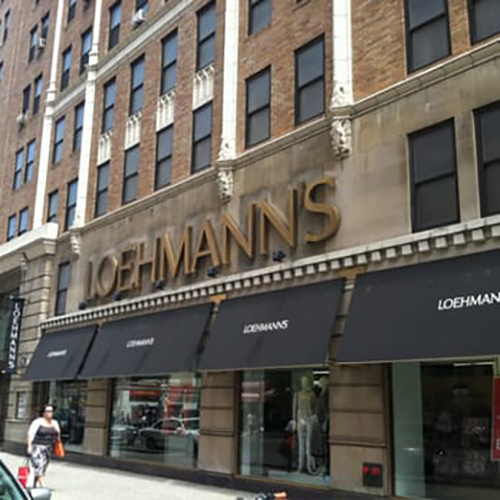
Loehmann’s, the storied New York discount department store with an enduring place in American Jewish shopping culture, will return to the retail scene later this month. As The Jewish Telegraphic Agency (JTA) reported, the relaunch — marking the brand’s first brick-and-mortar presence since its 2014 closure — will take the form of pop-up stores, beginning with a warehouse sale at Tanger Outlets in Deer Park, Long Island, on August 22. Additional locations are planned for Florida and New York City.
Founded in Brooklyn in 1921 by Frieda Loehmann, a former department store buyer, and her son Charles, Loehmann’s established itself as a pioneer in off-price retailing. As the JTA report noted, the store quickly gained a loyal following by offering designer clothing at steep discounts, a model that appealed to budget-conscious shoppers without compromising on style.
While Loehmann herself was of German-Lutheran heritage, the JTA report recalled a 1987 Washington Post profile by Jane Leavy that observed she had learned enough Yiddish to navigate New York’s garment district — a cultural bridge that may have helped cement her brand’s connection with the city’s large Jewish population.By the mid-20th century, Loehmann’s had expanded beyond its original Brooklyn base, eventually reaching around 100 locations nationwide. Yet even at its peak, the company retained the intimate, almost club-like atmosphere of its early years — complete with its famously intimidating communal dressing rooms.
According to the information provided in the JTA report, Loehmann’s became more than just a shopping destination for many Jewish families; it evolved into a cultural touchstone. In oral histories collected by the Jewish parenting and lifestyle site Kveller, customers described the store as an intergenerational rite of passage.
“No matter what teenage drama I was going through, Loehmann’s was always there to deliver the perfect weekend bat mitzvah dress,” one shopper named Jessica told Kveller. Another, Annie, recalled how “shopping there almost felt like a rite of passage into Jewish womanhood,” noting that such experiences were rarely shared by her non-Jewish peers.
The JTA report also pointed to Loehmann’s pop culture footprint, perhaps most famously in The Nanny. Fran Fine, the sitcom’s Jewish protagonist played by Fran Drescher, often boasted of scoring her high-fashion wardrobe at Loehmann’s clearance events — a nod to the store’s place in the Jewish New Yorker’s retail imagination.
Despite its strong brand identity, Loehmann’s was unable to adapt fully to the changing retail landscape. The JTA report noted that after filing for bankruptcy in 2013, the chain closed all stores the following year, ending a 93-year run.
The closure left a gap in the market, particularly for shoppers who valued the thrill of bargain-hunting in a physical store. As one former customer, Ann, explained to Kveller, the store’s origins in heavily Jewish neighborhoods such as Crown Heights and Fordham Road gave working- and middle-class Jewish families access to fashionable goods during a time when social and economic barriers limited entry into more exclusive retail spaces. Over time, that necessity became a tradition, cherished even when no longer economically essential.
In 2020, Loehmann’s intellectual property was acquired by Century 21, another New York retail institution specializing in discounted designer fashion. Century 21 — founded in 1961 by the Gindi family, members of the Syrian Jewish community — had faced its own financial turbulence. The company filed for Chapter 11 bankruptcy in 2020 amid pandemic-related shutdowns, but as the JTA reported, managed a rapid recovery. By 2023, its flagship Lower Manhattan store had reopened, and new locations were launched in 2021 and 2022.
Century 21’s acquisition of Loehmann’s represents a merging of two parallel retail legacies. Both brands are steeped in New York’s Jewish retail history, both emphasize access to luxury labels at reduced prices, and both cultivate a loyal, multigenerational customer base.
Larry Mentzer, Century 21’s chief operating officer, told the New York Post — as cited by JTA — that Loehmann’s remains a powerful retail name. “Loehmann’s continues to rank high as a retail destination that consumers recall, admire [and] want to patronize,” Mentzer said, emphasizing that “now is the time for a re-imagined Loehmann’s” as other retailers scale back.
The pop-up format appears to be central to this re-imagining. Instead of reopening a chain of permanent stores, the brand will host limited-time events to create urgency and exclusivity — a tactic that may resonate in today’s event-driven retail environment.
One key feature of Loehmann’s revival will be the return of its fabled “Back Room.” As the JTA report highlighted, this was the section of the store reserved for the steepest discounts on luxury fashion — items from designers such as Michael Kors, Calvin Klein, Ralph Lauren, Fendi, Oscar de la Renta, and Marc Jacobs.
The upcoming Deer Park warehouse sale, expected to run for two weeks, will reportedly include a Back Room experience, preserving an element of the original Loehmann’s that long-time customers remember vividly.
While Loehmann’s is not unique in attempting a nostalgic comeback, the JTA report noted that the challenge lies in translating brand loyalty into sustained business in a retail environment increasingly dominated by e-commerce. Brick-and-mortar discount fashion faces stiff competition from online platforms offering deep discounts and convenience without the need to travel or sort through racks.
However, the Loehmann’s experience — particularly its communal and social dimensions — has no exact digital equivalent. The store’s open dressing rooms, while polarizing, fostered a kind of shared experience, with shoppers offering each other candid opinions on fit, style, and value.
According to the information contained in the JTA report, the resurrection of Loehmann’s will tap into the powerful emotional connections built over decades. For many, the brand is a bridge between past and present — a reminder of outings with mothers and grandmothers, of whispered advice in front of mirrors, and of the pride in finding a designer label at a fraction of the cost.
Ann’s recollection, as quoted by Kveller, captures this sentiment: Loehmann’s was once a gateway to the American consumer dream for Jewish immigrants and their descendants, evolving into a symbol of tradition and resilience.
The Deer Park pop-up will serve as the first test of the Loehmann’s revival strategy. If successful, JTA reported, Century 21 plans to expand the model with additional short-term locations in key markets, potentially restoring Loehmann’s as a recognized national brand.
Whether the comeback can sustain itself beyond the initial wave of nostalgia will depend on several factors: the ability to source high-quality designer merchandise at competitive prices, the strength of Century 21’s marketing efforts, and the willingness of shoppers to re-engage with in-person discount hunting in the post-pandemic era.
For now, Loehmann’s return offers both a retail experiment and a cultural reunion — a chance for long-time fans to revisit a beloved shopping tradition and for new customers to discover what made the brand a fixture in Jewish and New York retail history. Its legacy is as much about community and identity as it is about fashion and savings, and that heritage may be its most valuable asset in navigating the modern marketplace.
