



|
Getting your Trinity Audio player ready...
|
Largest Nurses Walkout in NYC History Becomes ‘Lethal,’ Union Leader Claims
By: Russ Spencer
A deepening labor conflict at three of New York City’s largest hospital systems has entered ominous new territory. What began as a contentious dispute over staffing levels, pay, and working conditions has now escalated into allegations that the ongoing nurses’ strike is costing lives. According to a New York Post exclusive report on Saturday, union officials claim that at least one patient death at Mount Sinai Hospital can be directly linked to reduced levels of care resulting from the walkout.
The claim, which hospital administrators vehemently deny, has transformed an already high-stakes standoff into a moral and political crisis that reaches far beyond the negotiating table.
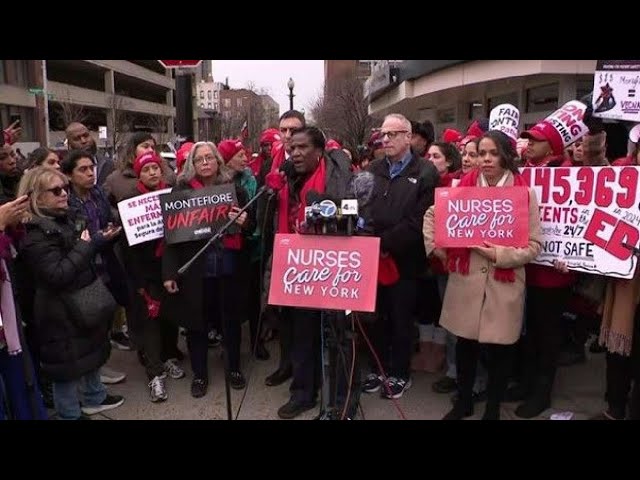
Nearly 15,000 nurses walked off the job Monday at Mount Sinai, Montefiore Medical Center, and NewYork-Presbyterian Hospital, launching what is now being described as the largest nurses’ strike in New York City history. The action has drawn national attention, with labor leaders insisting that the strike is not simply about wages but about patient safety and sustainable staffing ratios.
As the New York Post exclusive report noted, this strike dwarfs a similar action in 2023, when roughly 7,000 nurses picketed for three days. That earlier walkout ended with what many considered favorable contracts for the union. This time, however, hospital executives appear determined to take a harder line, deploying temporary replacement nurses and insisting that patient care has not been compromised.
Union officials argue the opposite.
The most incendiary assertion to emerge from the strike centers on the death of a 24-year-old intensive-care-unit patient at Mount Sinai. According to the New York Post report, Darla Joiner, a senior official with the New York State Nurses Association (NYSNA) who heads the Mount Sinai bargaining unit, stated that the death was the direct result of inadequate care during the strike.
Retired nurse practitioner Katie Duke, who worked for years at Mount Sinai and has joined the picket lines in solidarity, told The Post that she has been in regular contact with hospital staff who describe increasingly chaotic conditions inside the facility.
Duke recounted the circumstances of the alleged incident in stark detail. The young patient, she said, had been on a sophisticated life-support machine designed to circulate blood and assist breathing while awaiting a lung transplant.
“It is the highest level of life support for somebody who’s waiting on, like, a lung transplant,” Duke explained in the New York Post exclusive report. According to her account, the patient was not properly restrained or sedated, managed to dislodge a critical tube from his neck, and subsequently died.
“He pulled a tube out of his neck, and he died,” Duke told The Post.
Hospital officials have categorically rejected the union’s narrative. A spokesperson for Mount Sinai strongly denied that any death could be attributed to strike-related staffing issues, though the hospital declined to provide further details. City Health Department representatives did not immediately respond to inquiries, leaving the conflicting accounts unresolved.
Beyond the single alleged fatality, union leaders say the broader situation inside the affected hospitals is deteriorating rapidly.
Joiner told the New York Post that patient care associates have reported a sharp increase in emergency alerts—known in medical parlance as “code blues,” the urgent calls made when a patient goes into cardiac or respiratory arrest.
“Our PCAs are saying a lot more code blues are being called,” Joiner said. “There are things happening inside, because this hospital is settling for staff who are not qualified to take care of patients.”
She added bluntly: “Our patients are sicker. And more people are dying. I mean, I’m not gonna lie to you about that.”
A “code blue,” Joiner explained to The Post, is one of the most serious events in a hospital environment. “Code blue means somebody’s dead. It has a medical emergency. So, like, you have to start CPR and an emergency team comes,” she said. “It’s literally just to try to resuscitate someone.”
Union representatives insist that the reliance on temporary replacement nurses—many flown in from out of state—has led to confusion, miscommunication, and dangerously inconsistent care. According to the New York Post exclusive report, Joiner characterized the situation as “really unsafe,” suggesting that the temporary workers are overwhelmed by unfamiliar protocols and patient loads.
Hospital administrators have mounted an aggressive defense, asserting that contingency plans have ensured continuity of care despite the mass walkout. Executives insist that highly trained contract nurses have been brought in to fill critical gaps and that all necessary safety measures remain in place.
In statements provided to media outlets, the hospital systems involved have repeatedly emphasized that patient well-being remains their highest priority. They maintain that the union’s claims are exaggerated and that no evidence supports the assertion that the strike has led to any preventable deaths.
Yet the allegations reported in the New York Post exclusive report have undeniably shaken public confidence. For families with loved ones currently hospitalized, the specter of compromised care is deeply unsettling.
The strike has also taken on an unmistakably political dimension.
Mayor Zohran Mamdani, who has voiced strong support for the nurses, has framed the dispute as emblematic of broader inequities in the city’s healthcare system. Speaking earlier in the week, Mamdani praised the nurses for standing up for what he called “basic standards of dignity and safety.”
Hospital leaders, by contrast, accuse the union of holding patients hostage to achieve unrealistic contractual demands. They argue that the NYSNA is pushing for staffing mandates and benefits that would impose unsustainable financial burdens on already strained institutions.
The standoff has hardened on both sides. Union negotiators are seeking significant pay increases, guarantees on nurse-to-patient ratios, and preservation of existing health benefits. Hospitals counter that they have already offered competitive compensation packages and that rigid staffing requirements would hamper their ability to manage fluctuating patient volumes.
On the sidewalks outside Mount Sinai, Montefiore, and NewYork-Presbyterian, the strike has become a daily spectacle of chanting picketers, honking horns, and impassioned speeches. Many New Yorkers have expressed solidarity with the nurses, viewing them as frontline heroes who carried the city through the darkest days of the pandemic.
Others, however, worry that the walkout has gone too far.
Patients scheduled for elective procedures have faced delays and cancellations. Family members report longer wait times in emergency rooms and confusion over who is overseeing their loved ones’ care. The uncertainty has created a pervasive sense of anxiety among those who rely on the affected hospitals.
The New York Post exclusive report captured this tension vividly, presenting dueling narratives of dedicated nurses fighting for patient safety and hospital officials scrambling to maintain order under unprecedented pressure.
Nurses’ strikes are relatively rare in New York City, and those that do occur are typically brief. The 2023 walkout, which ended after just three days, was seen at the time as a watershed moment for organized labor in the healthcare sector.
This year’s confrontation has unfolded very differently.
According to labor analysts, hospital systems were blindsided by the 2023 action and quickly capitulated to avoid prolonged disruptions. Having learned from that experience, administrators now appear more willing to endure short-term turmoil in hopes of securing a more favorable long-term settlement.
Whether that strategy will succeed remains an open question.
Lost amid the bargaining positions and political rhetoric are the patients themselves—the people whose lives depend on the smooth functioning of these vast medical institutions.
The claims highlighted in the New York Post exclusive report, whether ultimately substantiated or not, underscore the profound human stakes of the conflict. Even the perception that care may be compromised has sown fear and mistrust at a moment when hospitals should be places of reassurance.
As the strike enters its second week, pressure is mounting on both sides to find a resolution. State mediators have reportedly intensified efforts to bring negotiators back to the table, though significant gaps remain.
For now, New York City finds itself in uncharted territory: a prolonged healthcare strike, escalating accusations, and a public caught in the middle.
If the allegations of strike-related deaths gain further traction, the political and legal ramifications could be severe. Conversely, if hospitals can convincingly demonstrate that patient safety has been preserved, the union may face difficult questions about its tactics.
What is clear, as detailed in the New York Post exclusive report, is that this dispute has moved far beyond the realm of routine labor negotiations. It has become a test of the city’s capacity to balance workers’ rights with the fundamental obligation to protect the sick and vulnerable.
The coming days will determine whether cooler heads prevail—or whether an already bitter conflict descends into even deeper crisis.

I left nursing for many reasons… INCLUDING the lack of respect for highly educated, skilled professionals.
NYC: You reap what you sow.
TO ALL PATIENTS: My advice? Try to keep yourself as healthy as possible. Boost your immune system. Exercise. Eat properly. Learn about homeopathy & home remedies. And pray that the nurses get a fair shake soon for everyone’s sake.
Isn’t it ironic that the strike took place AFTER Mamdani took office on January 1st?
Union Leaders should NEVER use extremely ill (lCU) & seriously compromised patients as helpless pawns in Union negotiations!! Every patient could be YOUR beloved child or cherished family member! We should ALL lift Special Prayers to our loving GOD this terrible crisis ends ASAP saving helpless patients lives & for the immediate resolution of all issues involves.
“LORD, HAVE MERCY ON ALL INVOLVED!”