



|
Getting your Trinity Audio player ready...
|
By: Meyer Wolfshiem
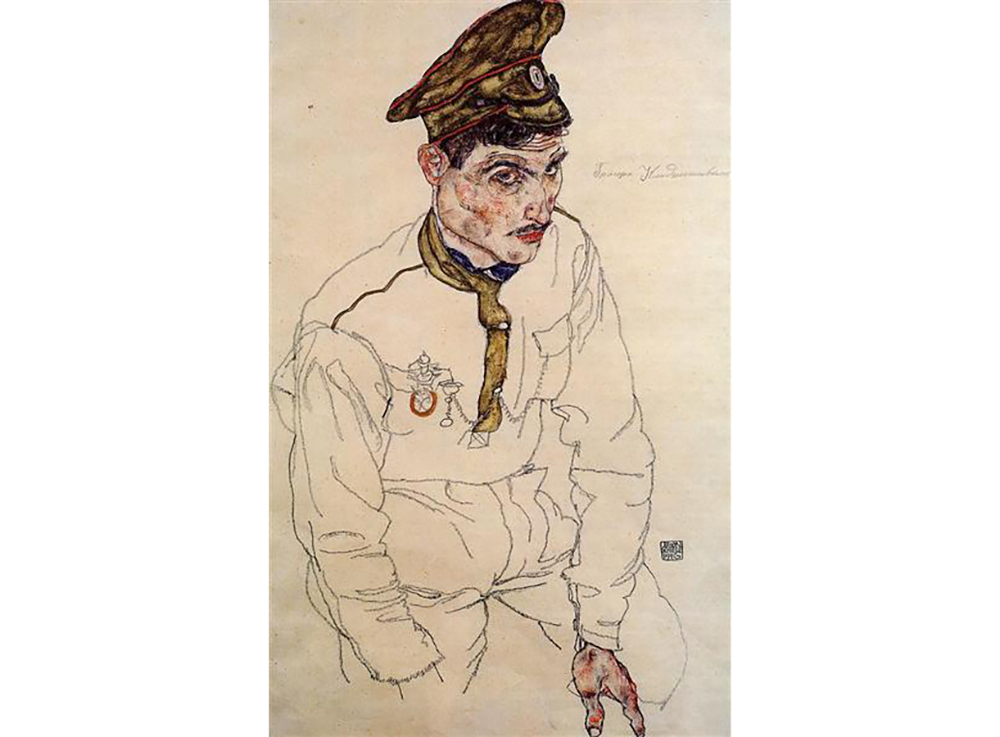
The Art Institute of Chicago has likely shelled out more than a million dollars in a high-stakes legal fight to retain a Nazi-looted artwork, according to repeated reporting from the New York Post. At the heart of the battle is Egon Schiele’s “Russian War Prisoner,” a drawing that once belonged to Jewish Austrian cabaret star and art collector Fritz Grünbaum, who was murdered in the Holocaust.
In a powerful blow to the museum’s case, a Manhattan judge last month ruled that the city’s district attorney has the jurisdiction to seize stolen art—even if it’s currently housed outside New York—so long as the piece once passed through the city. The New York Post reports that the decision could have “monumental” implications for the international effort to recover art stolen during the Nazi era.
The judge, Althea Drysdale of Manhattan Criminal Court, delivered a stinging opinion, slamming the Art Institute for failing to investigate the artwork’s ownership history properly. “This Court cannot conclude that Respondent’s inquiries into the provenance of ‘Russian War Prisoner’ were reasonable,” Drysdale wrote in her ruling, cited by the New York Post.
The court found that Grünbaum’s extensive collection was seized by Nazis after his arrest in 1938. While imprisoned in Dachau, Grünbaum reportedly maintained his wit and resistance even under horrific conditions, the Post noted, quoting Drysdale’s account of his legacy. He was killed three years later, never recovering his collection.
The artwork’s provenance is now central to a broader legal debate, and the ruling significantly extends the reach of Manhattan District Attorney Alvin Bragg’s office, the New York Post reports. The DA argued the drawing was sold at a Manhattan gallery in 1956, allowing New York to claim jurisdiction despite the piece now residing in Chicago.
Art theft and restitution expert Raymond Dowd, who represents Grünbaum’s heirs, called the ruling “extraordinary” and “monumental for the world.” He told the New York Post, “If [an artwork] passes through New York City, the court will retain jurisdiction, no matter where it goes.”
While a dozen other institutions voluntarily returned Schiele works once owned by Grünbaum, the Art Institute mounted the most aggressive legal resistance, spending more in the legal fight than the drawing’s estimated $1.25 million value, according to the Post. Experts say this may have backfired.
“They fought tooth and nail for over two years,” Dowd said. “They wanted to cut off [the DA’s] jurisdiction. They wanted the DA to stick to New York.”
In her ruling, Drysdale also refuted a key claim made by the gallery that sold the work to the museum: that Grünbaum’s sister-in-law had sold the drawing legally after the war. She stated there was no documentation to support that account. Worse, the dealer in question was later identified as a “prominent dealer in Nazi-looted art,” as reported by the New York Post.
Despite these red flags, the Art Institute never verified the dealer’s claims, Drysdale noted, underscoring the museum’s failure to perform due diligence.
Bragg’s office has already recovered 12 out of 76 Schiele works formerly belonging to Grünbaum, the New York Post reports. “This decision is already the talk of the town,” art lawyer and former prosecutor Georges Lederman told the Post, noting the ruling allows criminal courts to handle ownership disputes if theft is involved.
Museum ethics attorney Leila Amineddoleh told the New York Post the decision sends a clear message: “This is a warning to museums and to collectors to dig deeper.”
