



|
Getting your Trinity Audio player ready...
|
By: Tzirel Rosenblatt
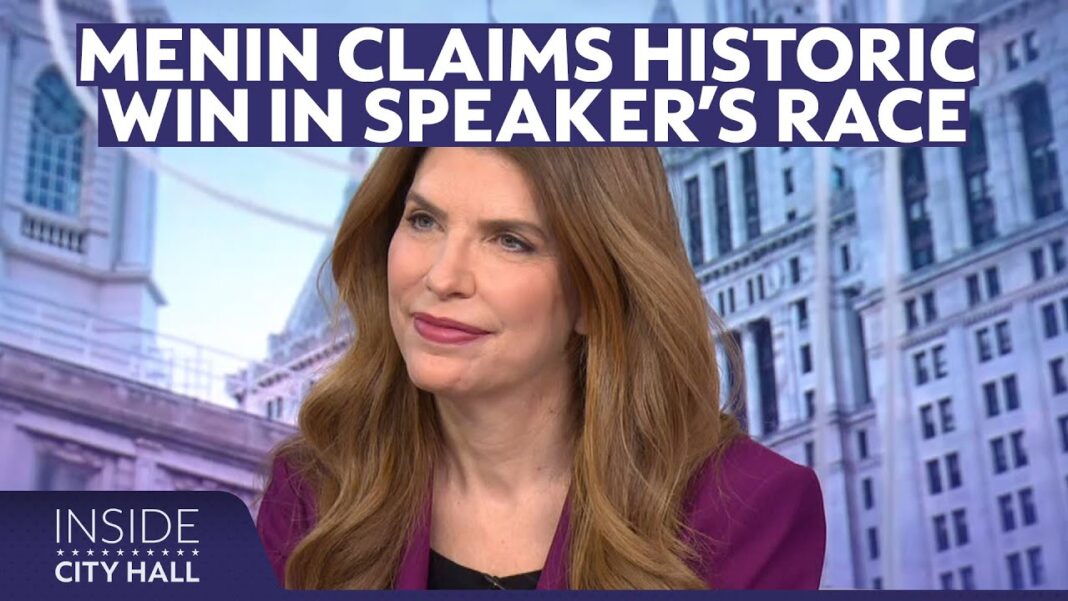
Julie Menin is not yet officially Speaker of the New York City Council — but, as The New York Post reported on Saturday, the Manhattan lawmaker is already acting like a leader preparing to inherit one of the most formidable legislative gavels in American municipal life. In an expansive interview with The New York Post, Menin outlined an ambitious and decidedly pragmatic agenda that she hopes will define her tenure if, as widely expected, she is elected Speaker in the coming days, becoming the first Jewish woman to ever hold the post.
Her ascent comes at a moment of profound political transition in the city, with Mayor Zohran Mamdani beginning his administration amid ideological ferment and public anxiety over affordability, public safety, antisemitism and the basic functionality of City Hall itself. Menin, a veteran of both government service and private-sector law, is positioning herself as the ballast in stormy waters — neither reflexively oppositional nor deferential, but insistent that the City Council must remain a coequal branch of municipal power.
Speaking to The New York Post, Menin was unequivocal: the Council under her stewardship will not be a reactive body waiting for mayoral marching orders. “We must be proactive,” she said, signaling that her Speakership would be rooted in legislative independence, institutional accountability and a willingness to set the city’s agenda rather than merely ratify it.
Menin’s expected elevation to the Speakership marks a personal milestone but also a symbolic one. Her father survived the Holocaust, a family history that has shaped her civic outlook and her fierce sensitivity to rising antisemitism in New York. As The New York Post report noted, she has made combating hate crimes a central plank of her platform, vowing that the Council must be “actively engaged in protecting all communities.”
In an era in which antisemitic incidents have surged to record highs, Menin’s Jewish identity is not merely biographical detail — it is political substance. She told The New York Post that she sees the Council as a moral sentinel, charged with ensuring that the city does not drift into indifference as extremist rhetoric metastasizes in neighborhoods, on campuses and online.
While Mayor Mamdani has branded himself a democratic socialist and pledged to govern “audaciously,” Menin is casting herself as a pragmatic Democrat. The contrast, carefully framed in her interview with The New York Post, is not adversarial but deliberate.
She acknowledged that she and Mamdani approach policy from different ideological traditions, but she was equally clear that the city cannot afford paralysis. Areas of cooperation, she suggested, are obvious: improving public transit, easing the crushing cost of living, and modernizing the machinery of municipal governance.
But Menin did not shy away from signaling that disagreement is inevitable. She sees the Council as a counterweight, not a cheering section. “We can work together where we align,” she told The New York Post, “but the Council must remain its own institution.”
No issue looms larger in Menin’s agenda than housing — and here she intends to move aggressively. As The New York Post report detailed, Menin is exploring what she calls “creative approaches,” including the repurposing of underutilized city-owned properties.
This is more than rhetoric. New York’s housing crisis has become existential: middle-class families are fleeing, young professionals are doubling up, and longtime residents are being priced out of the very neighborhoods they helped build. Menin’s proposal to unlock dormant public assets signals a break from the incrementalism that has long defined the Council’s approach.
Her vision is not merely about construction but about systems. Menin emphasized to The New York Post the need to overhaul procurement rules, speed up approvals, and eliminate the bureaucratic chokepoints that can turn a shovel-ready project into a decade-long ordeal.
Menin’s interview with The New York Post also revealed a keen awareness of the plight of small businesses, which she described as the city’s “economic backbone.”
She singled out bureaucratic delays, labyrinthine regulations and punitive fines as forces that are hollowing out the city’s commercial corridors. Streamlining procurement rules, easing red tape, and creating a more responsive regulatory environment are, in her telling, not ideological battles but practical necessities.
For Menin, helping bodegas, restaurants, and family-owned shops survive is not just about jobs — it is about preserving the social fabric of neighborhoods that have lost too much already.
Perhaps the most quietly radical plank in Menin’s agenda is universal child care. In her interview with The New York Post, she framed it not as a luxury but as economic infrastructure.
For too many families, child care is the hidden tax that makes work untenable. By pushing for universal access, Menin is staking a claim that affordability must be addressed not only through housing but through the everyday arithmetic of family life.
If Menin becomes Speaker, she will inherit a Council emerging from the long shadow of the Eric Adams administration, whose final year was marred by corruption scandals and public cynicism. Menin told The New York Post that restoring accountability at City Hall is non-negotiable.
Her vision is of a legislature that asks uncomfortable questions, audits executive action and insists on transparency even when it is politically inconvenient. This, she suggested, is the only way to rebuild public trust in municipal government.
As the New York Post report underscored, Menin’s election would make her the first Jewish woman Speaker in the Council’s history — a milestone freighted with symbolism in a city that is home to the largest Jewish population outside Israel.
Menin has not framed her candidacy in identity terms, but she has been candid about the responsibility she feels. With antisemitic incidents rising and Jewish New Yorkers increasingly vocal about feeling unsafe, her leadership would resonate far beyond legislative chambers.
She told The New York Post that the Council must treat antisemitism not as an episodic problem but as a structural threat to civic life. That means funding, policy, partnerships with law enforcement and education — not platitudes.
The Council is expected to vote on its next Speaker within days. The outcome will shape not only the body’s internal dynamics but the trajectory of Mayor Mamdani’s administration.
If Menin prevails, as The New York Post predicts, City Hall will be governed by a duality: a mayor elected on a wave of socialist fervor and a Speaker grounded in pragmatism, institutional memory and managerial rigor.
It is a pairing that could either combust or catalyze. Menin, at least, is betting on the latter.
In her closing remarks to The New York Post, she did not indulge in triumphalism. She spoke instead of work — unglamorous, relentless, essential. “New Yorkers are tired of dysfunction,” she said. “They want a government that delivers.”
If Julie Menin becomes Speaker, history will remember the first Jewish woman to wield the Council’s gavel not merely for breaking a ceiling, but for trying to steady a city that has forgotten what steady feels like.