



|
Getting your Trinity Audio player ready...
|
By: Tzirel Rosenblatt
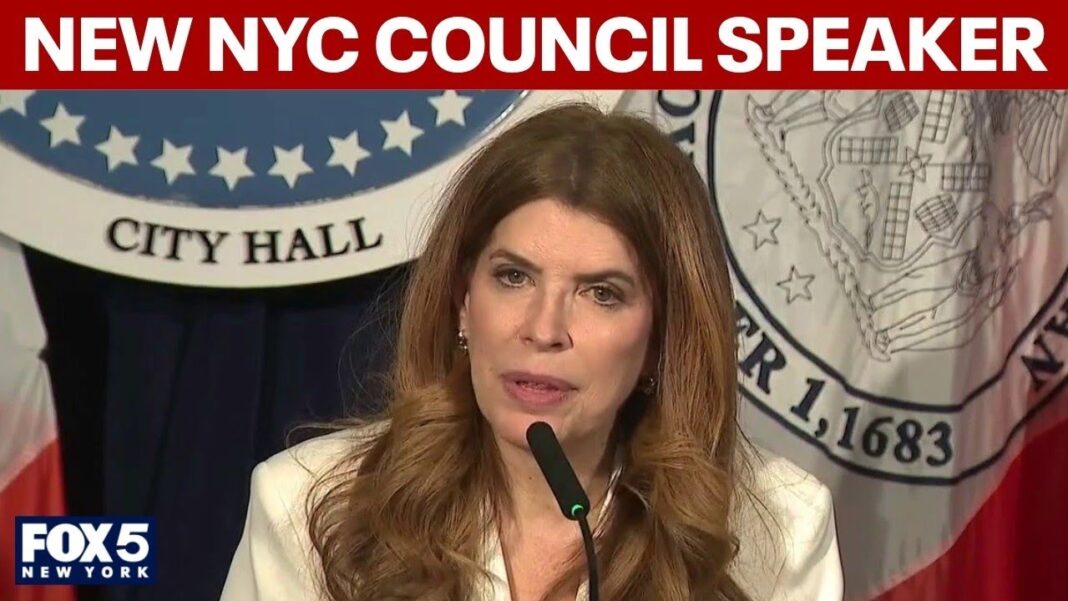
In a city whose identity has always been forged at the intersection of countless cultures, languages, and faiths, the New York City Council on Tuesday inscribed a new chapter into its long political chronicle. As reported on Wednesday by VIN News, council members voted unanimously, 51–0, to elect Manhattan Democrat Julie Menin as the body’s new speaker, making her the first Jewish person to hold the powerful post in the council’s history.
The moment reverberated far beyond the chamber walls at City Hall. As VIN News observed in its coverage, Menin’s elevation is not merely a personal milestone but a profound symbol of New York’s evolving civic tapestry: a Jewish woman assuming the council’s top leadership role under the city’s first Muslim mayor, a pairing that would have been inconceivable in prior generations but now feels almost quintessentially New York.
In an age of political polarization, the unanimity of Menin’s election was itself historic. According to the VIN News report, all 51 council members, representing a borough-spanning mosaic of ideological positions, voted to elevate Menin to the dais. The speaker’s role is no ceremonial flourish; it is the institutional fulcrum of the council, responsible for setting the legislative agenda, overseeing committee assignments, and serving as the primary counterweight to the mayor’s office.
That Menin was able to secure not merely a majority but complete consensus speaks volumes about her stature among colleagues. Several council members, quoted by VIN News, praised her reputation as a meticulous listener, a coalition-builder, and a leader who approaches policy through pragmatism rather than polemic.
“This is a moment of pride for the city,” Menin said following the vote, as reported by VIN News. “I look forward to working with my colleagues to deliver for every neighborhood and every New Yorker.”
Her words were measured, almost understated — yet beneath them lay the weight of a century-long absence now rectified.
New York’s Jewish community has long been an engine of the city’s civic life, producing mayors, comptrollers, congressional leaders, and state legislators. Yet, as the VIN News report highlighted, the City Council speakership had somehow remained beyond reach.
Menin’s ascent closes that gap.
For many Jewish New Yorkers, the symbolism is acute. The speakership is not merely a leadership position; it is the nerve center of municipal power. From that seat, Menin will shape debates on policing reform, housing affordability, public education, and the city’s fragile post-pandemic recovery.
The VIN News report noted that community leaders across the Jewish spectrum — Orthodox, Conservative, Reform, and secular — welcomed the development as a reflection of both inclusion and continuity. In a period marked by rising antisemitism nationwide, Menin’s election carries added resonance, affirming Jewish visibility not as a vulnerability but as a source of civic legitimacy.
Menin’s path to the speakership is not the product of political accident. As the VIN News report detailed, her résumé reads like a compendium of municipal governance.
She first entered city leadership as commissioner of the Department of Consumer Affairs, where she oversaw regulatory enforcement and consumer protections. Later, she served as director of the Mayor’s Office of Media and Entertainment, navigating the labyrinthine relationships between Hollywood, Broadway, and City Hall to keep New York’s cultural industries afloat.
Colleagues describe her as a technocrat with a moral compass — someone who masters the minutiae of city budgets while retaining a sensitivity to the lives affected by every line item.
The report at VIN News characterized her leadership style as “pragmatic, consensus-driven, and relentlessly detail-oriented,” qualities that are likely to be indispensable in the fractious years ahead.
Menin’s tenure begins under the shadow of a historic mayoralty: New York’s first Muslim mayor. As the VIN News report observed, the pairing of a Jewish speaker and a Muslim mayor at the helm of America’s largest city is a living rebuttal to the politics of fear that have dominated much of the national discourse.
The dynamic is not merely symbolic. The speaker-mayor relationship defines the rhythm of municipal governance. Cooperation can yield transformative policy; discord can mire the city in legislative paralysis.
Menin has already signaled her intent to pursue a collaborative approach, emphasizing that the council must function as both partner and watchdog. The VIN News report quoted her as saying she intends to lead “with fairness and inclusion,” framing the council as an institution that must speak to every borough, every faith, every community.
If the ceremony was uplifting, the reality awaiting Menin is sobering. As the VIN News report indicated, she inherits a city confronting overlapping crises: spiraling housing costs, public safety anxieties, uneven economic recovery, and a social services system stretched thin.
The speaker will preside over budget negotiations at a time when fiscal pressures threaten to pit borough against borough and ideology against necessity. Committee chairs will look to her for guidance; advocacy groups will test her resolve; the mayor’s office will negotiate, cajole, and occasionally confront.
VIN News analysts have already speculated that Menin’s greatest challenge may be maintaining unity in a council that, while unanimous in her election, remains ideologically diverse. Progressive members pushing for sweeping structural reforms will expect her to champion their priorities, while moderates and fiscal hawks will demand restraint.
Her ability to balance these forces will determine whether her historic tenure becomes a footnote or a watershed.
What makes Menin’s speakership uniquely promising is the perception that she is less a factional warrior than a civic bridge. Council veterans have described her as a rare figure capable of translating between ideological dialects — someone who understands both the moral imperatives of social justice and the bureaucratic realities of city administration.
In a body often fractured by personality and policy, that quality may prove transformative.
One senior council member told VIN News that Menin has an “instinct for finding the third way — not compromise for its own sake, but solutions that actually work.”
For the New York City Council itself, Menin’s election is a statement of institutional maturity. The body has evolved dramatically over the past two decades, asserting itself as a coequal branch of city government rather than a rubber stamp for mayoral initiatives.
Menin’s speakership comes at a time when the council’s voice has never mattered more. From zoning battles to police oversight, the speaker will stand at the fulcrum of decisions that shape daily life for over eight million residents.
As Menin took the gavel, applause echoing through the council chamber, one could sense the quiet gravity of the moment. This was not simply a leadership change; it was a recalibration of New York’s political self-image.
The VIN News report captured the essence of the day in a single phrase: “a historic moment reflecting the changing face of leadership in New York City.”
For a city built by immigrants, defined by diversity, and perpetually reinventing itself, the election of Julie Menin as the first Jewish speaker is less a departure than a homecoming — a reminder that the story of New York is still being written, one unanimous vote at a time
Thank goodness for her