



|
Getting your Trinity Audio player ready...
|
By: Jerome Brookshire
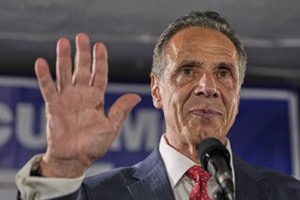
A shifting tide in New York City politics has dramatically altered the contours of the mayoral race, with former Governor Andrew Cuomo securing a wave of endorsements from across the city’s Jewish communities in the immediate aftermath of Mayor Eric Adams’ abrupt withdrawal.
According to a report that appeared on Tuesday at The Jewish Telegraphic Agency (JTA), Jewish leaders and institutions across multiple boroughs have moved swiftly to consolidate behind Cuomo, positioning him as the strongest challenger to Democratic nominee Zohran Mamdani, whose outspokenly anti-Israel record has stirred widespread unease within Jewish communities.
On Monday, Crown Heights United PAC—deeply rooted in the Chabad-Lubavitch community—became the first major Jewish organization to formally back Cuomo. Their endorsement letter, signed by 13 rabbis and community figures, left little room for ambiguity. “We proudly endorse Andrew Cuomo for Mayor of New York City,” the statement read. “With extremism and antisemitism on the rise, and the city facing an unprecedented crisis, it is more important than ever to make our voices heard and vote.”
The JTA reported that the momentum accelerated quickly. By Tuesday morning, a joint endorsement letter was released featuring signatures from a cross-section of Jewish leaders representing virtually every borough. Among them were Senator Sam Sutton, a well-known voice from Brooklyn’s Sephardic community, along with representatives from the Far Rockaway Jewish Alliance, Queens Jewish Alliance, Staten Island Jewish Coalition, Crown Heights United, and the Association of Crown Heights Shuls. Activists from Manhattan and the Bronx also lent their names, signaling a rare moment of broad Jewish unity in city politics.
This unified letter struck a tone of urgency and concern, explicitly citing Mamdani’s record. “In light of Assemblyman Mamdani’s past support for those calling to ‘globalize the intifada,’ we cannot remain silent. We urge communities to unite with us in endorsing Andrew Cuomo for Mayor,” it declared.
The JTA report noted that such coordination across disparate Jewish constituencies—Sephardic, Ashkenazi, Hasidic, and Modern Orthodox—underscores the intensity of the moment. Leaders who often differ on local political priorities are, for now, united by a shared alarm at the prospect of a Mamdani mayoralty.
The backdrop to these endorsements is the stunning decision by Mayor Eric Adams to suspend his reelection campaign. As JTA reported, Adams’ announcement came on Sunday, less than a month after vowing to remain in the race. The sudden reversal followed reports that the White House had pressured him to withdraw.
According to the JTA report, Adams recently met with White House special envoy Steve Witkoff to discuss a possible position in the Trump administration. The offer, insiders say, was designed to clear the political path for Cuomo, who is now running as an independent, having lost the Democratic primary to Mamdani earlier this year.
For many Jewish leaders, Adams’ exit created a sense of urgency. Without the incumbent in the race, the choice appeared to crystallize between Cuomo and Mamdani—a dynamic that galvanized Jewish institutions to rally quickly around Cuomo.
Cuomo’s pivot into the mayoral race has been marked by sharp criticism of Mamdani’s record on Israel and antisemitism. The JTA has extensively documented Mamdani’s controversies: his refusal to condemn the phrase “globalize the intifada,” his outspoken criticism of Israel on October 8, 2023—just one day after Hamas’s massacre in southern Israel—and his rejection of the International Holocaust Remembrance Alliance (IHRA) definition of antisemitism.
Most explosively, Mamdani has threatened to have Israeli Prime Minister Benjamin Netanyahu arrested should he set foot in New York City, a declaration that sent shockwaves through Jewish communities.
Cuomo has seized upon these positions, branding Mamdani “pro-Hamas” in remarks covered by JTA. While Cuomo has been careful to separate his political identity from Netanyahu himself—recently noting, “I never stood with Bibi”—his record underscores his alignment with Israel during moments of crisis.
In November 2024, Cuomo joined Netanyahu’s legal team after the International Criminal Court issued an arrest warrant for the Israeli prime minister, a move intended to demonstrate his commitment to defending Israel against international delegitimization.
Beyond statements of support, Jewish groups are mobilizing resources. The Sephardic Community Federation (SCF), one of the most influential political organizations within the city’s Sephardic population, has reportedly entered “full campaign mode” on Cuomo’s behalf. As JTA reported, the SCF is urging donations ahead of New York’s stringent campaign finance matching-funds deadlines, underscoring the practical impact of endorsements.
Meanwhile, Crown Heights United PAC is preparing to direct its considerable grassroots organizing power toward canvassing and voter outreach. For Chabad and other Orthodox communities, where voter turnout often exceeds citywide averages, such mobilization could prove decisive.
The Jewish endorsements of Cuomo represent more than a tactical political maneuver; they are being framed as a referendum on the values at stake in the city’s leadership. The JTA report highlighted the language in the endorsements, which stressed not only concerns about antisemitism but also the broader social crisis facing New York.
“With extremism and antisemitism on the rise, and the city facing an unprecedented crisis, it is more important than ever to make our voices heard and vote,” Crown Heights United’s statement declared.
Jewish leaders view Mamdani’s positions not merely as ideological disagreements but as existential threats to community security. As one Brooklyn activist told JTA, “This isn’t about partisan politics. It’s about whether Jewish New Yorkers can feel safe in their own city under the next mayor.”
The fight over New York’s mayoralty has attracted national attention, with the Trump administration openly maneuvering to shape the outcome. For Jewish organizations, the stakes extend beyond local governance: the battle over Mamdani’s candidacy is seen as a litmus test for how American politics will grapple with antisemitism and anti-Israel activism in the years ahead.
The JTA report noted that Mamdani’s rise has become symbolic of broader currents in American progressive politics, where criticism of Israel and the embrace of radical slogans like “globalize the intifada” have gained traction among certain factions. The unified Jewish support for Cuomo, by contrast, reflects a determination to push back against these currents forcefully.
Despite the surge of endorsements, Cuomo faces an uphill battle. Running as an independent after losing the Democratic primary presents structural challenges in a city where party affiliation has historically dictated outcomes. Yet the collapse of Adams’ campaign and the consolidation of Jewish support could significantly reshape the race.
The JTA report observed that Jewish constituencies, while not the largest demographic bloc in New York, are highly organized and politically engaged. In a fractured field—where Mamdani’s progressive base competes with Cuomo’s coalition of moderates, independents, and disaffected Democrats—Jewish support could prove a kingmaker.
The sudden alignment of Jewish organizations behind Andrew Cuomo’s mayoral bid reflects both the urgency of the political moment and the community’s deep unease with Zohran Mamdani’s record. As the JTA has reported, Jewish leaders across boroughs and traditions have set aside internal differences to present a united front, signaling the gravity with which they view the choice facing New York.
For Cuomo, the endorsements bolster his campaign with both moral authority and practical resources. For Jewish communities, they represent a collective assertion that antisemitism and radical anti-Israel activism have no place in the leadership of America’s largest Jewish city.
With only a month to go before voters head to the polls, the mayoral race has already become one of the most consequential in recent memory—not only for New York but for the trajectory of Jewish political engagement in America.
