



|
Getting your Trinity Audio player ready...
|
By: Carl Schwartzbaum
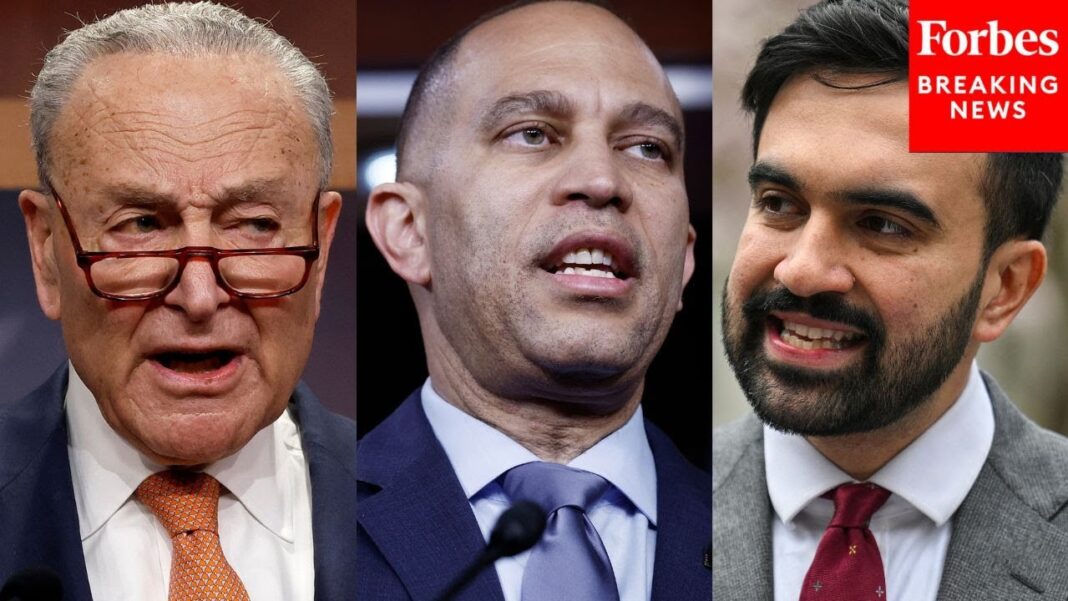
As the November New York City mayoral election inches closer, two of the nation’s most powerful Democratic leaders—Rep. Hakeem Jeffries and Sen. Chuck Schumer—remain conspicuously hesitant to embrace Zohran Mamdani, the insurgent Democratic nominee whose pro-Hamas stance and tax-heavy affordability agenda have made him both a darling of the party’s left flank and a lightning rod for criticism among moderates.
According to a report that appeared on Saturday in The New York Daily News, the dynamic illustrates the tension at the heart of the Democratic coalition: balancing the enthusiasm of progressive activists with the necessity of appealing to swing voters in suburban and heartland districts, where control of Congress will ultimately be decided in 2026.
Mamdani, a 33-year-old state assemblyman from Queens and a proud member of the Democratic Socialists of America, stunned the political establishment when he trounced former Gov. Andrew Cuomo in the June Democratic primary. His campaign, infused with grassroots energy and a promise to fundamentally restructure city government around affordability, rent relief, and expanded social programs, has made him the most prominent left-wing contender for City Hall in decades.
Yet, as The New York Daily News report highlighted, Mamdani’s unapologetically pro-Hamas, anti-Israel rhetoric and his proposals to finance his agenda through significant tax increases have also given Republicans a powerful line of attack. President Donald Trump and GOP leaders have wasted no time in branding Mamdani as a “radical socialist” and “communist,” hoping to tether Democratic candidates nationwide to his image.
That political reality is why Jeffries, the House Minority Leader, and Schumer, the Senate Minority Leader, are adopting a posture of careful restraint.
Jeffries, who represents Brooklyn and is widely viewed as the future of the Democratic Party’s national leadership, has made clear that his priority is retaking the House of Representatives in 2026. Democrats need to flip only about half a dozen seats to reclaim the majority, a feat that could restore Jeffries’ caucus to the Speakership and create a “firewall against Trump,” as one source close to him told The New York Daily News.
That calculus helps explain why Jeffries has limited his interactions with Mamdani to two closed-door meetings since the primary—one at a private Brooklyn residence and the other at a Black church in Flatbush last week. Rep. Yvette Clarke, a close ally of Jeffries, also attended the latter meeting along with several Black clergy.
Both sides described the conversations as “constructive,” but Jeffries has avoided making any public appearances with Mamdani, much less issuing a formal endorsement. When pressed on the issue during a recent interview on The Bulwark podcast, Jeffries downplayed speculation that he might back an independent like Cuomo or incumbent Mayor Eric Adams. “What I can say is: He’s the only one I’m scheduled to meet with,” Jeffries said.
The New York Daily News noted that Mamdani performed strongly in Jeffries’ home district during the primary, energizing younger voters and progressives, but underperformed among older Black voters, a core Democratic constituency. That underperformance may explain Jeffries’ measured approach, as he balances loyalty to his district’s diverse base with national electoral imperatives.
Schumer, who has represented New York in the Senate since 1999 and now serves as Minority Leader, has charted a similar course. While he has praised Mamdani in general terms since the primary, he has yet to appear alongside him or offer an official endorsement.
According to a spokesman quoted in The New York Daily News report, Schumer and Mamdani have spoken on the phone several times over the summer, and a face-to-face meeting could take place “soon” after Labor Day. But like Jeffries, Schumer’s energy has been focused elsewhere—namely, recruiting candidates for tough Senate races in states such as North Carolina, Ohio, and Maine.
Democrats would need to flip four GOP-held seats to reclaim the majority and return Schumer to the majority leader’s post. That daunting task means Schumer must court centrist figures like North Carolina Gov. Roy Cooper and former Ohio Sen. Sherrod Brown, moderates who might distance themselves from the ideological baggage of Mamdani’s campaign.
As one source familiar with Schumer’s thinking told the Daily News, “The thing Chuck is really judged by is who he recruits and can they win.”
Complicating the picture are the independent bids of Andrew Cuomo and Eric Adams. Cuomo, though tarnished by scandal and his 2021 resignation, still retains a base of support among moderate Democrats and is trying to stage a comeback. Adams, the embattled incumbent mayor, has also launched an independent re-election campaign despite being denied matching public funds by the city’s Campaign Finance Board amid ongoing investigations.
Jeffries and Schumer have shown no interest in aligning with either candidate, but their reluctance to fully embrace Mamdani reflects the delicate balancing act. “They’re probably weighing the potential blowback from swing districts nationally from the perceptions of progressive politics,” Columbia professor and Democratic strategist Basil Smikle told The New York Daily News.
Mamdani’s victory electrified the party’s left. Endorsements poured in from progressive stalwarts like former Mayor Bill de Blasio and city Comptroller Brad Lander. Grassroots donors have propelled his fundraising, with small-dollar contributions matching millions in public funds under the city’s campaign finance program.
But the New York Daily News report stressed how that enthusiasm has not yet translated into broader establishment support. Suburban moderates like Reps. Tom Suozzi and Laura Gillen of Long Island have signaled they won’t back Mamdani, fearing his radical policy positions could endanger their re-election campaigns.
“To Jeffries, keeping the party brand ‘moderate’ enough in the suburbs to, say, defeat [Republican Rep.] Mike Lawler or make sure Suozzi holds on, is probably taking priority,” said J. Miles Coleman, a political analyst at the University of Virginia.
The Mamdani question is not confined to New York. Republicans are eager to nationalize his candidacy, portraying him as emblematic of a Democratic Party hijacked by the far left. Trump himself has derided Mamdani as a “communist” and worse, while GOP-aligned super PACs have begun circulating ads tying Democratic congressional candidates to Mamdani’s proposals on taxes and policing.
For Jeffries and Schumer, both Brooklynites who live just subway stops apart, the challenge is clear: how to maintain unity within the Democratic coalition while insulating their national candidates from damaging associations. As The New York Daily News report pointed out, Republicans will always have a “bogeyman”—be it Mamdani, Rep. Alexandria Ocasio-Cortez, or Nancy Pelosi. But the danger is that suburban voters in Omaha or Des Moines might come to view Mamdani’s brand of politics as synonymous with the national Democratic platform.
Gov. Kathy Hochul, facing her own re-election campaign in 2026, has also kept her distance. Though she congratulated Mamdani after his primary victory, she has avoided public appearances with him and has not hinted at an endorsement. As the New York Daily News reported, Hochul’s reticence underscores the unease among moderates in the state party about aligning too closely with Mamdani’s hard-left brand.
Her focus remains on her statewide agenda and cultivating centrist support, particularly upstate and in Long Island suburbs—regions where Mamdani’s rhetoric on Israel and taxation is viewed with skepticism.
For his part, Mamdani has downplayed the lack of public embrace by national Democratic leaders. His campaign has emphasized grassroots energy, noting that his primary win was built on thousands of small donations and volunteer efforts. Dora Pekec, a campaign spokesperson, told the New York Daily News that the candidate’s fundraising momentum reflects “genuine enthusiasm for Zohran’s vision for a more affordable New York City.”
Still, Mamdani’s team knows that establishment support—or at least neutrality—matters in a general election where independents and moderate Democrats could determine the outcome. His challenge is to maintain progressive authenticity while avoiding further alienation of the party’s center.
As November approaches, the dynamics remain fluid. Polls show Mamdani with a lead over his rivals, but his margins are far from insurmountable, especially if Adams or Cuomo peel off significant blocs of centrist voters. Jeffries and Schumer, meanwhile, continue to walk a tightrope, signaling respect for Mamdani’s victory while keeping their political capital focused squarely on 2026.
The stakes are enormous. A Democratic takeover of Congress could reshape the balance of power in Washington and blunt Trump’s legislative agenda. Yet, the rise of a proudly socialist mayor in New York could either energize a new generation of Democrats or provide fodder for Republican attacks nationwide.
As The New York Daily News report framed it, the decision by Jeffries and Schumer to keep Mamdani at arm’s length is less about personal animus than political arithmetic. With control of Congress hanging in the balance, they appear willing to let Mamdani navigate his own path to City Hall while they concentrate on the midterm battlefield.
In many ways, the Mamdani saga is a microcosm of the Democratic Party’s broader identity crisis: torn between progressive ambition and pragmatic caution, between a base hungry for transformation and swing voters wary of radical change.
For Jeffries and Schumer, the calculation is cold but clear. Their legacies will not be judged by who sits in Gracie Mansion, but by whether Democrats control the levers of power in Washington. And until the midterms are decided, Zohran Mamdani may have to settle for polite phone calls, private meetings, and carefully worded praise—while waiting for the day when the nation’s top Democrats decide it is safe to stand beside him in public.

cheesy chuck, the self proclaimed guardian, should denounce manadani.