



|
Getting your Trinity Audio player ready...
|
Jay Jacobs’ Break with Mamdani Exposes Bitter Divide in NY’s Democratic Party
By: Arthur Popowitz
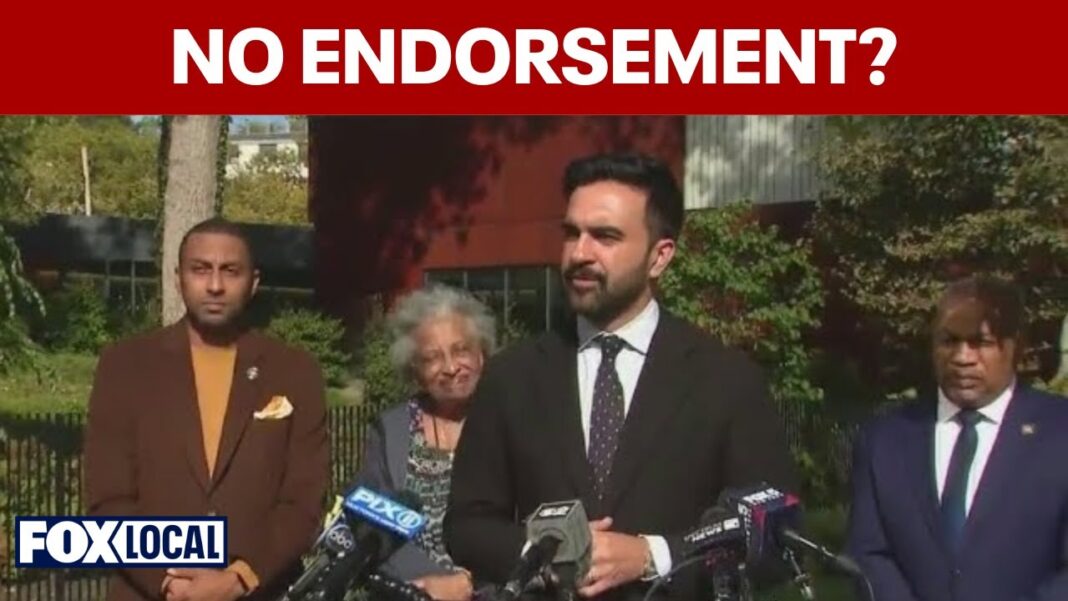
New York’s Democratic Party finds itself mired in a bruising internal conflict after its longtime chair, Jay Jacobs, announced Thursday that he would not endorse Zohran Mamdani, the Democratic nominee for New York City mayor. Jacobs’ statement, pointed and deeply personal, not only widened the rift between moderates and progressives in the state but also placed him on a direct collision course with Gov. Kathy Hochul, who shocked many by endorsing Mamdani earlier this week.
As The New York Post reported on Thursday, Jacobs’ refusal to support Mamdani represents an extraordinary breach of party orthodoxy, in which state chairs traditionally rally behind nominees after primaries. Instead, Jacobs released a declaration that sounded more like an ideological manifesto than a perfunctory political statement, underscoring how profoundly unsettled Democrats have become over Mamdani’s candidacy.
Jacobs, who has chaired the state party since 2019 and remains the leader of Nassau County Democrats, issued a carefully worded but unmistakably forceful rejection of Mamdani.
“Mr. Mamdani and I are in agreement that America’s greatest problem is the continued growth in income disparity in our nation. On how to address it – we fundamentally disagree,” Jacobs began, in remarks reported in The New York Post.
He went on to detail his objections: “Furthermore, as I expressed to him directly, I strongly disagree with his views on the State of Israel, along with certain key policy positions. I reject the platform of the so-called ‘Democratic Socialists of America’ and do not believe that it represents the principles, values or policies of the Democratic Party. For those reasons I will not be endorsing Mr. Mamdani for Mayor of the City of New York.”
The statement reverberated across the political landscape, not least because it directly contradicted Hochul’s Sunday endorsement of Mamdani. The governor’s embrace of the left-wing Assemblyman had already stunned moderate Democrats; Jacobs’ defiance made the divide public, undeniable, and politically dangerous.
According to the information provided in The New York Post report, Jacobs was furious at Hochul’s decision to endorse Mamdani, which he viewed as a betrayal both personally and institutionally. One Democratic official told the paper: “She’s putting him in a bad situation. The governor is trying to get him to stay on, but he’s saying he’s not going to step back and be for this guy who is against Jews.”
The reference to Mamdani’s stance on Israel illustrates a central grievance. Jacobs, a staunch supporter of the Jewish state, has made defense of Israel a defining feature of his leadership. Mamdani, by contrast, is an outspoken ally of the Democratic Socialists of America and a vocal supporter of the BDS movement against Israel.
This clash over Israel, as The New York Post report highlighted, exemplifies the broader ideological schism tearing apart New York Democrats: the tension between suburban moderates, who prioritize pragmatic governance and electoral viability, and urban progressives, who champion leftist causes even at the cost of alienating swing voters.
Almost immediately after Jacobs’ statement, rumors circulated that he might resign. Some party insiders speculated that he faced an impossible choice: remain loyal to his principles and lose credibility as state chair, or back Mamdani and risk alienating Nassau County voters, where anti-socialist sentiment runs deep.
One source told The New York Post: “How does Jay Jacobs win in Nassau County? You’re almost going to force him to resign. Do you stay a state chairman or lose your local party? And how does the state chairman not endorse the largest city’s Democratic pick?”
Hochul, according to the paper, has been attempting to talk Jacobs “off the ledge,” but the damage is done. Even if he remains in place, his authority has been shaken and his relationship with the governor strained.
A Hochul spokesperson attempted to play down the rupture, telling The New York Post that “the governor and party chair have not discussed his tenure since his statement today. As the leader of the party, the governor is holding ongoing discussions about who the best person is to serve as chair moving forward.”
The equivocal phrasing only fueled speculation that Jacobs’ days as chair could be numbered.
If moderates privately sympathized with Jacobs, progressives responded with fury. State Sen. Mike Gianaris, the Deputy Majority Leader, blasted the move as “disgraceful.” “The Chair of the Democratic Party refusing to support the candidate clearly selected by the voters of the Democratic Party,” Gianaris posted on X. “If he won’t perform that most basic responsibility of a party leader, what exactly is he doing over there?”
Other Democrats echoed the sentiment. One party official, speaking anonymously to The New York Post, said: “Jay publicly hates democratic socialists and it seems wildly out of touch to even consider staying on as chair given the circumstances.”
The outrage highlights how the Democratic Socialists of America have transformed from a fringe faction into a powerful force within New York politics. Figures such as Mamdani, Alexandria Ocasio-Cortez, and Tiffany Cabán represent a new generation of politicians whose influence Jacobs has openly resisted. Now, with Mamdani as the mayoral nominee, that tension has exploded into open warfare.
Jacobs’ relationship with progressive activists has long been fraught. Appointed chair by then-Gov. Andrew Cuomo in 2019, Jacobs quickly became known as the voice of moderate Democrats, particularly suburbanites on Long Island. After Cuomo’s resignation in 2021, Hochul retained him despite demands from the left that she install a more progressive ally.
As The New York Post reported, many progressives blamed Jacobs for the party’s poor showing in the 2022 midterms, arguing that his centrism failed to energize the base. Calls for his ouster were frequent, though Hochul’s loyalty shielded him.
Now, however, that shield may no longer protect him. The schism over Mamdani has left Jacobs exposed to attacks from both sides: moderates who believe his position as state chair is untenable if he cannot support the nominee, and progressives who view him as an obstacle to their ascendancy.
Complicating matters further is Jacobs’ continued association with Andrew Cuomo, who lost the Democratic primary to Mamdani but is now running as an independent for mayor. According to The New York Post, Jacobs allowed Cuomo access to the party’s voter database, known as NGPVAN, even after his defeat.
This decision outraged party officials, who accused Jacobs of undercutting Mamdani and effectively aiding Cuomo’s independent bid. Mayor Eric Adams, also running as an independent after abandoning the Democratic primary, reportedly retains access to the database as well.
While a source told The New York Post that Cuomo and Adams had purchased access and contracts typically run through the general election, the optics remain damning. “It’s despicable and he shouldn’t be allowed to step down,” one longtime party official said. “He should be run out of town on a rail.”
The rift is not just about ideology; it has tangible electoral consequences. On Long Island, Democrats are fighting to hold onto competitive congressional seats, including those of Reps. Tom Suozzi and Laura Gillen. Both have vocally opposed Mamdani, warning that his candidacy could sink Democrats in swing districts.
As The New York Post report noted, Jacobs’ leadership in Nassau County is already under strain as Democrats hemorrhage support to Republicans. Endorsing Mamdani, with his socialist platform and controversial views on Israel, could doom the party in the suburbs. For Jacobs, survival as county chair may be incompatible with loyalty to the state party nominee.
Former Gov. David Paterson, himself a former party chair, told The New York Post that Jacobs’ statement amounted to a “rebuke” of Hochul. “Jacobs’ statement reads like ‘I agree with Mamdani that it’s sunny and it’s a sunny summer day,’ and agree on nothing else,” Paterson quipped.
Paterson suggested that the split reveals a deeper ideological fracture within the party that must be addressed after the election. He also joked that Andrew Cuomo would never have tolerated such dissent: “Gov. Cuomo would have my head,” he said.
The conflict over Mamdani has crystallized a broader truth: New York Democrats are no longer a cohesive coalition. Moderates such as Jacobs, Suozzi, and Gillen see socialism as a political death sentence in the suburbs, while progressives like Gianaris and Mamdani view centrists as obstacles to a more radical transformation of governance.
As The New York Post reported, this left-moderate schism is more than a passing quarrel. It represents an existential struggle over the party’s identity in the Empire State. Whether Jacobs stays or goes, the episode has exposed how fragile Democratic unity has become.
Jay Jacobs’ refusal to endorse Zohran Mamdani is more than a personal decision; it is a public declaration that the Democratic Party in New York is at war with itself. His statement, Hochul’s counter-endorsement, and the fury of progressives together paint a picture of a party unable to reconcile its factions.
As The New York Post has reported, the stakes are high. With congressional seats hanging in the balance, a mayoral election likely to shape the future of the city, and national attention focused on New York’s leftward drift, the Democrats’ internal rupture could have far-reaching consequences.
For Jacobs, the choice is stark: hold firm to his principles and risk his leadership or yield to party unity and betray his convictions. For Hochul, the gamble is equally fraught: embrace the energy of the left at the risk of losing suburban moderates.
Either way, the fight over Mamdani has revealed a truth that cannot be ignored: New York’s Democratic Party, once disciplined and unified under Cuomo’s iron grip, is now fractured, divided, and uncertain of its future.

The Democrats are evil enemies of the Jewish people, no matter how you describe it. Not a single Democrat party leader will directly and strongly oppose the antisemite Democrats? “Not endorsing” their Muslim monsters is a betrayal and capitulation. This isn’t a “war“. Imagine Germany’s Jews in the 1930’s “not endorsing“ the Nazis. It is a surrender by the Democrats to the Democrat enemies of the Jewish people.