



|
Getting your Trinity Audio player ready...
|
By: Jerome Brookshire
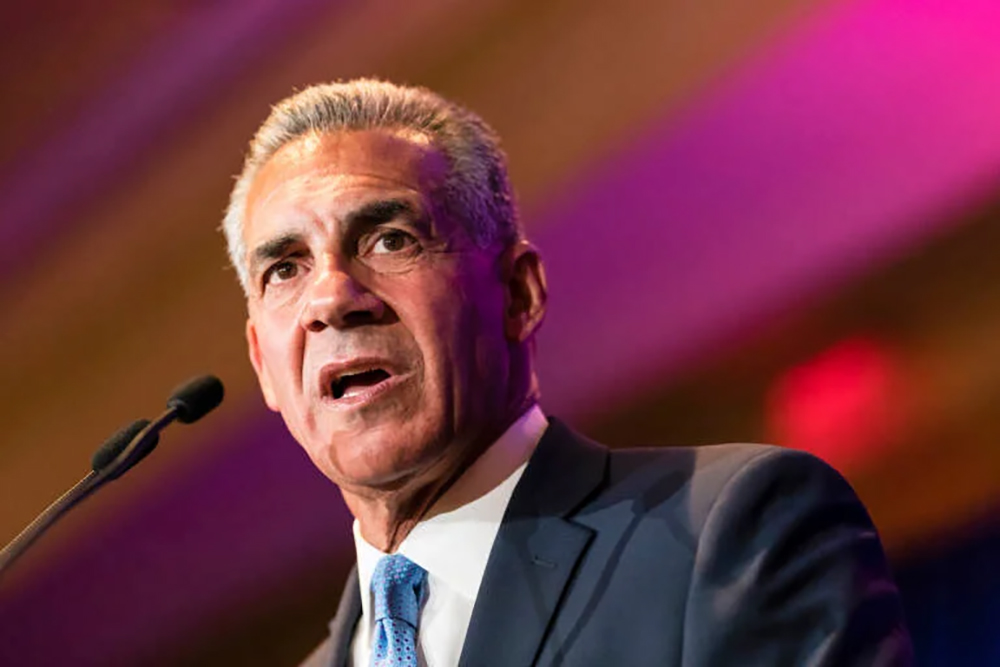
Republican gubernatorial candidate Jack Ciattarelli is projecting confidence in the final stretch of New Jersey’s fiercely contested 2025 race for governor, touting strong early Republican turnout, a tightening set of polls, and a platform focused on reversing what he calls the state’s “culture of overregulation.” As VIN News reported on Thursday, Ciattarelli’s campaign has sharpened its message around consumer freedom, affordability, and middle-class relief — capped by a pledge to repeal New Jersey’s statewide plastic bag ban, which he describes as “a daily tax on common sense.”
With Election Day set for November 4, 2025, the former state assemblyman and Somerset County businessman faces off against Democratic Rep. Mikie Sherrill, a former Navy helicopter pilot and federal prosecutor who currently represents the 11th Congressional District. Sherrill, who captured the Democratic nomination in June, is banking on her suburban base, an extensive fundraising network, and high-profile national support — including endorsements from former President Barack Obama and Governor Phil Murphy, whose two-term tenure she hopes to build upon.
Ciattarelli, backed by President Trump and a wave of energized Republican voters, insists momentum has shifted his way. “We’ve had more Republicans return vote-by-mail ballots than ever before,” he said in a statement obtained by VIN News. “We’re matching them voter for voter here in the early voting. We’re in great shape. We’re heading for a victory.”
Early voting numbers appear to bear him out. According to the information provided in the VIN News report, turnout among Republican voters during the first week of early balloting exceeded internal projections, signaling what campaign insiders are calling “a groundswell of enthusiasm not seen since Chris Christie’s 2013 landslide.”
The numbers tell a story of narrowing margins. A co/efficient poll released Wednesday shows Sherrill leading Ciattarelli 48% to 47%, with just 5% of voters still undecided — effectively a statistical tie. Earlier surveys, including one conducted by Rutgers-Eagleton, had given Sherrill a 5-point advantage, 50%-45%. The latest RealClearPolitics average, as the VIN News report noted, now places Sherrill ahead by only 3.7 percentage points, a slippage that has jolted Democratic strategists.
The closeness of the race has national implications. A Republican victory in deep-blue New Jersey — where Democrats outnumber Republicans by more than 800,000 registered voters — would represent a stunning rebuke of the Biden-era Democratic establishment and could serve as an early barometer of public sentiment toward Trump’s second term.
Yet Ciattarelli, who lost narrowly to Murphy in 2021, insists this race is less about partisan realignment than about restoring practicality and balance to state governance. “New Jerseyans are tired of being told what to do, how to live, and what bags they can carry their groceries in,” he told VIN News during a campaign stop in Morris County. “They’re tired of high taxes, overregulation, and arrogance in Trenton. This election is about returning power to the people who actually live here — not the bureaucrats.”
Among Ciattarelli’s most talked-about proposals is his call to repeal the state’s plastic bag ban, enacted in 2022 under Governor Murphy’s environmental initiative. While the law was initially praised by environmental groups for curbing single-use plastics, it has since drawn widespread complaints from consumers and small businesses alike.
As the VIN News report observed, Ciattarelli has skillfully used the ban as a symbol of what he portrays as Democratic overreach — a tangible example of how “progressive virtue-signaling” collides with the realities of everyday life.
“The plastic bag ban sounds good in a press release, but it’s been a disaster for families and small businesses,” Ciattarelli said. “It’s an example of how Democrats are governing from an ivory tower — not from the checkout aisle or the deli counter.”
He has pledged to replace the current ban with a “balanced, incentive-driven recycling program” that he argues would reduce waste without penalizing consumers. Environmental advocates have dismissed the proposal as regressive, but Ciattarelli’s campaign sees it as emblematic of his appeal to working- and middle-class voters frustrated with what they perceive as unnecessary state intrusion.
The VIN News report quoted one supermarket owner in Bergen County who described the current law as “government absurdity.” “I have customers walking out with armfuls of groceries because they forget to bring bags — or they buy new reusable ones every week,” he said. “It’s wasteful, it’s inconvenient, and it’s bad business.”
The contrasts between Ciattarelli and Sherrill are stark — in biography, ideology, and tone.
Sherrill, 53, a former Navy helicopter pilot and federal prosecutor, has emphasized her experience in national security and governance. In a recent debate, she positioned herself as a pragmatic problem-solver with a focus on affordability, healthcare, and women’s rights, vowing to codify abortion protections in state law and expand access to child care.
“I’ve spent my career serving this country — first in uniform, then in Congress,” Sherrill said. “What I bring to the table is steady leadership and a record of delivering results.”
Ciattarelli, by contrast, has leaned into his reputation as a fiscal conservative and small-business advocate, pledging to lower property taxes, streamline state government, and restore “civility and common sense” to Trenton. His message — “Let’s Fix New Jersey” — has resonated with suburban and rural voters who feel alienated by Murphy’s progressive policies and Sherrill’s alignment with Washington Democrats.
In the second and final debate, held October 8 in New Brunswick, the exchanges were sharp. Sherrill accused Ciattarelli of being a “Trump lackey,” pointing to the former president’s endorsement and Ciattarelli’s appearance at a pro-Trump fundraiser in Bedminster. Ciattarelli countered that Sherrill was “a rubber stamp for the Biden-Murphy agenda” and “out of touch with working New Jerseyans.”
“You can call me whatever names you want,” Ciattarelli shot back, as reported by VIN News. “But when I’m governor, I’ll be working for all New Jerseyans — not for Washington, and not for Trenton insiders.”
Whether Trump’s endorsement proves a blessing or a burden remains to be seen. A Rutgers poll cited by VIN News found that 52% of likely voters view Trump as a “major factor” in their decision, with 78% of Democrats citing him as a reason to oppose Ciattarelli. Among independents, however, Trump’s influence appears more nuanced: while 41% say it makes them less likely to vote Republican, 38% say it makes them more likely — a virtual split that underscores New Jersey’s unique political terrain.
Ciattarelli has walked a careful line, praising Trump’s economic policies while maintaining a degree of distance from the president’s personality and controversies. “This election isn’t about Trump or Biden,” he told VIN News. “It’s about New Jersey — our taxes, our schools, and our future.”
For Democrats, the race carries existential implications. A Sherrill victory would preserve their control of the governor’s mansion and validate the Murphy administration’s progressive legacy. A Ciattarelli upset, on the other hand, would send shockwaves through the national political establishment — particularly as both parties look toward the 2026 midterms.
The VIN News report noted that Republicans haven’t won a gubernatorial race in New Jersey since Chris Christie’s 2013 reelection, but the state’s volatile voting history suggests it remains fertile ground for political surprises. In 2021, Ciattarelli came within just three percentage points of unseating Murphy, despite being outspent by more than 2-to-1.
Now, buoyed by a disciplined campaign and renewed GOP enthusiasm, he appears poised to make history. “This race proves that New Jersey isn’t as blue as people think,” said a senior campaign strategist quoted in the VIN News report, “People are ready for change — they just need a candidate who reflects their frustration and their optimism. Jack is that candidate.”
With less than a week until polls close, both campaigns are intensifying their ground games. Sherrill has focused her efforts on Essex, Hudson, and Union Counties, where Democratic registration is strongest, while Ciattarelli has campaigned relentlessly through Morris, Somerset, and Ocean Counties — regions crucial to any GOP path to victory.
Ciattarelli’s stump speeches emphasize affordability, deregulation, and respect for local control. Sherrill’s emphasize equity, healthcare, and social progress.
But as the VIN News report noted, the race may ultimately hinge on turnout among independent voters, who make up roughly 42% of New Jersey’s electorate.
“If Republicans continue their early momentum and independents break their way,” the outlet wrote, “Ciattarelli could achieve what no Republican has in over a decade: a victory in deep-blue New Jersey.”
As Election Day approaches, the choice before New Jersey voters is as clear as it is consequential: continuity versus change, progressive idealism versus pragmatic conservatism.
For Jack Ciattarelli, the path forward lies in harnessing discontent and translating it into a movement. For Mikie Sherrill, it lies in reassuring voters that progress and stability can coexist.
Whichever way the race breaks, one truth remains: “The eyes of the nation are once again on New Jersey, where every ballot cast is a message about what kind of future America wants.”