



|
Getting your Trinity Audio player ready...
|
By: Fern Sidman – Jewish Voice News
In a climate already roiled by surging antisemitism and relentless anti-Israel agitation, a new flashpoint emerged this week in Manhattan. An Israeli real-estate information firm, CapitIL, abruptly canceled a scheduled event—promptly igniting a wave of triumphalism from radical anti-Zionist activists who attempted to portray the scrapped gathering as a victory for their campaign of disruptive protests targeting Jews and pro-Israel organizations across New York.
But the reality, according to multiple reports and a spokesperson for the company, is decidedly more mundane.
As The Algemeiner noted in a report on Tuesday, CapitIL clarified that the Tuesday event had been called off before any protest was announced, and that the cancellation stemmed from internal strategic considerations—not external pressure. The firm said it intends to redirect its energy toward hosting a significantly larger New York gathering later in the year.
Yet that did not stop Pal-Awda—the extremist anti-Israel group responsible for some of the most aggressive street demonstrations in the city—from immediately declaring victory. In a victory-lap post dripping with incendiary rhetoric, the organization boasted that its mobilization had “forced the cancellation” of what it characterized as a “genocidal settler-colonial” event.
The claim was false. The optics, however, were unmistakably intentional.
As The Algemeiner reported, Pal-Awda framed the cancellation as proof that “principled protest and disruption” can impose real-world consequences on Jewish organizations, Israeli-affiliated businesses, and mainstream pro-Israel groups—an assertion that has sent new tremors through an already rattled Jewish community.
And in a city where antisemitic incidents have risen to alarming heights since Hamas’s Oct. 7, 2023 massacre in Israel, these theatrics were not viewed as mere chest-thumping. They were interpreted as a warning.
Pal-Awda, whose local chapter has become a fixture of anti-Israel protests across the metropolitan area, is known for its aggressive targeting of synagogues, Jewish cultural institutions, and even private residences. As The Algemeiner has repeatedly documented, the group’s rhetoric openly endorses the harassment of Jews in any public space where pro-Israel activity may occur.
The organization’s proclamation following CapitIL’s cancellation made that clear. It vowed to continue confronting “zionist settlers” not only at public events but also at private homes, businesses and houses of worship.
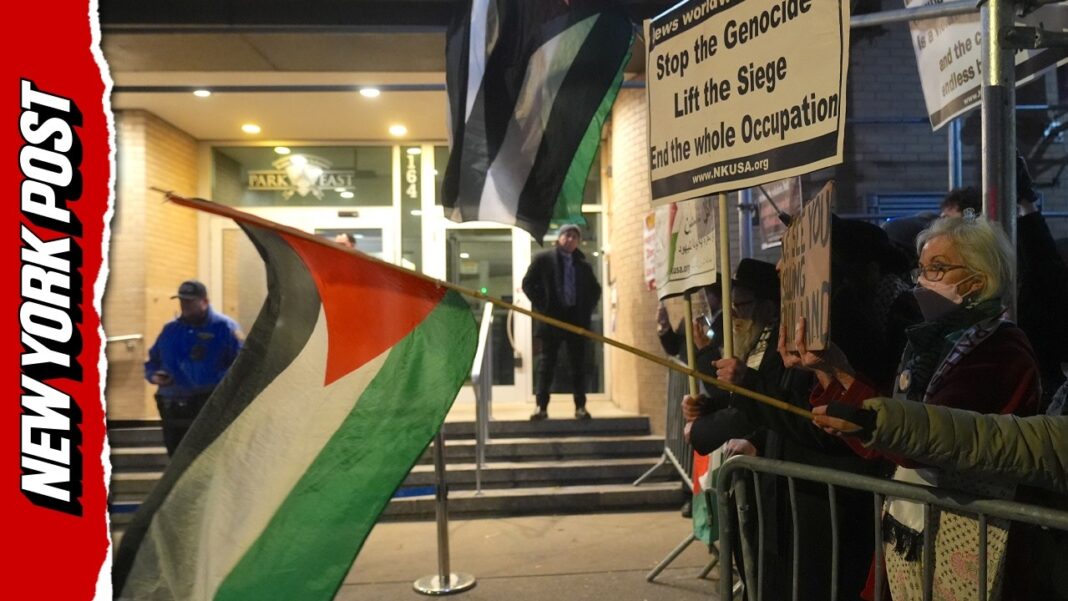
These promises are not abstract threats. Only weeks earlier, Pal-Awda had organized a large anti-Israel protest outside Manhattan’s Park East Synagogue, where nearly 200 agitators shouted violent slogans as Jewish attendees tried to enter a Nefesh B’Nefesh program. Video verified by The Algemeiner captured demonstrators chanting “We don’t want no Zionists here!”, “Resistance, you make us proud, take another settler out!”, “Death to the IDF!” and “Globalize the intifada!”
One speaker went so far as to declare, “We need to make them scared.”
Jewish community leaders now say that the events in Manhattan are part of a dangerous continuum of intimidation that is not merely anti-Israel in nature but increasingly anti-Jewish in practice.
The Algemeiner reported that the Times of Israel had already confirmed the true reason behind CapitIL’s cancellation before Pal-Awda ever advertised its protest. Yet the organization seized on coincidence as narrative ammunition—deliberately blurring the line between reality and its preferred storyline of activist dominance.
It is a tactic increasingly common among anti-Israel groups, many of which have begun to frame even unrelated events as evidence of their rising political and cultural power. For Jewish organizations watching these developments unfold, the concern is not merely the dishonesty—it is the fact that these groups believe they can operate with impunity.
Indeed, Pal-Awda’s sweeping claims went beyond CapitIL. The group stated that its activism had caused “a series of cancellations” across multiple Jewish and pro-Israel institutions—though those assertions, too, were unverified. As The Algemeiner report noted, the group even alleged credit for the recent postponement of a Nefesh B’Nefesh event planned for this Thursday. Those allegations remain unconfirmed.
But accuracy was never the point.
By flaunting its supposed victories, Pal-Awda seeks to normalize harassment campaigns, escalate pressure against Jewish organizations, and create the appearance of inevitability around its disruption strategy.
And, as observers have noted, that strategy has intensified dramatically as New York City approaches its political transition to a mayor whose posture toward Israel is markedly hostile.
The rise of Zohran Mamdani—a self-described democratic socialist and outspoken anti-Zionist—to the mayoralty of America’s largest Jewish population center has generated widespread alarm among Jewish civic organizations. His previous statements have included accusations that Israel is an “apartheid” and “genocidal” state, unequivocal support for boycotts against all Israeli entities, and refusal to condemn slogans such as “globalize the intifada,” which are widely understood to be calls for violence against Jews worldwide.
His reaction to the Park East harassment incident did little to assuage those fears.
In a statement criticized broadly across the political spectrum, Mamdani “discouraged” the protesters’ violent chants—but simultaneously chastised the synagogue for holding a pro-Israel program, claiming it had used “sacred spaces … to promote activities in violation of international law.”
Jewish leaders interpreted that framing as a shocking inversion of basic civic responsibility.
As one communal figure told The Algemeiner, Mamdani’s comments amounted to “political justification for threatening Jews on their way into a synagogue.”
Rabbi Marc Schneier, president of the Foundation for Ethnic Understanding, expressed deep concern following the CapitIL incident and the broader trend of escalating protests. Speaking with The Algemeiner, Schneier said he urged Mayor-elect Mamdani directly to ensure that New York does not become a city where Jews are routinely harassed at their own places of worship.
“In my conversation with Mayor-elect Mamdani, I made it clear that the Jewish community will not stand idly by for such antisemitic and violent protests,” he told the publication. “This cannot be the new norm in New York City.”
Schneier has proposed that the new administration pursue a ban on protests occurring on or immediately adjacent to the property of houses of worship—a policy that would protect mosques, churches, synagogues, and temples equally.
Mamdani’s public response to that proposal has yet to be clarified.
The CapitIL cancellation arrives amid what city officials have described as a “relentless surge” in antisemitic acts targeting New York’s Jews.
According to police data highlighted by The Algemeiner, Jews were the most frequently targeted victims of hate crimes in New York City in the year following Hamas’s Oct. 7 massacre. The nature of the attacks has ranged from violent assaults, synagogue vandalism, campus harassment, property destruction and organized intimidation campaigns.
At CUNY, Columbia, and NYU, anti-Israel protests—some involving explicit praise for Hamas—have left Jewish students afraid to walk freely on campus.
At public schools, anti-Israel messaging has entered classrooms through teachers, student groups, and unauthorized “toolkits.”
And on New York’s streets, pro-Hamas demonstrators have repeatedly blocked bridges, subways, highways, and hospitals while chanting slogans calling for violence against Jews, Zionists, and Israelis.
This is the environment in which Jewish community leaders now fear a newly empowered anti-Zionist fringe will test the boundaries of acceptable conduct.
For its part, CapitIL has refrained from responding to Pal-Awda’s provocation or the misrepresentation of its cancellation. As The Algemeiner report emphasized, the Israeli firm simply clarified that it had not been pressured into anything and that it remains committed to serving clients in the United States.
But the incident underscores a deeper question now facing New York’s Jewish population: If radical groups can falsely claim “victory” in shutting down Jewish or Israeli-related events without consequence, what message does that send about the city’s tolerance for intimidation?
Jewish leaders warn that the message is already being heard—and echoed across the country.
The battle unfolding in New York is not merely about a single real-estate seminar. It is about whether organized harassment of Jews can become socially and politically normalized under the guise of activism.
As The Algemeiner reported, the Jewish community is confronting not only a wave of antisemitic hostility but also a political climate increasingly hesitant to condemn those who stoke it.
And while CapitIL’s cancellation may have had nothing to do with Pal-Awda’s theatrics, the activists’ triumphant narrative reveals a new and unsettling dynamic: a radical movement eager to claim that intimidation works—and determined to push that claim further.
New York’s Jewish community, watching these developments with deepening concern, is left with a question that will define the coming months: Will the city’s political leadership side with those who target Jews—or with those who are targeted?
Because as this week’s events made plain, the fringe is not retreating.
It is advancing—and it believes momentum is on its side.