



|
Getting your Trinity Audio player ready...
|
Israeli Consulate in NYC Launches Times Square Billboard Campaign to Counter Hamas Narratives
By: Fern Sidman
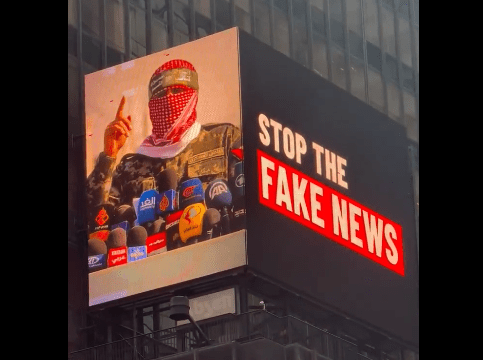
The Israeli Consulate in New York has taken its public diplomacy to one of the world’s most prominent stages: Times Square. This week, massive digital billboards lit up the iconic Manhattan crossroads, showcasing Israel’s humanitarian aid efforts in Gaza while condemning Hamas for exploiting children and spreading what Israeli officials describe as “blood libels” against the Jewish state.
Hamas lies. Israel delivers.
While Hamas and its supporters flood the world with fake photos and blood libels – Israel has facilitated over 4.4 BILLION lbs of humanitarian aid into Gaza.
Now lighting up Times Square:
Because the truth matters.Consul General in New York… pic.twitter.com/CGI4ogCVle
— Israel in New York (@IsraelinNewYork) August 1, 2025
The campaign, spearheaded by Ambassador Ofir Akunis, Consul General of Israel in New York, is the latest salvo in a growing battle of images, words, and narratives between Israel and its adversaries amid the ongoing conflict in Gaza. By situating the initiative in Times Square—an epicenter of international visibility and influence—the consulate aims to reach not only New Yorkers and American audiences but also the millions of global visitors who pass through the landmark each year.
According to the Consulate, the campaign highlights both Israel’s substantial humanitarian assistance to Gaza’s civilian population and the ways in which Hamas manipulates imagery of suffering for propaganda purposes. The billboards, which rotate on screens visible to tens of thousands of daily passersby, juxtapose visuals of Israeli aid convoys and medical relief against stark depictions of Hamas’ alleged misuse of children in its messaging.
“We will fight the blood libel that Hamas is spreading about ‘starvation’ in Gaza,” Ambassador Akunis declared at the campaign’s launch. He accused the militant group of manufacturing or distorting images of suffering children, including photographs of young patients with unrelated illnesses, to advance the claim of mass starvation under Israel’s blockade.
“Anyone who collaborates with Hamas’ lies is, in effect, collaborating with a terrorist organization,” Akunis added. “Any complaint about the situation in Gaza should be directed at the Hamas terrorists who steal humanitarian aid from Gaza’s residents while shooting at them with live ammunition.”
The use of Times Square is highly symbolic. Known as “The Crossroads of the World,” the district offers unmatched visibility for public campaigns, particularly those seeking to shape opinion in the United States. By embedding Israel’s message in such a high-profile venue, the consulate is signaling the importance it places on winning the battle of perception, especially in the American public sphere where debates over the Gaza war have become increasingly polarized.
Israeli officials emphasize that despite the ongoing hostilities with Hamas, Israel has facilitated extensive humanitarian aid deliveries into Gaza. These include truck convoys carrying food, water, medicine, and other critical supplies through border crossings under Israeli coordination.
The consulate’s campaign underscores this point, presenting Israel not as an aggressor but as a provider of humanitarian relief. The message seeks to counter accusations that Israel is deliberately starving Gaza’s population, a charge that has been echoed in international forums, including the United Nations.
For Israel, this issue carries historical weight. The reference to “blood libel” by Ambassador Akunis evokes centuries-old false accusations against Jews, which were often used to incite violence and persecution. By framing Hamas’ starvation claims in those terms, the consulate is drawing a direct line between medieval anti-Jewish myths and contemporary propaganda.
Central to the billboard campaign is the accusation that Hamas exploits children—both literally and symbolically—in its communications strategy. Israeli officials allege that the group stages or manipulates photographs of malnourished or sick children to present them as victims of Israeli policies, regardless of the actual medical context.
This charge builds on a long-standing Israeli narrative that Hamas embeds its operations within civilian populations, including schools and hospitals, thereby endangering children and families while simultaneously using their suffering as a propaganda tool.
For Israel, countering these images is essential. The global circulation of photos and videos depicting children in distress has often galvanized international opinion against Israeli military operations. By drawing attention to Hamas’ alleged fabrications and manipulations, Israel seeks to undercut the emotional power of such imagery and redirect responsibility onto Hamas.
Ambassador Ofir Akunis has made clear that combating antisemitism and defending Israel’s legitimacy in the public arena are among his top priorities. His remarks at the Times Square launch reflect a combative style of diplomacy aimed at confronting hostile narratives head-on.
The campaign also reflects a broader strategic shift by the Israeli consulate toward highly visible, media-driven outreach in the United States. By employing digital billboards in Times Square, the consulate has opted for a method that transcends traditional press releases or diplomatic statements, reaching mass audiences directly and immediately.
The launch comes at a time of heightened debate in the United States over the war in Gaza. University campuses, city streets, and social media platforms have all become battlegrounds for competing narratives, with pro-Hamas and pro-Israeli groups staging protests and counter-protests.
Against this backdrop, the Times Square campaign functions as both a defensive and offensive measure: defending Israel against charges of war crimes and humanitarian abuses, while offensively accusing Hamas of cynically weaponizing human suffering.
Diplomats and analysts note that Times Square has long been a site of international messaging campaigns, from advocacy on climate change to awareness campaigns about human rights crises. By choosing this venue, Israel is placing its conflict with Hamas squarely within that tradition of public persuasion.
The invocation of “blood libel” by Akunis is not incidental. Israeli officials have repeatedly described contemporary accusations of starvation or genocide as modern iterations of historic antisemitic myths. The Times Square campaign therefore aims not only to counter specific charges but also to situate them within a broader pattern of anti-Israel hostility.
For Israel, the stakes are both immediate and long-term. In the short term, global perception of its military actions in Gaza influences diplomatic pressure, relations with allies, and the legitimacy of its operations. In the longer term, Israel is engaged in what officials describe as a generational battle against delegitimization campaigns, including those advanced by movements such as Boycott, Divestment, and Sanctions (BDS).
While the campaign is still in its early days, its visibility ensures that it will become a point of discussion among both supporters and critics of Israel in the United States. For pro-Israel advocacy groups, the initiative represents a bold attempt to seize the narrative in a climate where Israel is often on the defensive. For pro-Palestinian groups, however, it is likely to be viewed as an attempt to obscure or deflect attention from humanitarian suffering in Gaza.
The broader implications extend beyond New York. As images of the billboards circulate on social media, the campaign will likely reach audiences worldwide, amplifying its message far beyond the physical boundaries of Times Square.
The Israeli consulate’s decision to launch a digital billboard campaign in Times Square represents a calculated move to confront Hamas’ propaganda and highlight Israel’s humanitarian role in Gaza. By framing accusations of starvation as “blood libels” and spotlighting Hamas’ exploitation of children, Israel is seeking to shape global perception in one of the most visible public arenas on earth.
As the conflict in Gaza continues, such campaigns reflect the parallel war of narratives waged alongside the physical battlefields. In the neon glow of Times Square, Israel has signaled that the contest for public opinion remains as critical as any military engagement.

4.4 billion lbs of humanitarian aid wasted. Free the hostages. Until then, bubkis.
Israel will be condemned no matter what. Get your hostages back. Then if you are feeling generous provide aid, not before.
Be interesting to see if or how the NYT covers the billboard. Hope it is helpful.
“It” meaning the billboard.