



|
Getting your Trinity Audio player ready...
|
By: Fern Sidman
As the world paused on Tuesday to mark International Holocaust Remembrance Day, the luminous heart of New York City—Times Square—became the stage for a message that was both memorial and manifesto. Towering digital billboards, launched by the Israeli Consulate in New York in partnership with the Israeli Ministry of Foreign Affairs, cut through the commercial noise with a stark historical warning and an unambiguous declaration of resolve. Nearly ninety years after the Nazis rose to power, the campaign declared, history is not merely remembered—it is echoing.
The visual spectacle was not designed as spectacle alone. It was conceived as a moral intervention in the global public square, a confrontation with what Israeli officials describe as a dangerous convergence of historical amnesia and contemporary hostility toward Jewish communities. In one of the world’s most visible urban spaces, Israel chose to transform remembrance into a living political and ethical statement.
View this post on Instagram
Ofir Akunis, Israel’s Consul General in New York, articulated the gravity of the moment with words that resonated far beyond diplomatic protocol. “Nearly 90 years after the Nazis rose to power, history is repeating itself,” he said, warning that the silence of world leaders in the face of rising antisemitism, incitement, and boycott initiatives against Jews constitutes a perilous moral vacuum. His language was deliberately stark, invoking not only memory but pattern—suggesting that the conditions that once enabled catastrophe are again forming, this time in new ideological guises.
For Akunis, the danger lies not only in overt hatred but in normalization: in the quiet acceptance of antisemitic rhetoric in political discourse, in the mainstreaming of exclusionary boycotts, and in the selective moral outrage that isolates Jewish communities as uniquely illegitimate. The campaign’s presence in Times Square—arguably the most symbolically globalized space in the world—was a calculated act of visibility, forcing a confrontation between collective memory and present-day realities.
Yet the message was not confined to warning. It was also a declaration of transformation. “Unlike in the past, when the Jewish people did not have a state, Israel knows how to defend itself with strength and force,” Akunis stated. The sentence drew a sharp historical contrast: between Jewish vulnerability in the 1930s and Jewish sovereignty in the present era. Memory, in this framing, is no longer passive remembrance but strategic consciousness. The lesson of history, he implied, is not only mourning but preparedness.
This distinction is crucial. Holocaust remembrance has often been framed as a moral appeal to the conscience of others—a call for empathy, solidarity, and protection. The Times Square campaign reframed that narrative. While honoring memory, it asserted autonomy. Israel, Akunis declared, possesses the capability to repel any enemy that seeks the destruction of the Jewish people and will not hesitate to act to ensure that history does not repeat itself. The language of victimhood was replaced with the language of deterrence, resilience, and sovereignty.
This rhetorical shift reflects a broader transformation in Jewish political identity since 1945. The Holocaust reshaped Jewish consciousness around vulnerability and survival; the existence of the State of Israel reshaped it around power, responsibility, and self-defense. The billboard campaign embodies that evolution, merging commemoration with capability, memory with military and political agency.
The collaboration with the Israeli Ministry of Foreign Affairs situates the campaign within a broader strategic communications effort. Previous initiatives have focused on exposing Hamas atrocities and highlighting the plight of Israeli hostages, positioning Israel not only as a state defending itself militarily, but as a moral actor engaged in narrative warfare. In an era where global opinion is shaped as much by digital imagery as by diplomacy, Times Square becomes a battlefield of perception as much as a site of remembrance.
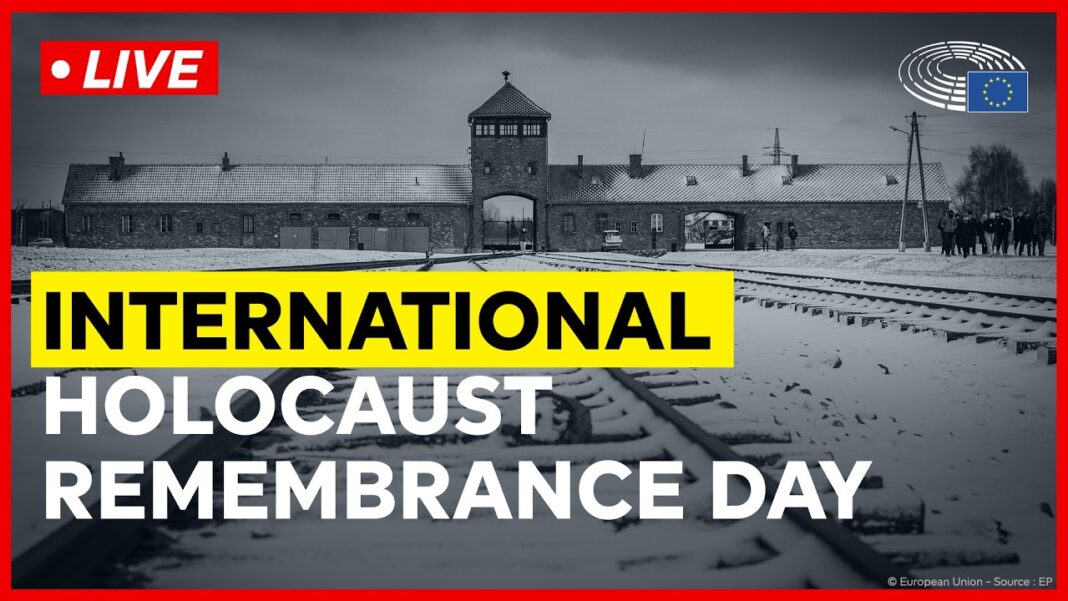
International Holocaust Remembrance Day, marked annually on January 27, commemorates the liberation of Auschwitz-Birkenau in 1945. It is a day consecrated to the memory of six million Jews murdered in the Holocaust, but also to the universal warning that genocide begins not with gas chambers but with dehumanization, isolation, and indifference. The Israeli campaign deliberately connects that historical trajectory to contemporary dynamics—antisemitism, delegitimization, and silence.
What makes the campaign particularly striking is its refusal to separate remembrance from contemporary politics. It rejects the notion that Holocaust memory belongs only to the past. Instead, it frames remembrance as a lens through which present threats must be interpreted. In this sense, the campaign is not merely commemorative; it is diagnostic.
Times Square, with its endless flow of tourists, commuters, and digital imagery, becomes a symbolic crossroads of history and modernity. The billboards’ presence there transforms remembrance into interruption—forcing passersby to engage, even momentarily, with a narrative that challenges complacency. In a city that is home to one of the largest Jewish populations in the world, the message carries local resonance as well as global significance.
The campaign’s underlying thesis is unsettling but deliberate: that antisemitism today does not require explicit hatred to be dangerous. It can manifest as silence, selective outrage, institutional exclusion, and ideological double standards. It can operate through boycotts framed as justice, through rhetoric framed as activism, and through narratives that isolate Jews as uniquely undeserving of collective rights. The danger, as Akunis suggested, lies not only in those who attack Jews, but in those who remain silent when it happens.
Yet the tone of the campaign is not despairing. It is defiant. It insists that Jewish history has crossed a civilizational threshold: from vulnerability to sovereignty. The existence of Israel, in this narrative, is not simply a geopolitical fact but a historical safeguard. The phrase “Never Again” is no longer only a moral vow—it is a strategic doctrine.
This is the deeper philosophical shift embodied in the Times Square billboards. Memory is no longer framed solely as mourning but as mandate. The Holocaust becomes not only a tragedy to be remembered but a responsibility to be operationalized. Defense, deterrence, and self-reliance become ethical imperatives rooted in historical experience.
In this sense, the campaign speaks simultaneously to multiple audiences. To Jewish communities, it offers reassurance and solidarity. To global leaders, it delivers a warning about the consequences of silence. To adversaries, it signals resolve. And to the broader public, it reframes Holocaust remembrance as something living, urgent, and politically relevant.
As the digital lights of Times Square pulsed with commercial imagery, Israel’s message cut through with a different kind of illumination—one drawn not from consumer culture but from historical consciousness. It reminded the world that remembrance is not passive reflection but active responsibility, and that memory without action risks becoming ritual without meaning.
In the shadow of the twentieth century’s greatest atrocity, Israel chose not only to remember—but to declare. History, the campaign insists, does not repeat itself by accident. It repeats itself when silence replaces courage, when indifference replaces responsibility, and when memory is reduced to ceremony instead of conviction.
In Times Square, on International Holocaust Remembrance Day, Israel answered that risk with a simple, uncompromising message: remembrance must become resolve, and memory must become power.
