



|
Getting your Trinity Audio player ready...
|
By: Fern Sidman
Even the underground arteries of New York City — long mythologized as a refuge from the elements — proved no sanctuary from the merciless grip of Winter Storm Fern. As The New York Post reported throughout Sunday, straphangers across the five boroughs found themselves confronting a surreal and unsettling reality: snow and ice had infiltrated the subway system itself, coating platforms, slicking staircases, and, in some cases, even dusting the interiors of train cars. In a city that prides itself on resilience and infrastructure designed to withstand almost anything, the storm delivered a humbling reminder that nature remains the ultimate authority.
From East Harlem’s 103rd Street station to the bustling arteries of Canal Street in Chinatown, riders described slippery platforms and dangerous accumulations of snow in areas normally shielded from the elements. Social media posts cited by The New York Post captured the disbelief of commuters who expected chaos above ground, but not beneath it. One rider sarcastically remarked that the storm was “a total bust” at Canal Street — a comment made ironic by the fact that even a modest accumulation had penetrated the subterranean world of the subway. Another post showed patches of fresh snow inside a train car itself, an image that felt less like a weather anomaly and more like a symbol of the storm’s total dominance.
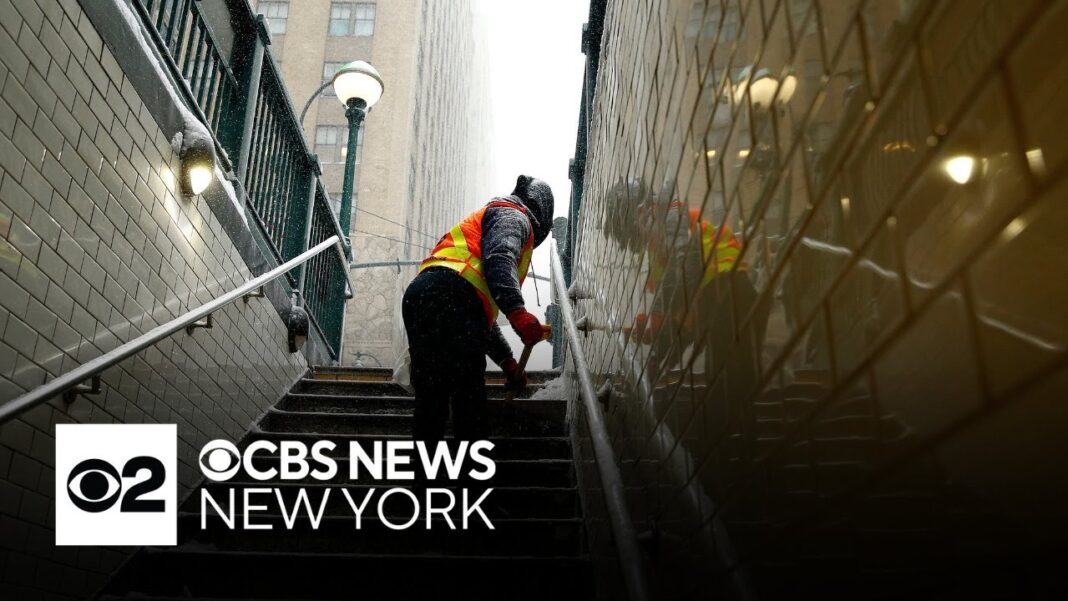
According to The New York Post and NY1, Metropolitan Transportation Authority crews were forced into the unthinkable: shoveling snow off subway platforms, including on the No. 4 line at the 176th Street station in the Bronx. The sight of workers clearing snow underground, beneath layers of concrete and steel, became one of the most haunting visual metaphors of the storm — proof that Winter Storm Fern was not merely a weather system, but a national disruption of extraordinary scale.
What unfolded beneath New York was only a microcosm of a catastrophe that engulfed much of the United States. As The New York Post report detailed, Winter Storm Fern pummeled 34 states with snow, ice, and arctic temperatures, triggering one of the largest nationwide transportation shutdowns in modern history. By Sunday evening, more than 11,601 flights had been canceled across the country, according to FlightAware — a figure rapidly approaching the pandemic-era record of 12,143 cancellations recorded on March 30, 2020, at the height of COVID-19 lockdowns. For millions of Americans, Fern transformed airports into liminal spaces of uncertainty, where departures vanished from screens and terminals filled with stranded travelers.
The New York metropolitan area became one of the storm’s most visible epicenters. LaGuardia Airport canceled 436 outgoing flights. JFK International Airport scrapped 462 departures. Newark Liberty International Airport, one of the nation’s busiest hubs, canceled an astonishing 84% of its flights, grounding 444 outbound trips. As The New York Post reported, even aviation strongholds were not spared: Atlanta’s Hartsfield-Jackson International Airport, the busiest airport in the world, canceled 597 flights, while Ronald Reagan National Airport in Washington, D.C., shut down completely, canceling all 820 scheduled arrivals and departures.
The disruption extended far beyond the Northeast. Ninety-two flights were canceled at Los Angeles International Airport, illustrating how Fern’s impact reverberated across the national aviation network. In total, more than 16,000 flight delays compounded the cancellations, creating what The New York Post report described as a logistical nightmare rippling through every major airline and airport system in the country.
Yet the storm’s toll was not measured only in inconvenience. It carried a human cost that cast a somber shadow over the spectacle of cancellations and closures. According to The New York Post report, at least two men in Louisiana died from hypothermia linked to the storm, bringing the nationwide death toll to seven. This followed the tragic discovery of five New Yorkers found dead on Saturday due to extreme cold — before the snow had even begun to fall. The sequence of events underscored a brutal reality: Winter Storm Fern was deadly not merely because of its snow, but because of the sustained arctic cold that preceded and followed it.
Power infrastructure across the country buckled under the pressure. More than one million customers were left without electricity on Sunday, according to PowerOutage.us. Tennessee alone recorded more than 300,000 outages. Mississippi and Louisiana each reported over 140,000 customers without power. Texas, Kentucky, Georgia, West Virginia, and Alabama joined the growing list of states plunged into darkness, turning the storm into a humanitarian crisis as well as a meteorological one.
The severity of the outages prompted federal intervention. Energy Secretary Chris Wright issued emergency orders directing grid operators in Texas and the Mid-Atlantic to keep power plants running throughout the storm’s onslaught. His statement framed the moment in stark terms: maintaining “affordable, reliable, and secure power” was “non-negotiable.” In at least 18 states, governors declared states of emergency, while 12 states activated National Guard troops to assist with storm response and recovery efforts.
As The New York Post report documented, more than 190 million Americans remained under winter weather alerts, with the National Weather Service forecasting heavy snow and ice from Arizona to Maine. In New England, totals were projected to reach 18 inches by midday Monday. For New York City, forecasters warned that accumulations could reach as high as 14 inches — potentially the largest snowfall since 2021. The storm’s geographic scale was staggering, its footprint spanning deserts, plains, mountains, and coastal cities alike.
And yet, in a narrative twist that felt almost surreal, parts of the country basked in warmth even as others froze. Florida, The New York Post report noted, experienced record-breaking heat on Sunday. Orlando reached 86 degrees, tying a record set in 2023. In Tampa Bay, residents strolled along piers under blue skies, far removed from the snowbound scenes dominating the North. Joan, a 69-year-old Florida resident originally from northern New Jersey, told The New York Post she felt “relieved” not to be facing the storm that had engulfed her former home. Clad in a tank top and jean shorts, sipping Chardonnay on a pier, she embodied the stark climatic divide splitting the nation in two.
But even Florida’s reprieve was temporary. Central Florida issued a freeze watch as temperatures were expected to plunge after Monday’s rain, with Tuesday’s forecast to bring mid-30s temperatures — a reminder that Fern’s atmospheric influence extended even into regions spared its snow.
Back in New York, the symbolism of snow in subway tunnels resonated deeply. For generations, the subway has represented continuity — a system that runs through blackouts, heatwaves, hurricanes, and blizzards. To see it infiltrated by snow was to witness a rare breach in that mythology. As The New York Post report emphasized, the storm’s presence underground was not merely an inconvenience; it raised safety concerns about slipping hazards, delayed service, and the vulnerability of infrastructure in extreme weather.
The images of MTA crews shoveling snow off platforms, commuters navigating icy stairs, and trains carrying traces of winter inside their cars became emblems of a city forced to confront the limits of its defenses. It was not just a storm above ground; it was a storm everywhere.
Winter Storm Fern will be remembered not only for its meteorological ferocity, but for its symbolism. It blurred the boundaries between inside and outside, between shelter and exposure, between safety and vulnerability. It turned subway tunnels into snow corridors, airports into ghost terminals, and highways into frozen arteries. The storm’s narrative emerged not as a single event, but as a national ordeal — one that exposed the fragility of modern systems in the face of nature’s extremes.
In the end, Fern did more than disrupt transportation and power grids. It disrupted assumptions — about infrastructure, preparedness, and even geography itself. When snow falls underground and heat blooms in winter in Florida, the familiar rules no longer apply. And as America digs out from the wreckage, one truth remains unmistakable: Winter Storm Fern was not just a storm. It was a reckoning, written in snow, ice, and silence, from subway platforms in Manhattan to darkened homes across the South.
