



|
Getting your Trinity Audio player ready...
|
How the MTA’s Mismanagement and Waste is Adding to the Failure of the City’s Economy by Forcing in Secret Congestive Pricing on NYC
By Gary Tilzer
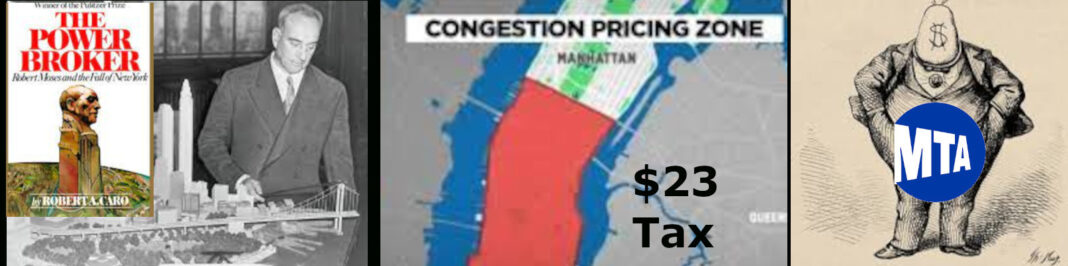
Master builder Robert Moses called putting all the state’s transportation in one super authority, “absurd” and “grotesque” for its unwieldiness, power, and its inability to control its operation, overspending, making it unaccountable to public needs.
The powerful too big to fail MTA has colluded with government and business leaders to bypass the public in darkness to implement Congestive Pricing (CP) to balance its books, without agreeing to stop its uncontrolled and corrupt spending ways. Not only are NY’s government insiders forcing the public to pay more to drive into Manhattan below 60th street, their actions according to economists will bankrupt the City economy, already damaged by crime and the pandemic caused by the working-from-home revolution. CP will surge the amount of future NYC budget deficits by increasing the number of Manhattan Central Business District empty office buildings, closing more restaurants, small businesses in neighborhoods like Chinatown and speed up the move out of the City’s wealthy and middle class who pay the bulk of the taxes. The increase in empty office buildings caused by CP according to an economist from NYU Stern Business School will set NY on an “urban doom loop” that will destroy the quality of life in the city and drive more residents out. NYC no longer has leaders who understand how the city prospers like Governor DeWitt Clinton who built the Erie Canal in 1825, which kick-started the City’s economic engine, building the strongest economy in the world.
Sam E. Antar Twitter @SamAntar: “Hey NYC Comptroller Brad Lander (who supports Congestive Pricing): The “rich” and many tax revenue generating businesses are no longer trapped in NYC, due to online connectivity and remote work. 1% of NYC residents (approx. 40,000 residents) pay 48% of NYC income taxes. If just 10% of them (4,000 “rich” residents) bolt, you can kiss NYC goodbye.”
The implementation of CP, at the time when billions are spent on the migrants and the federal pandemic bailout funding for local governments ended, along with the lack of proper leadership from the economically destructive City Council, will lead to a perfect storm of budget deficits in future years. The City is being pushed into bankruptcy by the MTA’s borrowing and a progressive City Council addicted to social spending by its progressive members who, according to Mayor Adams, “do not understand basic accounting.” Don’t count on Controller Brad Lander who most recently lost 36 billion from NYC’s pension fund and is pushing for CP and more bike lanes. Lander sees his job as a woke social warrior, not as the City’s top fiscal watchdog educating the voters on the weaknesses in the City’s budget and protecting the NYC economic engine that took a century to build but has been badly damaged during the last three years. The expected gaps in coming fiscal years already total more than $11 billion, if the City falls into a recession that number could be doubled or tripled. Who is Watching the City’s Watchmen? In other words, elections, and the media (the watchdogs) no longer have the ability to assure elected officials (the watchmen) protect the public needs, endangers the quality of life in NYC.
The MTA, which was designed to have great power, is acting like a futuristic AI robot that is doing what is best for itself, rather than serving the public with a better transit system. Both master builder Robert Moses and Mayor John Lindsay predicted when Governor Nelson Rockefeller created the MTA in the 1960s, that it would become too powerful, and wasteful, functioning for the authority’s good and not the public’s good. Robert Moses called putting all the state’s transportation in one super authority, “absurd” and “grotesque” for its unwieldiness, power, and its inability to control its operation, overspending, making it unaccountable to public needs. Mayor Lindsay believed that operation of the City’s subways and buses would be more accountable to the public and the City’s needs if they were run by City Hall, not a super authority.
The all-powerful MTA is conspiring with government insiders to impose CP on the City, out of public view and control, to do what is best for the authority and not the City–just as predicted by both Robert Moses and Mayor Lindsay 75 years ago. The heavily in debt MTA is acting like a junkie hooked on money to keep its power addiction control and wild spending ways, destroying everything in its path. Albany is acting like a drug dealer, throwing money at the out-of-control wasteful authority, instead of demanding that it kick the habit of overspending and wasting. The MTA imposing CP on a very weakened NYC economy to continue its addiction, will cause a recession that will make the City’s problems critically worse, cuts in essential government services, causing great harm to every New Yorker that stays.
The subway system struggled financially since the 1970s, when a municipal fiscal crisis brought to light problems caused by the system’s crumbling antiquated infrastructure. To help stave off further decay, Richard Ravitch, then chairman of the M.T.A, lobbied Albany lawmakers in the 1980s to allow the Authority to issue bonds to balance its books. Over the years, the transportation authority kept borrowing, increasing its debt to cover its overspending and wasteful ways. The MTA continues to borrow to pay for the interests on its bonds and is now taxing New Yorkers with CP to pay for those debt services and to make up the revenue lost by the 40% drop in ridership caused by crime in the subways.
Reza Chowdhury @RezaC1 NYS Comptroller sounding warning bells on MTA. He wants MTA to use incremental rev to pay down debt. Instead, MTA is going to borrow another $15B. MTA spent $11.7B in capital improvements last year, the most ever in history in a single year. Did you notice any improvement?
According to the former chairman of the MTA, Ravitch, the biggest problem the Governor had during this year’s budget negotiations was the MTA. “It is in deep trouble financially,” Ravitch said. “And whatever solution [is chosen, it] will have an impact on state taxpayers or riders. Either the system goes under, or New Yorkers pay more taxes to support the public transportation system. Ravitch made no mention of the reasons for the growing MTA debt in his NY1 interview or offered any ideas on how to stop the authority’s waste and corruption. Ravitch did comment on NYC’s dysfunctional government when he recently wrote that The City Council must recognize that fiscal cliffs are looming over New York and prepare for the possibility of a recession.
The late Assemblyman Richard Brodsky called the state’s quasi-public authorities “Soviet-style bureaucracies” that together constitute a “shadow government.” The NY Times said Brodsky was instrumental in empowering NYS to monitor its 700 quasi-public authorities, including the MTA. Brodsky wielded his chairmanship of the Assembly Committee on Corporations, Authorities and Commissions as a cudgel over the MTA, which operates largely to avoid oversight by the voters and their approval to incur debt beyond what the state can borrow on its own. The current chair of Brodsky’s Committee on Corporations, Stony Point’s Kenneth Zebrowski, used his power to exempt suburban workers from the payroll tax NYC workers must pay to balance the MTA budget.
To Stop Public Opposition Cuomo Created Congestive Pricing in Darkness, Gave the MTA Complete Control on Running It and Using its Tolls
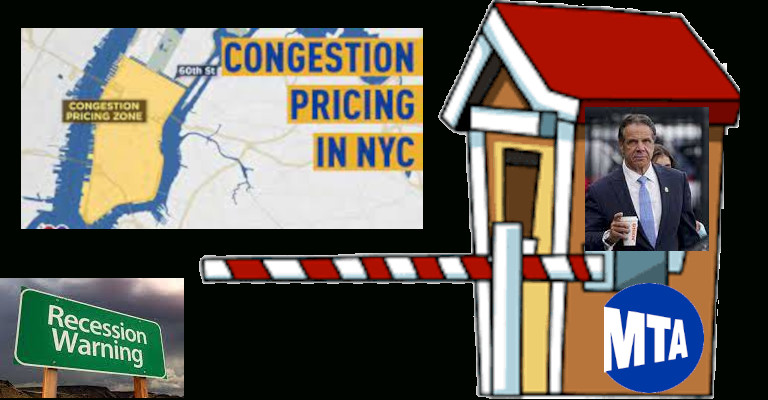
The CP law pushed by former Governor Cuomo was passed in 2019 in the middle of the night with almost no public discussion, as part of his “big ugly” last minute budget agreement, where controversial programs like bail reform are hidden from public view and discussion.
The “big ugly” always passes during a massive insider final end of term omnibus deal, because it contains member item patronage money for each Albany elected official and pay to play deals for lobbyists and their clients who contribute millions in campaign contributions to those passing and signing the “big ugly” bill. The NY Daily News wrote on June 12, 2022, “NYC congestion pricing plan shrouded in secrecy as MTA, feds hide review process,” never follow up their charges of secrecy.
Cuomo and legislature leaders hiding the passage of CP agreement inside the year ending “big ugly” was deliberately designed to avoid the mobilization of public opinion that derailed an attempt by former Mayor Bloomberg to implement CP in 2005. In 2005, the late Councilman Lew Fidler, began organizing against CP by submitting with six other council members a bill that called on Bloomberg to oppose CP before the Mayor even got a chance to propose it as a bill in Albany.
Councilman Fidler began to build a public momentum by stating that CP was economically unjust, hurting the poor and that it would result in a $3 billion loss in economic output, eliminate thousands of jobs and close small businesses. Unlike in 2005 when NYC economy was strong, today with 30 to 50% of the City’s Central Business District offices vacant because of Crime, the pandemic technology that allows office workers to work from home, there has been no discussion on the further damage CP will do to the city’s already empty subways and growing budget deficit.
As other elected officials joined Fidler’s campaign against CP in 2005, Bloomberg lost support in Albany to pass a bill that would make the lower Manhattan toll zone. The MTA and Albany insiders learned the Bloomberg lesson two decades ago, successfully creating this passage of CP out of public view and control. When Bloomberg first tried to pass CP, he was proposing an $8 toll along with new subway and bus services. Today the MTA wants almost three times as much, $23 toll, with no new transit services offered.
Bloomberg said that CP will mean cleaner air in lower Manhattan. Opposing Bloomberg’s push for CP, Councilman Fidler said in 2005 that “he supports mandating the federal government ban the manufacturing of combustion engines in 10 years to achieve Mayor’s cleaner air goals.” Today, with the federal government fast-tracking electric cars, bike lanes replacing car lanes and empty office buildings, cleaner air has not been used as a selling point for CP. With CP passing in darkness, those implementing it did not even bother to give a reason for the new tolls, which is really a regressive tax to bail out the MTA, in the highest taxed City and State in the nation.
Albany gave the heavily in debt MTA complete control of CP through a six-member Traffic Mobility Review Board which the authority appoints to set up the tolling structure and rules to enter lower Manhattan. One of the members of the six-person board pushing for CP is the head of the Partnerships Kathy Wylde, who mostly real estate members will surlily see their office building become more emptier after the $23 dollar Manhattan toll tax starts. Another member of the board is the President Transportation Workers Union John Samuelson, whose members just received a new contract with no work rule changes or givebacks. A third member of the traffic board is Scott Rechler, who also sits on the MTA’s board.
There were no spending or auditing controls put in place by Cuomo or any of the legislative lawmakers in exchange for the passage of CP, to force the MTA to end its over spending and wasteful ways, which is causing the growing debt, which will require in future years more increases in taxes to pay for. Albany just threw money at the poorly run transportation authority. State leaders have already used the one billion in tolls expected to be brought in from CP along with a fare increase and new business tax to balance the spending junkie MTA’s books for only next year.
The Daily News Ignores the Danger of Congestive Pricing on NYC’s Already Weak Economy, But Connects Canada’s Hazardous Air to Passage of Feds Environmental Review
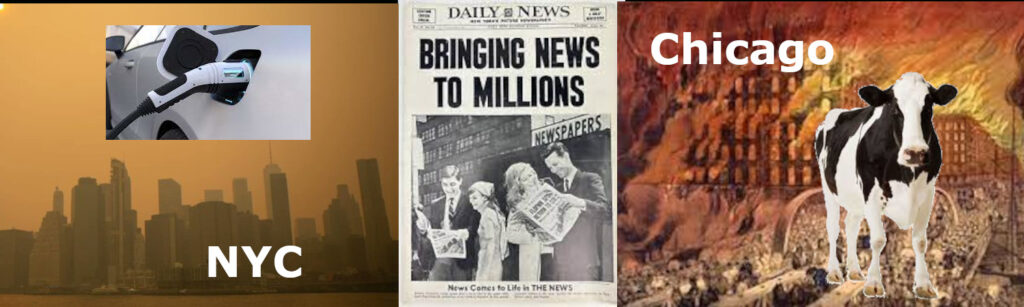
The NY Daily News should not have connected federal environmental passage of CP to the Canadian forest fires, it should have connected it to a Chicago cow. The MTA has become to NYC what Mrs. O’Leary’s cow was to Chicago without the fires, so nobody notices.
The NY Daily News Editorial Board (DNEB) was disingenuous when they connected the end of the Federal Highway Administration’s 30-day public review period for congestion pricing, to the dangerous air coming from the Canadian fires. The DNEB that supported the federal electric car clean air mandates for years, knows that unlike the 2005 clean air campaign to pass CP, it is not a reason for passage in 2023. Vehicles purchased in NYC will need to be zero-emission models beginning in 2035. To reach that target, 35% will need to be zero-emission by 2026 and 68% by 2030. If the DNEB really wanted clearer air they should have pressured Albany’s Green progressive supporters to reduce crime by tweaking the bail law, resulting in NY commuters returning to the subways, decreasing pollution. The DNEB did not explain why Long Island residents, who benefited the most from the overspending on the $12 Billion East Side Access project, were exempt from the increase in payroll taxes dedicated to the subways, buses, and commuter rail lines. The editorials of DNEB, the former hometown paper (now produced mostly in Chicago, printed in NJ, and controlled by the Democratic Party in Washington) support CP while paying no attention that there was no cost controls in the CP law and despite dozens of past DNEB editorials describing the MTA’s overspending, waste, and corrupt ways:
In the Hey, big spender: Debates over MTA funding shouldn’t gloss over agency’s waste the DNED wrote: “Yes, it is expensive to build in New York, and yes, the cost of labor is high, but that doesn’t come close to explaining why each track of mile, for example, is multiple times the cost of a mile in similar urban centers. What does explain it is wasteful practices enshrined by the Transport Worker Union’s political stranglehold and the lack of proper oversight and accounting for how the public funds are spent. All the good ideas in the world won’t help if the funds are frittered away.” December 11, 2022. On 2/27/23 The Daily News Editorial Board wrote, “East Side Access: How to waste 10 years and billions of dollars: “Stop overbuilding, such as LIRR’s new terminal instead of using Grand Central’s lower level, with plenty of room, or going extravagant on the Second Ave. subway’s deep stations rather than stops closer to the surface. Ergo, Gateway should use Penn Station and not a new annex.” On 1/18/23 The Daily News Editorial Board wrote, “Why does the MTA bleed money?”
The NY Daily News Editorial Board ignored the warning of NJ Congressman Josh Gottheimer, who said that “The MTA is literally robbing Peter to pay Paul to boost revenue for the MTA, by implementing CP.” Congressman Gottheimer believes NYC’s “Congestion Pricing” program concerns cash flow as much as traffic flow since it is designed to cover some of the MTA’s outsized construction and maintenance costs. This “cash grab,” as Gottheimer put it, comes after the authority had “squandered” roughly $15 billion in cash aid sent by Congress to bolster the authority’s balance sheet — which was shaky even before the pandemic evaporated 40% of its fare revenue. As to the MTA’s day-to-day operating costs, Gottheimer doesn’t have to look far to witness waste. He could start by summoning any of the 700-plus MTA employees who collected more in overtime than regular wages during 2021, when MTA overtime costs topped $1 billion. Four workers, all on the MTA’s commuter rail outfits, collected more than $200,000 each in overtime. The politically powerful Transportation Workers Union (TWU), who politicians strongly seek endorsements, campaign contributions and GOTV volunteers from, just received another sweetheart contracts in return for campaign endorsements, enabling their members to rack up more unnecessary overtime caused by outdated and politically rewarded wasteful work rules. The TWU message to members after the past agreement: “NO Givebacks! No Concessions of Any Kind!”
Maria Danzilo Twitter @Maria4Dist6: The regressive tax known as “ congestion pricing “will hurt NYC’s working & middle-class workers/car owners/& small businesses & will be used by the CP tolls to pay down debt that grew from gross mismanagement.”
The NY Daily News Editorial Board also endorsed the subway and bus fare hike “Go fair on the fare hike,” “it was smarter politics to let the MTA handle the matter (fare hike).” The editorial protects elected officials from responsibility and blame for the MTA growing debt and using the economically damaging CP to pay for that growing debt. The editorial failed to pressure Albany to fix the MTA’s overspending, pay to play corruption waste, so that more tax increases are not needed in the future. The DNEB should tell the MTA to follow the Musk’s Twitter example and fire some politically connected employees at the authority:
Nolan Hicks Twitter @ndhapple: “I think I count three rows of MTA officials from major projects at the City Planning Commission meeting on Penn Station.”
Examples of the MTA Wasting Billions on Unnecessary Projects and Over Spending Over the Years:
The LIRR extension to Grand Central Station started being built in 2007 and was planned to be open in 2009, at a total cost of $3.4 billion. The cost for the two miles of connecting tract between Queens and the Eastside of Manhattan ended up costing $12 billion. The extension of the number 7 line to Hudson Yards is the most expensive mile of subway track on Earth, at a cost of $2.5 billion or $1.5 billion per mile. A 24-block extension of the 2nd Avenue Subway, with three stops, costs $4.4 billion or $2.5 billion per mile. The MTA wasted $31 million dollars to build an extra Times Square Staircase. The MTA wasted $4 billion on remaking the Fulton Street Station in Manhattan. Former Governor Mario Cuomo pressured the MTA to spend tens of millions of dollars to study outfitting MTA bridges with lights capable of choreographed displays, including the Mario M. Cuomo Bridge. Former Comptroller Stringer’s Audit revealed widespread mismanagement and waste. The MTA spent billions of dollars on opulent station makeovers and other projects that did nothing to boost service or reliability, while leaving the actual movement of trains to rely on a 1930s-era signal system with fraying, cloth-covered cables. Cuomo cut signal funding to pay for vanity projects like the 2nd Ave line. The MTA spends billions repairing elevators and escalators that are out of service more often than in.
The MTA’s Mismanagement of the Subways Cameras Over Two Decades has Caused Crime and Racial Tensions to Increase and Riders to Die
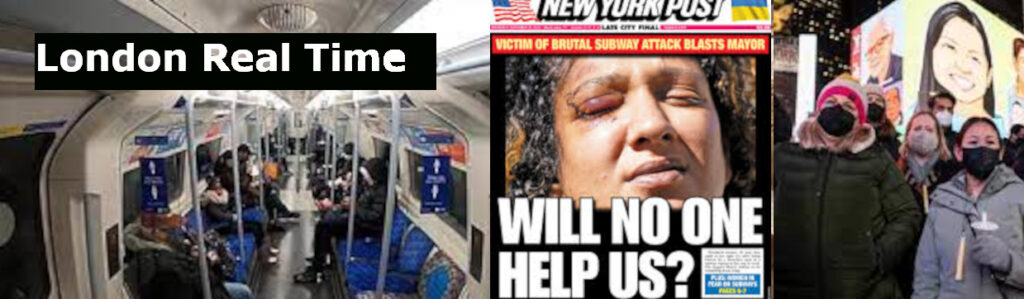
If the MTA followed the London subway plan and used their technology starting in 2005, the controversy and racial tension associated with the Jordan Neely and Daniel Penny incident would have never happened. New Yorkers would have had a video to judge Nelly’s behavior on the train and see if he was a danger to the passengers.
The Nelly-Penny confrontation and many of the other crimes might have never happened if NYC police and mental health experts had live CCTV cameras in each train car, platform, and station, which London police have had for two decades, to locate and remove for shelter or treatment the homeless and mentally ill in real time occupying the subways.
After the London terrorist bombing in 2005 that killed 52 UK residents, those in charge of the Underground—London’s subway system, built a live closed-circuit video station network that is monitored by the police to protect English riders. After the World Trade Center bombing in 2001, the MTA tried to build a live CCTV system here in NYC, but akin to most things NY’s MTA does, it spent billions on politically connected tech consultants and vendors, accomplishing nothing. If the MTA did not mess up building the same CCTV live video system as in London, the police stations and every cop on their cell phone would have been able to monitor in real time signs of danger in the subway. When Michaele Go was waiting on the R train platform in the Times Square Station at 9:20 a.m. on a quiet Saturday morning, before she was pushed in front of the path of an oncoming train by Martian Simon, a mentally ill homeless man, two officers were patrolling other parts of the multi-platform station. If those two cops had the ability, on their city issued phones to see a homeless mentally ill man acting irrationally on a platform, they could have run to where Michelle was waiting for her train, along with other live video connected cops on the nearby streets and stopped Simon before he murder her. Train operators can warn the police if they see the homeless on their train or stop the train in the tunnel if they are warned by a central real time video monitoring operator of trouble in the station the train is about to enter.
Jason Curtis Anderson @JCAndersonNYC: Michell Go’s murder SHOULD have been the turning point where NY’s demand real solutions for letting mentally ill homeless people occupy so much of the subway system.
The NY Times reported in 2010 that “more than nine years after the Sept. 11, 2001, attacks, the subway’s video surveillance system, one of the key tools the City has in deterring crime and investigating attacks in the subways, remained a patchwork of lifeless cameras, unequipped stations, and problem-plagued wiring. The Times reported that of the 4,313 cameras that were installed by 2010, more than half were inoperable. Even after the MTA was warned its camera system was a mess, the authority continued to waste billions, hiring more tech consultants and politically connected vendors. When Frank James shot ten riders inside an N train, as it approached the Sunset Park subway stop ten years after The Times warned the MTA their camera system was a mess, the station’s cameras in the 36th street station were not able to record James’s escape, because they were broken. Nicholas Casale, a former MTA counterterrorism expert, said to the Times, “the MTA is in the business of trying to get trains and buses to run on schedule, they’re not in the security or police business.” No kidding.
The MTA overpaid and much too successful public relations staff announced in September of 2021 that all of its 472 subway stations have security cameras. But it was really a CYA move, after their own study two years earlier, in 2019, reported that after billions were spent, a third of subway stations still had no cameras. In response to a flood of bad press to their 2019 report, the MTA quickly installed cameras attached to tape recorders in the final third of the subway stations, which was cheaper and easier to install and provided video that could be retrieved and used in the investigation of crimes after they were committed. Unlike the London real time 15,516 live video cameras, the NYC subway system cameras cannot prevent crimes, like the UK system has for two decades. The MTA installed cameras are mostly located over the turnstiles to tape fare evaders that City’s District Attorneys are no longer prosecuting.
Today the MTA thrives in darkness, communicating only through its public relation army that pumps out fake news to local reporters, who believe press releases are the new investigative journalism. The MTA press release solution to the $700 million lost to fare jumpers last year ($285M buses, $315M subway), covered by all the local news outlets, is to install two high gate prototype turnstile at Grand Central Station, that would take years and billions, which the MTA does not have to install at every station. The MTA press release, which almost every media organization used as news, did not mention how they would stop fare evaders entering through subway exit doors or on buses. The MTA’s record of wasting billions on camera technology seems to be repeating itself with the $645M OMNY tap turnstile fare system, which has already been hit with software bugs, missed deadlines, and cost overruns.
The MTA press release answer to prevent riders from being pushed to their death in front of oncoming trains like Michelle Go, is to install station gates on three of the subway’s 1,000 platforms at a price of $100 million. No word in the press release about how the bankrupt MTA system will come up with the billions needed to install and maintain the new turnstiles or platform station gates, or how long the MTA really means, when it says it will take several years to install each new system. Which is exactly what the Authority said when it announced its new live camera monitoring system in 2001. Let’s hope the MTA uses better vendors and maintenance workers on the upkeep of turnstiles and station doors than they do for their elevators and escalators, which are out of order more than they are in service.
By Not Building Live Video Camera System The MTA Caused Unnecessary Fights Between the Mayor and the Progressives and Made the Riders Victims
Media corporations trained their audience – and then convinced themselves – that the only legitimate form of “journalism” is personal attacks–sensationalism for clicks, rather than explaining to their readers why government problems are not being solved or how their government really operates. Newspaper editorial boards are more interested in reporting on the Neely-Perry subway confrontation and racially charged protests, than finding solutions to prevent it from happening. Mayor Adams tried to give judges the power to institutionalize very sick people like Simon, who pushed Go into a train, in hospital long term. Albany progressives attacked Adams’ proposal but were never asked by the media how Michelle Go’s and others’ deaths on the subway platforms could have been prevented. The killer of Go, the attacker of Gomes and Neely all left Court-Ordered, government-funded drug rehab programs and stopped taking their antipsychotic drugs.
Public Advocate Jumaane Williams, City Councilwoman Tiffany Cabán and other progressives like AOC railed against the Mayor’s plan to involuntarily commit New Yorkers with untreated mental illnesses living on the streets and subways, for 72 hours for mental health evaluations. Cabán and Williams both claimed Adams’ plan to get the mentally ill off the subways would create a deadly confrontation with the police. Williams and Cabán were right about a deadly confrontation, but it was not between the NYPD and the Mentally Ill, it was between an emotionally disturbed man and a subway rider. Councilwoman Cabán claimed that the attack on Elizabeth Gomes by a mentally ill homeless man, who was in and out of prison and hospitals, was a one in a million event. Cabán, with the help of the media, no longer following-up on stories that do not fit its liberal narrative, ignored the almost daily criminal attacks in the subways, including several additional murders, disproving Cabán’s one-in-a-million statement. The NY Times called the Mayor a fear-monger for his efforts to reduce crime, which included trying to get help to the mentally ill. The Times could have used their vast investigative powers to pressure Albany to come up with better solutions to the City’s mentally ill and homelessness deadly problem and still stick to their politically progressive beliefs to empty the jails.
Who pays the Price for the MTA’s mismanagement and incompetence that Albany refuses to fix? The late Michelle Go, Elizabeth Gomes who lost an eye, and hundreds of their fellow riders who were murder or beaten on the subways. Now the entire City is facing an economic recession, which undoubtedly will be made more severe by the adoption of CP to bring in revenue to help cover the MTA’s overspending caused by growing unnecessary debt. The MTA has become to NYC what Mrs. O’Leary cow was to Chicago, without the fires so nobody notices.
@GaryTilzerTips
