



|
Getting your Trinity Audio player ready...
|
Edited by: Fern Sidman
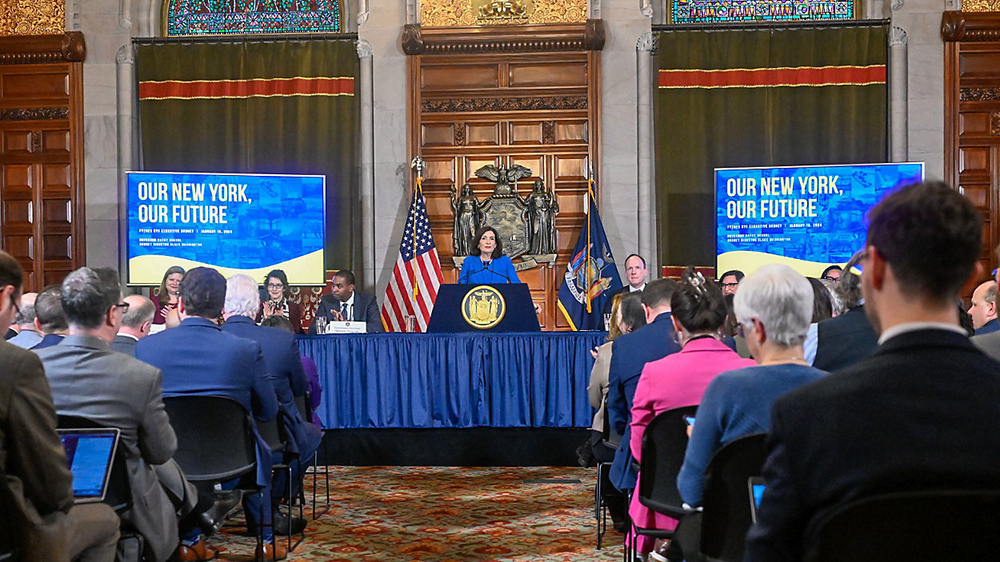
Governor Kathy Hochul presented a comprehensive $233 billion budget for New York State, navigating the delicate balance between fiscal responsibility and addressing urgent concerns such as the migrant crisis and rising Medicaid costs. As was reported by the New York Times, the proposed budget includes a significant allocation of $2.4 billion to aid New York City in managing the escalating migrant situation, reflecting a $500 million increase to accommodate the growing influx of immigrants.
The budget proposal underscores the gravity of the migrant crisis, which has become a focal point for Democrats facing the challenges of immigration in a presidential election year. According to the NYT report, Governor Hochul’s package aims to cover various aspects of the crisis, including sheltering migrants and asylum seekers, case management, National Guard staffing, medical and legal expenses, and employment-related services.
Under Hochul’s proposal, New York State will assume funding for approximately 3,000 beds, fully covering the costs of existing shelters at Creedmoor, the state psychiatric hospital in Queens, and Randall’s Island. As was indicated in the NYT report, this commitment supplements the state’s earlier promise to fund a 2,000-bed shelter at Floyd Bennett Field in Brooklyn. The decision to allocate resources to the migrant crisis reflects the political urgency of the issue for Democrats.
Amidst the pressing needs of the migrant crisis, the state also faces challenges related to Medicaid, the report in the NYT said. Projected increases in Medicaid costs will necessitate an additional $3 billion in spending this year. Enrollment in state-subsidized plans has risen, contributing approximately $400 million in new costs. Furthermore, the state is awaiting the repayment of a $1.5 billion loan extended to distressed regional hospitals during the COVID-19 pandemic.
Governor Hochul acknowledged the economic reality, emphasizing the need to make tough decisions in light of projected multibillion-dollar deficits. According to the information provided in the New York Times report, despite a revised projection indicating a $2.2 billion surplus due to higher revenues, Hochul’s budget was characterized as “modest” by the progressive Fiscal Policy Institute. Critics argue that it lacks the deep investments required to address New York’s affordability crisis and population loss.
In anticipation of potential criticism, Governor Hochul maintained her stance against implementing new income taxes. She acknowledged the challenges faced by the state but emphasized the necessity of making tough decisions in the current economic landscape.
Education funding stands as a focal point of negotiations, with Hochul expressing support for extending Mayor Eric Adams’s control of New York City public schools for an unprecedented four-year term, doubling the current two-year period, as per the NYT report. The budget proposes ending the longstanding “hold harmless” practice, ensuring school districts never receive less money than the previous year. The NYT reported that while the overall school aid is set to increase by $825 million (2.4%), certain districts might receive less due to a smaller federal infusion tied to Covid recovery, prompting Hochul to acknowledge the challenge of replicating the massive increases of recent years.
A consequential change to education funding involves altering the Foundation Aid formula, basing funding partially on the average cost of living over the past decade, diverging from the previous year’s model. Despite the proposed changes, Governor Hochul remains committed to maintaining state budget reserves at 15%, a significant increase from the 4% level when she assumed office in 2021, according to the NYT report. However, she dipped into these reserves for the first time, allocating $500 million to address the increased state spending on the migrant crisis.
While the proposed $2.4 billion for the migrant crisis is a substantial commitment, it falls short of the $10 billion estimated by Mayor Adams through the summer of 2025. Governor Hochul, acknowledging the financial gap, plans to visit Washington to renew calls for federal support, including work authorizations for migrants, the report in the NYT also noted. The governor’s budget presentation reflects the complex challenge of balancing state and federal resources to address the ongoing crisis.
Governor Hochul’s budget also outlines plans for housing, proposing a four-year extension of the 421a housing tax credit to complete ongoing projects. Simultaneously, she aims to negotiate a longer-term solution with the State Legislature to facilitate the construction of hundreds of thousands of new housing units over the next decade, as was noted in the NYT report. The inclusion of statewide tenant protections, a demand from Democratic lawmakers, adds a layer of complexity to the negotiations, as it clashes with the real estate lobby’s stance, traditionally supportive of the governor.
A notable aspect of the budget is the prioritization of the state’s mental health system. Governor Hochul has earmarked $15 million for the development of supportive housing specifically tailored for individuals with intellectual disabilities, as was reported by the NYT. Additionally, a combined $12.4 million has been allocated for housing and service teams to support individuals with serious mental illnesses who are either homeless or involved with the justice system. These investments underscore the state’s commitment to enhancing mental health services and addressing the needs of vulnerable populations.
The budget presentation highlights substantial investments in transportation and opioid treatment, acknowledging the importance of addressing these critical areas. Furthermore, the proposal includes the establishment of new workforce development sites, amounting to hundreds of millions of dollars. Governor Hochul envisions these sites as instrumental in training the workforce of the future, aligning with the evolving needs of the state’s economy, the NYT reported.
A significant change proposed in the budget pertains to the taxation of cannabis. The potency tax, which cultivators and processors have long considered burdensome, would be replaced with a simpler weight-based formula, the report in the NYT said. This shift is anticipated to lower the overall effective tax on cannabis by nearly a third, from an estimated 34 percent to 22 percent. According to the New York State Society of Certified Public Accountants, this adjustment could lead to lower consumer prices, potentially enabling legal retailers to compete more effectively with illegal shops saturating the market with untaxed and untested products.
Historically, New York governors have used the state budget as a platform to introduce and advance policy initiatives. While Governor Hochul’s budget presentation focused primarily on fiscal matters, the state budget negotiations often witness the emergence of nonfiscal policy proposals. The NYT reported that last year, Hochul used the budget to amend the state’s bail laws, demonstrating the budget’s role as a multifaceted tool for governance.
Senate Majority Leader Andrea Stewart-Cousins, speaking after Governor Hochul’s address, emphasized that the budget presentation marked only the beginning of the negotiation process. As budget discussions progress, various aspects of the governor’s approaches and policies will come under scrutiny and debate, indicating an exciting and dynamic phase in shaping the state’s fiscal and policy landscape, as was indicated in the NYT report.
