



|
Getting your Trinity Audio player ready...
|
Hochul Speaks Out, Mamani Stays Silent After Protesters Praise Hamas at Queens Synagogue Protest
By: Fern Sidman
New York City has never lacked for political theater, but Thursday night’s demonstration in the quiet Queens neighborhood of Kew Gardens Hills has exposed something far more consequential than routine civic discord: a fracture in the city’s moral leadership at a moment of acute communal vulnerability. As reported on Friday by VIN News, roughly 200 anti-Israel protesters gathered outside the Young Israel synagogue to chant slogans openly endorsing Hamas, a U.S.-designated terrorist organization, while New York’s newly sworn-in mayor, Zohran Mamdani, remained conspicuously silent. By contrast, Governor Kathy Hochul moved swiftly and forcefully to condemn the rhetoric, drawing a stark contrast between Albany’s clarity and City Hall’s reticence.
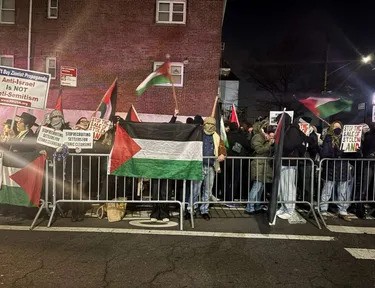
The episode has become an early and defining test for Mamdani, who assumed office just last week. As the VIN News report detailed, the rally—organized by the activist group Pal-Awda—targeted an Israeli real estate promotional event being hosted at the synagogue. Protesters chanted, “Say it loud, say it clear, we support Hamas here,” alongside “Death to the IDF” and the incendiary “Intifada people’s war.” These were not fringe murmurs but coordinated chants broadcast through megaphones, reverberating through a residential enclave home to many Jewish families.
SCANDAL: Pro-Palestine protesters gathered in a Jewish neighborhood in Queens and protested outside a yeshiva, chanting: “Say it loud, say it clear, we support Hamas here.”
Hamas is a U.S.-designated terrorist organization, responsible for mass murder, rape, and the slaughter of… pic.twitter.com/mkDyH6Zs2M
— Combat Antisemitism Movement (@CombatASemitism) January 9, 2026
Hamas, of course, is designated by the United States as a terrorist organization responsible for mass-casualty attacks against Israeli civilians, including suicide bombings, rocket barrages, and the October 7 massacre. Yet as the VIN News report noted, verbal expressions of support for such groups are protected under the First Amendment, creating a vexing tension between constitutional rights and communal safety.
Governor Hochul wasted no time in staking out her position. On Friday morning, she issued a blunt statement on social media, quoted by VIN News: “Hamas is a terrorist organization that calls for the genocide of Jews. No matter your political beliefs, this type of rhetoric is disgusting, it’s dangerous, and it has no place in New York.”
Her condemnation was not merely rhetorical. Hochul is preparing to unveil legislation establishing “safety zones” around houses of worship, requiring demonstrators to remain at least 25 feet from entrances. According to the information provided in the VIN News report, the proposal is designed to protect religious congregations from being enveloped in hostile protests, particularly when services, community events, or children’s programs are underway.
In doing so, Hochul has aligned herself firmly with Jewish community leaders who argue that the Kew Gardens Hills rally crossed the boundary from political protest into intimidation.
Mayor Mamdani, by contrast, offered no public comment Friday morning. His office did not respond to repeated inquiries, a silence that VIN News characterized as deafening given the gravity of the slogans being shouted under the watch of the NYPD.
Protesters in Queens: “Say It Loud, Say It Clear, We Support Hamas Here”
byu/McAlpineFusiliers innyc
The rally was the first major anti-Israel protest since Mamdani took office, and its timing has only intensified scrutiny. For Jewish leaders, the mayor’s reticence is not merely a communications lapse—it is a moral vacuum.
“This is not about whether people can criticize Israel,” one community advocate told VIN News. “This is about people chanting support for a genocidal terrorist organization outside a synagogue in a neighborhood full of children. Silence sends a message.”
According to the information contained in the VIN News report, the NYPD deployed heavily to the scene, erecting metal barricades and maintaining a buffer zone of roughly half a block between protesters and the synagogue entrance. Traffic was shut down, and officers separated demonstrators from counter-protesters—local residents waving Israeli and American flags, chanting patriotic slogans in defiance.
No arrests were made, and police reported no injuries. But the absence of physical harm belied the psychological toll.
New York State Assemblymember Sam Berger, who represents the area, told VIN News that the protest forced the early closure of after-school programs at a daycare and two elementary schools nearby.
“This is a residential neighborhood with a lot of young families,” Berger said. “People were genuinely worried about the safety of their children.”
For Sorolle Idels, founder of the Queens Jewish Alliance, the chants marked a turning point. Residents were urged to avoid the area during the demonstration. “We don’t welcome this kind of disturbance in a quiet community,” she said.
Pal-Awda insisted that the rally was aimed at Israeli real estate marketing, not the synagogue itself, which merely rented out its space for the event. Yet as VIN News has reported in past coverage, similar demonstrations have repeatedly been staged at or near Jewish religious institutions, even when congregations were not the organizers.
For many Jewish New Yorkers, this pattern feels deliberate. Synagogues are not corporate offices or political headquarters; they are sanctuaries—places of worship, learning, and refuge. When chants of “We support Hamas” echo off their walls, the symbolism is inescapable.
The Queens protest did not occur in a vacuum. VIN News has documented a disturbing surge in antisemitic incidents across the city. According to NYPD data released this week, Jews were the targets of 330 hate crimes in 2025—more than all other demographic groups combined.
This statistical reality has sharpened fears that hostile rhetoric, even when legally protected, is creating a climate in which Jewish New Yorkers feel increasingly besieged. Parents worry about sending their children to school; congregants think twice before attending evening services. What was once background noise has become a drumbeat of menace.
It is against this backdrop that the divergence between Hochul and Mamdani has assumed outsized significance. As the VIN News report emphasized, the governor’s condemnation was not merely a rebuke of one protest but a declaration of principle: that the glorification of terrorism has no place in New York’s civic discourse.
Mamdani’s silence, by contrast, has left many asking whether City Hall will draw similar red lines.
For a mayor just days into his tenure, the stakes could hardly be higher. The ability to balance civil liberties with the obligation to protect vulnerable communities is among the most delicate tasks in urban governance. Yet leadership is often defined less by policy detail than by moral clarity.
Hochul’s proposed safety zones have already sparked debate. Civil liberties advocates warn of potential First Amendment challenges, while Jewish organizations see them as a necessary shield against intimidation. VIN News reported that under the plan, demonstrations would still be permitted but would be required to maintain a buffer from religious entrances, ensuring that worshippers are not forced to pass through hostile crowds.
For residents of Kew Gardens Hills, such measures cannot come soon enough. The image of after-school programs shutting their doors because of a protest is one that has seared itself into the community’s consciousness.
New York has long prided itself on being a city where pluralism thrives—where Jews, Muslims, Christians, and people of every background coexist amid the cacophony of urban life. But pluralism is not sustained by tolerance alone; it depends on shared norms that reject the glorification of violence.
As the VIN News report observed, the Queens protest has forced a reckoning. Can a city that condemns hate crimes in the abstract remain silent when chants of “Death to the IDF” ring out in a Jewish neighborhood? Can leadership defer to constitutional abstractions when children are sent home from school for fear of their safety?
As Friday drew to a close, the mayor’s office still had not issued a statement. The void has become the story.
For Governor Hochul, the matter is settled: Hamas is a terrorist organization, and celebrating it is beyond the pale. For Mayor Mamdani, the question remains unresolved—at least publicly.
And so, one truth has become inescapable: in moments of communal crisis, silence is not neutral. It is a choice. Whether Mamdani’s choice will define his administration is a question New Yorkers are now asking with increasing urgency.

The silence is deafening. He needs to be recalled, pronto.
Is the zohran a communist Jew hater or a Jew hating communist? Hint: all of the above