



|
Getting your Trinity Audio player ready...
|
By: Arthur Popowitz – Jewish Voice News
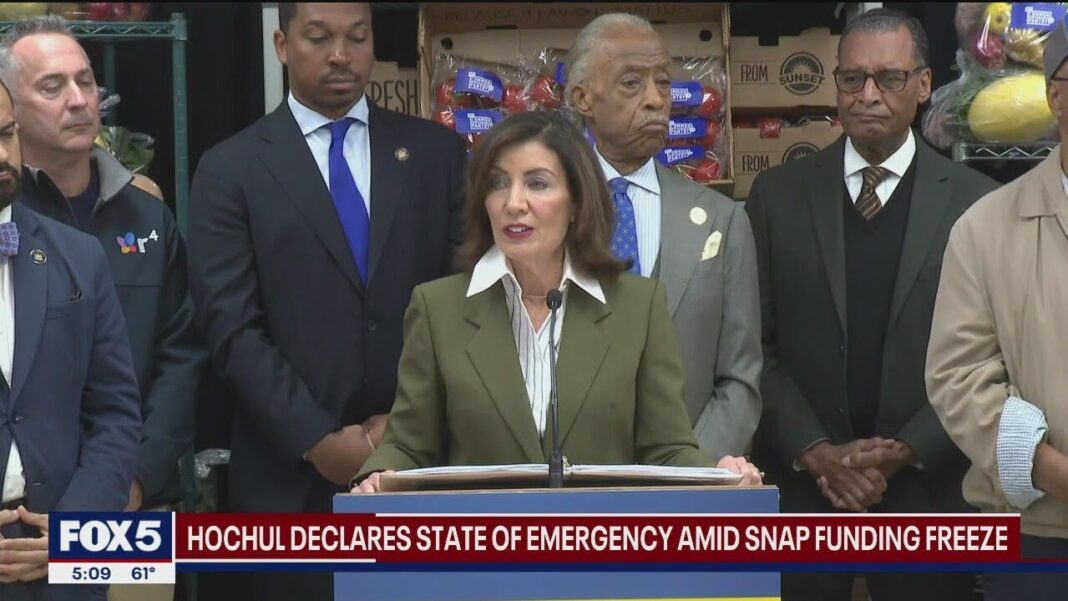
In a sweeping response to mounting hunger across New York State, Governor Kathy Hochul has declared a state of emergency and authorized $65 million in supplemental funding to sustain the state’s food supply chain amid the continuing federal government shutdown. The emergency action underscores the growing humanitarian crisis as federal Supplemental Nutrition Assistance Program (SNAP) benefits remain frozen for millions of Americans.
According to a report that appeared on Thursday at VIN News, Hochul’s emergency measure comes as November SNAP payments will not be issued, leaving an estimated 3 million New Yorkers—families, seniors, and children—without their primary source of food assistance. The governor’s order unlocks state reserves to fortify food banks and pantries statewide, enabling them to deliver an estimated 40 million meals to those in need over the next several weeks.
“This is not the time for politics—it’s the time for action,” Hochul said during her announcement at the New York State Emergency Operations Center in Albany. “No New Yorker should go hungry because Washington can’t do its job.”
As the VIN News report detailed, the federal shutdown—now entering its 30th day—has crippled essential social programs across the country. The shutdown, triggered by partisan gridlock in Congress, has left agencies such as the Department of Agriculture (which administers SNAP) without funding authority. As a result, SNAP payments, WIC benefits, and federal food procurement programs have come to a standstill.
In New York, the effects have been swift and severe. Families who rely on monthly SNAP distributions to purchase groceries have been left with nothing, while local food banks report surging demand.
“On a normal week, we serve about 600 families,” said a volunteer at a Brooklyn, who spoke to VIN News. “This week, it’s been closer to 1,800. The shelves are almost empty.”
The New York State Department of Social Services estimates that without the emergency allocation, food insecurity could have reached “unprecedented levels” by mid-November, especially in New York City, Buffalo, Rochester, and Syracuse, where the majority of SNAP recipients reside.
Governor Hochul’s executive order not only frees up $65 million in direct assistance but also mobilizes Empire State Service Corps and SUNY Corps members to aid distribution logistics, according to the VIN News report. The coordinated initiative will bolster food delivery systems, restock warehouses, and assist local nonprofits struggling to meet the explosion in demand.
“This is about dignity and survival,” Hochul emphasized, calling the move “a moral obligation to those who have been abandoned by Washington.”
Under the new framework, funds will be routed through the New York State Office of Temporary and Disability Assistance (OTDA), ensuring that both large-scale food networks and small community pantries receive immediate relief. The funding will complement an earlier $30 million emergency food aid package Hochul approved just two weeks ago—bringing the state’s total emergency food allocation to $95 million since the shutdown began.
As VIN News reported, the state’s food security plan has been hailed by local advocacy groups as a “lifeline” for millions of vulnerable residents. “Governor Hochul’s leadership has kept families afloat when the federal government has failed them,” said Leslie Gordon, CEO of Food Bank for New York City, in remarks to VIN News. “We’re talking about parents choosing between rent and groceries. This emergency funding means survival.”
While the governor’s declaration has earned praise from advocacy groups, it has also intensified political tensions between Albany and Washington. Hochul placed the blame squarely on the shoulders of President Trump and congressional Republicans, accusing them of “holding American families hostage in a reckless display of political brinkmanship.”
In remarks cited in the VIN News report, Hochul said, “We’ve been here before. When I approved emergency food aid earlier this month, it was because Washington was already failing to do its duty. But the cruelty of this shutdown—leaving children and seniors without food—is something we cannot accept.”
The governor’s language reflects a broader frustration shared by Democratic leaders across the state.
Senators Chuck Schumer and Kirsten Gillibrand, both of whom have been working to end the shutdown, joined Hochul in condemning congressional inaction. The two introduced the Keep SNAP and WIC Funded Act of 2025, emergency legislation that would ensure continued funding for food assistance programs during federal budget impasses.
In a joint statement, cited in the VIN News report, the senators said: “Families in New York—and across America—should not have to pay the price for Washington’s dysfunction. The Keep SNAP and WIC Funded Act will guarantee that food remains on the table, even when Congress fails to govern.”
The crisis has reverberated through neighborhoods already grappling with inflation and economic instability. Food prices in New York City have climbed nearly 18 percent since 2022, according to state data cited by VIN News, putting unprecedented strain on working-class families.
Local organizations report that many first-time visitors to food pantries are middle-income earners who have recently fallen below the poverty threshold due to rising costs.
“People who never thought they’d need help are now standing in line for groceries,” said David Greenfield, CEO of the Metropolitan Council on Jewish Poverty, in an interview with VIN News. “The ripple effects of this shutdown are not theoretical—they’re in the faces of mothers, children, and seniors who come to us hungry.”
The crisis has also hit Orthodox Jewish communities in Brooklyn and Rockland County particularly hard, where large families often depend on SNAP to supplement limited incomes. “These programs are not luxuries,” Greenfield said. “They are the difference between having food for Shabbos and going without.”
Beyond the immediate humanitarian concerns, economists warn that the prolonged suspension of federal food aid could have broader macroeconomic repercussions. As VIN News reported, the SNAP program injects billions of dollars annually into local economies, with every federal dollar generating up to $1.50 in economic activity through grocery purchases, supply chains, and small business revenues.
The loss of November’s federal payments could strip New York State alone of nearly $700 million in spending power, according to a recent analysis by the Center for Budget and Policy Priorities, cited in the VIN News report.
“This isn’t just a moral crisis—it’s an economic one,” said Dr. Irene Epstein, a professor of economics at SUNY Albany. “When low-income families can’t spend, businesses suffer, tax revenue drops, and local economies contract. The state’s emergency infusion of funds will help, but it’s a stopgap, not a solution.”
In a touching segment aired by VIN News, residents of Queens shared their stories of anxiety and uncertainty.
“I checked my account five times this week hoping my SNAP benefits would come through,” said Maribel Gonzalez, a mother of three from Jackson Heights. “There’s nothing. I don’t know how I’m going to buy milk or bread tomorrow.”
Her story is far from unique. At a food distribution site in the Bronx, volunteers said the demand has doubled since the start of the shutdown. “People are desperate,” said Rabbi Eli Goodman, who oversees a local Chabad food relief program. “We’re doing what we can, but the line keeps growing. We’re running out of supplies faster than we can restock them.”
Despite the mounting pressure, Governor Hochul struck a note of cautious optimism during her press conference, reaffirming the state’s resilience. “New Yorkers are tough,” she said, “but they should not have to prove it by going hungry.”
The governor pledged to continue working with federal partners, including Senators Schumer and Gillibrand, to push for immediate congressional action. In the meantime, her administration will monitor the emergency food network daily and make additional funding available “as needed.”
According to the information provided in the VIN News report, state agencies are also coordinating with religious charities and private donors to expand short-term meal programs during the crisis.
As the shutdown drags on, the story unfolding across New York is no longer just one of fiscal paralysis—it is one of moral urgency. In the face of federal dysfunction, the burden of compassion has fallen squarely on state shoulders.
The VIN News report described the moment as “a test of both leadership and humanity.” For millions of New Yorkers now dependent on emergency food lines instead of federal benefits, the test is deeply personal.
In the words of Governor Hochul: “When Washington forgets its people, New York remembers them.”
With the state of emergency declared, $65 million deployed, and food banks racing against time, New York stands as both a refuge and a reminder—that even in political darkness, leadership can still provide light.