



|
Getting your Trinity Audio player ready...
|
By: Jason Ostedder
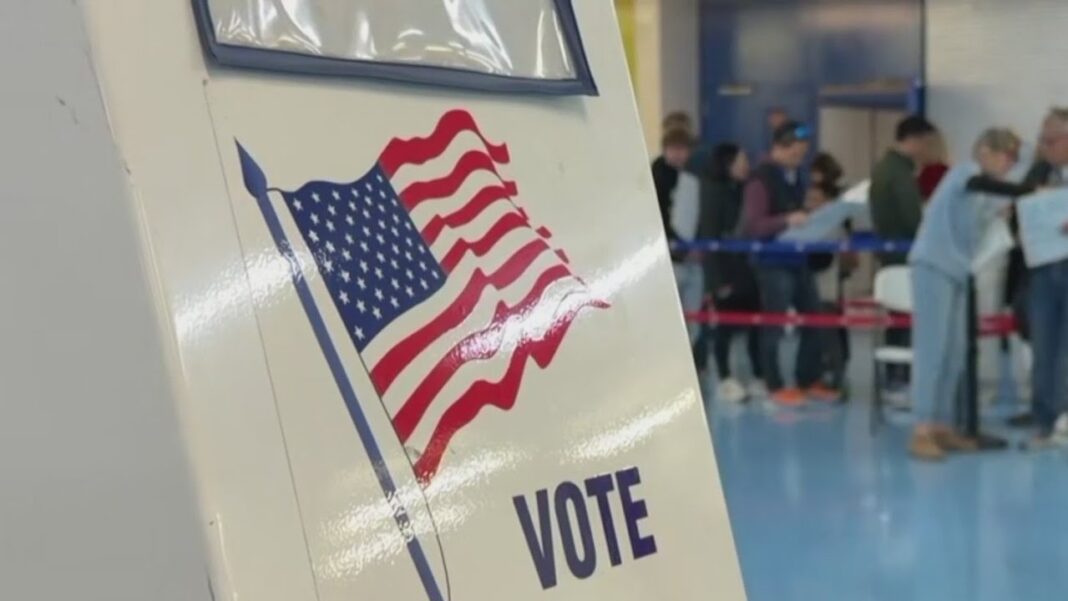
As New York City prepares for Election Day, a stunning surge in early voting has set the stage for what a report in The New York Daily News described as one of the most consequential and closely watched mayoral contests in decades. According to official figures released by the Board of Elections on Sunday evening, more than 735,000 New Yorkers cast their ballots during the nine-day early voting period that began on October 25 — a figure that could signal record-breaking participation once the final votes are tallied.
When early voting centers closed at 5 p.m. Sunday, the Daily News reported that New Yorkers had turned out in droves, surpassing expectations and injecting a renewed sense of civic engagement into a city that has often struggled with voter apathy in local elections. In addition to the 735,317 early ballots, tens of thousands of absentee votes had already been received, ensuring that total participation could climb well beyond traditional levels.
“It definitely looks like it’s going to be way over a million and a half at least,” said Jerry Skurnik, a veteran New York election analyst quoted in The New York Daily News report. Skurnik added that turnout could even surpass two million, a milestone not seen since the mid-20th century.
If that prediction bears out, the 2025 mayoral election could rival — or even exceed — the legendary 1965 race, when 2.6 million New Yorkers turned out to elect the youthful reformer John Lindsay as mayor after three-term incumbent Robert Wagner chose not to seek reelection. The parallels between that pivotal moment and the current contest have not escaped observers: once again, an incumbent has stepped aside, leaving an open field that has electrified the city’s political imagination.
The absence of Mayor Eric Adams from the race has created a political vacuum that few could have predicted a year ago. His abrupt withdrawal in September — following weeks of mounting legal trouble and dismal polling numbers amid a federal corruption probe — altered the trajectory of the race overnight.
The New York Daily News report noted that Adams’ decision not only reshuffled the electoral deck but also catalyzed a surge of new energy among voters seeking a clean break from scandal and stagnation. Into that vacuum stepped Zohran Mamdani, Andrew Cuomo, and Curtis Sliwa — three figures representing distinct, even clashing, visions for the city’s future.
At just 34 years old, Zohran Mamdani, the Democratic nominee and state Assembly member from Queens, stands at the center of the political maelstrom. Should he prevail, he would become the youngest mayor in modern city history, as well as the first Muslim to hold the office. His rise has been as meteoric as it is controversial.
As The New York Daily News has chronicled, Mamdani’s campaign has ignited both fervent enthusiasm and fierce opposition. A self-described democratic socialist, he has championed an unapologetically progressive platform: free public buses, a freeze on rent-stabilized leases, massive childcare subsidies, and a tax overhaul targeting corporations and the wealthy to pay for these ambitious initiatives.
Mamdani’s populist message has resonated strongly with younger voters and working-class New Yorkers, many of whom see him as the embodiment of a generational and ideological shift. Yet, as the Daily News has repeatedly pointed out, his critics warn that his proposals could drive away businesses, exacerbate fiscal instability, and plunge the city into economic uncertainty.
He has also generated headlines for his outspoken animus towards Israel and his barely cloaked anti-Semitic posture which has created enormous concern amongst the city’s Jewish voters and political moderates.
Standing opposite him is Andrew Cuomo, the former governor who resigned in 2021 amid sexual harassment and misconduct allegations that he continues to deny. Cuomo, a consummate political operator, has sought to recast himself as a stabilizing centrist alternative to Mamdani’s out-of-control radicalism.
The New York Daily News has detailed Cuomo’s attempts to position his campaign as a pragmatic counterbalance — promising to lower living costs through expanded housing development and targeted transit subsidies, but without what he derides as Mamdani’s “tax-and-spend utopianism.”
For Cuomo, the race is as much about redemption as policy. His reemergence has captivated political analysts and divided voters — some viewing him as a proven, if tarnished, executive; others as a relic of an old political order attempting an improbable comeback.
The third major contender, Curtis Sliwa, the Republican nominee and founder of the Guardian Angels, has played his familiar role as populist outsider. According to The New York Daily News report. Sliwa has framed both Mamdani and Cuomo as creatures of the Democratic machine — arguing that only a Republican administration could restore law, order, and fiscal discipline to the five boroughs.
Yet despite his impassioned rhetoric, Sliwa has consistently polled in third place. His campaign, though spirited, faces the daunting task of rallying an electorate that has trended overwhelmingly Democratic for decades.
“This is a race of contrasts — in ideology, in temperament, in worldview,” Lee Miringoff, director of the Marist Institute for Public Opinion, told The New York Daily News. “You have three candidates tapping into three very different elements of the city. It’s not similar candidates with similar messages. You have different messages, different ages, different religions even.”
Indeed, the race has become a mirror reflecting New York’s vast diversity and deep divisions. The Daily News has reported extensively on how each candidate’s identity — whether Mamdani’s Muslim faith, Cuomo’s Italian Catholic heritage, or Sliwa’s working-class populism — has subtly shaped the campaign narrative and voter outreach strategies.
Adding further drama to the race has been President Trump’s open intervention, warning that a Mamdani victory could trigger “punitive measures” against the city, including potential cuts to federal funding. The Daily News report noted that Trump’s remarks — unprecedented in their directness — have intensified the national spotlight on the contest, effectively transforming a local election into a referendum on the political soul of the nation’s largest city.
Behind the ideological theatrics lies a torrent of money. The New York Daily News has detailed how corporate leaders and billionaire donors have poured tens of millions of dollars into super PACs backing Cuomo, seeking to blunt Mamdani’s insurgent momentum.
One of the most aggressive of these groups, Defend NYC, spent over $1 million in the final week of early voting on targeted text-message blasts aimed at Republican voters — urging them to abandon Sliwa and instead rally behind Cuomo as the most viable “anti-Mamdani” choice. The move underscored just how much the city’s economic elite fears a Mamdani administration.
Cuomo, for his part, has leaned into this support while maintaining a careful rhetorical distance, insisting he remains independent of “special interests.” Mamdani has fired back relentlessly, accusing his rival of being “the candidate of billionaires,” and warning that corporate money will once again “buy” New York politics if Cuomo prevails.
If there is one factor uniting all factions, it is the sheer magnitude of voter participation. According to The New York Daily News report, Sunday — the final day of early voting — saw 151,212 ballots cast, the single largest daily total in the early voting period.
Election officials and political analysts alike have attributed the turnout surge to a confluence of factors: the absence of an incumbent, the ideological diversity of the candidates, and the extraordinary media attention generated by both local and national coverage.
For many New Yorkers, the 2025 race represents more than a contest of personalities — it is a test of the city’s resilience, its values, and its willingness to redefine what kind of metropolis it wants to become in the post-pandemic era.
The Daily News has drawn frequent comparisons between this year’s race and the 1965 election that brought John Lindsay to power. Both moments, analysts say, reflect inflection points when the electorate demanded transformation amid uncertainty.
Just as Lindsay symbolized a new urban liberalism that reshaped the city’s governance for a generation, Mamdani’s supporters believe he could herald a new progressive era built around social equity, climate justice, and expanded public investment. Cuomo’s backers counter that his return would mark a reaffirmation of competence and moderation in an era of political extremes.
Meanwhile, Sliwa’s presence, though marginal in polling, ensures the race retains a populist flavor — a reminder that a significant portion of the electorate remains skeptical of both establishment and left-wing politics.
As polling places prepare to reopen for Election Day, the New York Daily News reported a palpable sense of anticipation across the five boroughs. Lines are expected to be long, turnout heavy, and tensions high.
Observers note that the outcome could hinge on neighborhoods with historically low turnout — places like the Bronx’s Soundview, Brooklyn’s East Flatbush, and Staten Island’s North Shore — where grassroots enthusiasm for Mamdani or late-breaking support for Cuomo could tilt the balance.
Whichever candidate triumphs, historians are already framing 2025 as a defining political moment — one that will likely shape New York’s civic and economic direction for a generation.
In the final analysis, The New York Daily News has captured the essence of this year’s mayoral race: a city caught between competing visions of its identity and destiny. Is New York prepared to embrace a bold experiment in progressive governance under Zohran Mamdani? Will it seek stability and seasoned leadership through Andrew Cuomo’s return to public life? Or will a restless electorate once again surprise the pundits, as it so often does?
Whatever the verdict, the surge in early voting suggests one undeniable truth — New Yorkers have reawakened to the power of participation. In a metropolis that has weathered crisis after crisis, this election stands as a vivid reaffirmation of democracy itself: noisy, contested, unpredictable, and profoundly alive.
As the New York Daily News report observed, “New York may be divided in vision, but united in purpose — to decide its own fate, loudly and together.”
That, in the end, may be the most powerful headline of all.
 |
|