



|
Getting your Trinity Audio player ready...
|
By: Julie Herndon
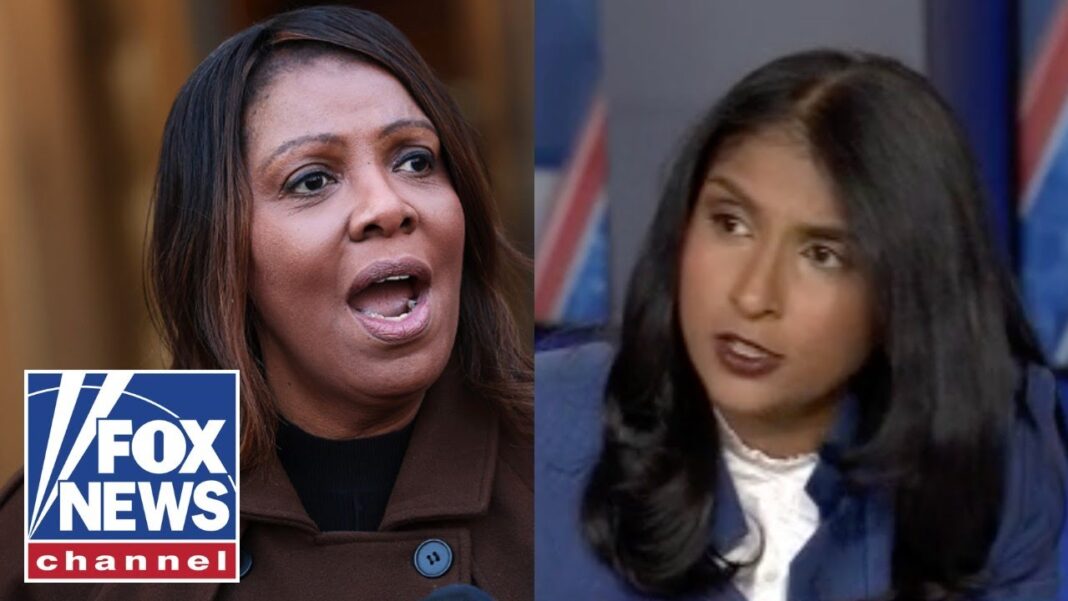
In a political landscape long dominated by Democratic power, a new Republican contender is attempting to chart an improbable path to statewide victory. Saritha Komatireddy, a former federal prosecutor and relative newcomer to electoral politics, has emerged as the GOP’s nominee for New York State Attorney General, positioning herself as a law-and-order alternative to incumbent Letitia James.
In an interview that appeared in The New York Post on Tuesday, Komatireddy outlined a campaign built on a central premise: that New Yorkers, regardless of political affiliation, are increasingly frustrated with what she describes as a growing climate of disorder, lack of accountability, and politicized law enforcement.
“These things affect innocent people. They affect everyday New Yorkers,” Komatireddy said. “And I think New Yorkers across the political spectrum just are tired of the lawlessness.”
Her candidacy, while facing steep structural and political obstacles, represents a broader Republican effort to regain relevance in a state where the party has struggled to secure statewide office for more than two decades.
Komatireddy’s entry into the race is rooted in a career defined by public service and legal rigor. A native New Yorker and daughter of Indian immigrants who settled in Coney Island in the 1980s, she describes her path as one shaped by both personal experience and national tragedy.
The attacks of September 11, 2001, served as a turning point. Motivated by the events, she pursued a career in law enforcement, eventually earning a law degree from Harvard Law School. She later clerked for Brett Kavanaugh during his tenure on the United States Court of Appeals for the District of Columbia Circuit.
Her professional trajectory took her into the Eastern District of New York, where she prosecuted cases involving terrorism and narcotics trafficking. According to The New York Post report, her work included cases against operatives linked to Al Qaeda and ISIS, as well as drug-related prosecutions tied to broader criminal networks.
In 2020, she was nominated by then-President Donald Trump for a federal judgeship, though the nomination did not advance before the end of his term. She has since built a career in private practice and currently serves as a partner at a prominent law firm. Now, she seeks to translate her legal experience into political capital in one of the nation’s most challenging electoral environments for Republicans.
At the core of Komatireddy’s campaign is a promise to restore what she characterizes as a more traditional prosecutorial focus: pursuing crimes rather than political figures. This distinction is central to her critique of Letitia James, whom she accuses of using the office of the attorney general to pursue partisan objectives.
“That was wrong. Real prosecutors, they don’t target people. They target crimes,” Komatireddy said, referencing James’ legal actions against Donald Trump during his time out of office.
The critique aligns with broader Republican narratives that have framed James’ tenure as overly political. As The New York Post has reported, James has played a prominent role in numerous lawsuits involving Trump, including cases tied to financial practices and public policy disputes.
Komatireddy, however, has been careful to present her own approach as nonpartisan. She has emphasized that, if elected, she would not make decisions based on political considerations, including in cases involving federal authorities. “I would rule out making decisions based on politics,” she said. “I’m not going to have a knee-jerk partisan reaction to anything.”
Komatireddy’s campaign also places significant emphasis on public safety, particularly in urban environments where concerns about crime and disorder have become increasingly prominent. She argues that policies she describes as “soft-on-crime” have contributed to a deterioration in quality of life, affecting everything from public transportation to housing facilities.
Among her proposed priorities is a more aggressive approach to drug-related offenses, as well as a renewed focus on combating antisemitism and ensuring safety in public spaces such as homeless shelters. “We have to make sure that the people taking taxpayer money to provide services are actually providing those services,” she said, pointing to what she views as systemic inefficiencies and potential abuses within state-funded programs.
Her plan includes auditing homeless shelters across the state to assess their effectiveness and ensure accountability. According to The New York Post report, she believes such measures could identify both successful programs and areas requiring reform.
Beyond specific policy proposals, Komatireddy has framed her candidacy as a broader challenge to what she describes as the consequences of one-party dominance in New York politics.
With Democrats holding a significant majority of registered voters—48 percent compared to 22 percent for Republicans—the structural imbalance presents a formidable barrier. An additional 25 percent of voters are unaffiliated, representing a potential determining bloc.
Komatireddy argues that prolonged one-party control has led to insufficient oversight and a lack of meaningful checks and balances. “Everyone in an official position is friends with everyone else, and no one’s really a check,” she said, suggesting that this dynamic has contributed to issues such as fraud in Medicaid and inefficiencies in nonprofit-driven social services.
Her campaign seeks to appeal not only to traditional Republican voters but also to independents and disaffected Democrats who may be receptive to a message centered on accountability and governance.
Letitia James, who assumed office in 2019 following the resignation of Eric Schneiderman, remains a formidable opponent. A prominent figure within the progressive wing of the Democratic Party, she has built a national profile through her legal challenges to both corporate entities and federal policies.
As The New York Post report noted, James has been involved in dozens of lawsuits during the first year of Trump’s second term, including efforts to restore federal funding for major infrastructure projects such as the Gateway Tunnel and the Second Avenue Subway.
Her tenure has been marked by a willingness to engage in high-profile legal battles, a strategy that has earned both praise from supporters and criticism from opponents.
Komatireddy’s candidacy faces significant historical headwinds. No Republican has held the office of New York State Attorney General since Dennis Vacco left office in 1998. Moreover, the last time a Republican won a statewide election in New York was in 2002, when George Pataki secured a third term as governor.
These statistics underscore the difficulty of the task ahead. Yet Komatireddy remains optimistic, arguing that her message has the potential to resonate across party lines. “I’m confident having a message of safety and community should resonate enough,” she said, according to The New York Post report.
Her confidence is bolstered by recent developments within the Republican Party, including her selection as the nominee following the withdrawal of a previous candidate. She secured the nomination after defeating another contender at the party’s convention on Long Island.
The race for attorney general is unfolding within a broader context of political polarization, both at the state and national levels. Issues such as crime, public safety, and the role of government have become central points of debate, with sharply contrasting visions offered by the two major parties.
Komatireddy’s campaign seeks to position itself as a pragmatic alternative, emphasizing professional experience and a commitment to impartial enforcement of the law. At the same time, her critiques of the incumbent reflect the broader ideological divides that characterize contemporary politics.
The challenge lies in bridging these divides sufficiently to build a coalition capable of overcoming the Democratic advantage.
As the campaign progresses toward November, both candidates are expected to intensify their efforts to define the race and mobilize their respective bases. For Komatireddy, this will involve expanding her visibility and articulating a compelling vision for the office. For James, the focus will likely remain on her record and the achievements of her tenure, as well as her alignment with broader Democratic priorities.
The outcome of the race will not only determine the leadership of the attorney general’s office but also serve as an indicator of the political dynamics shaping New York State.
The contest between Saritha Komatireddy and Letitia James represents a clash of contrasting philosophies, backgrounds, and visions for governance. On one side stands an experienced incumbent with a national profile; on the other, a newcomer seeking to disrupt the status quo.
As chronicled by The New York Post, the race encapsulates broader questions about law enforcement, political accountability, and the role of the attorney general in a highly charged political environment. Whether Komatireddy can translate her message into electoral success remains uncertain. What is clear, however, is that her candidacy has introduced a new dimension to the race—one that reflects both the challenges and the possibilities of political competition in a deeply entrenched landscape.
In the months ahead, New Yorkers will be asked to weigh these competing visions, deciding not only who will lead the state’s top legal office but also what direction that office should take in an era of profound change.
