



|
Getting your Trinity Audio player ready...
|
Giuliani’s Endorsement of Anthony Constantino in High-Stakes NY Congressional Race Speaks Volumes
By: Fern Sidman
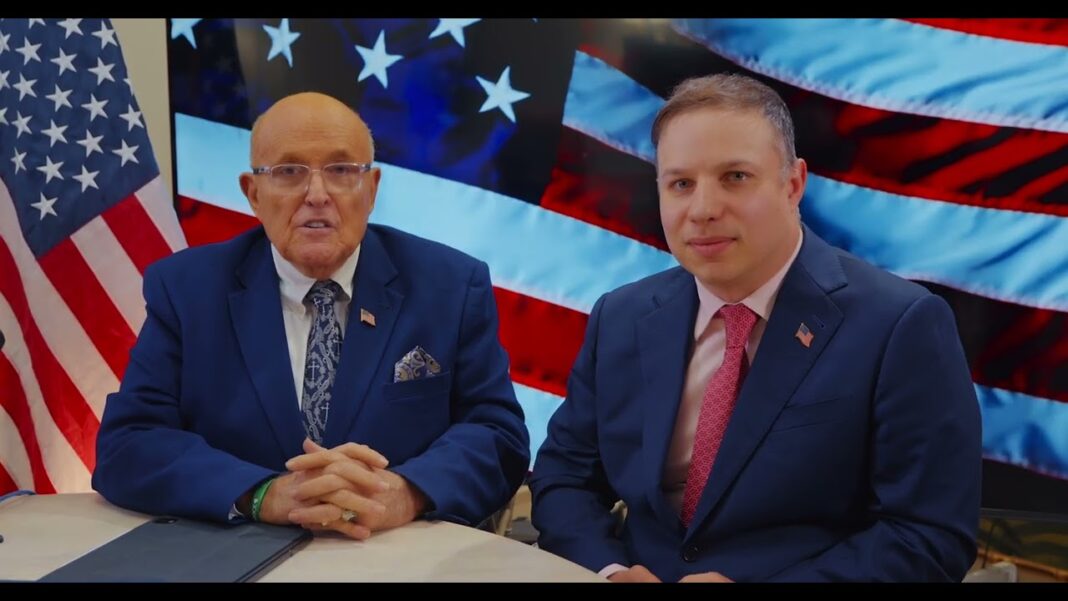
In the increasingly volatile and ideologically charged landscape of American politics, few developments capture the intersection of personality, populism, and party realignment as vividly as the emergence of a political outsider buoyed by the endorsement of a well-respected national figure. Such is the case in New York’s 21st congressional district, where business executive Anthony Constantino— a political neophyte—has vaulted into the spotlight following a high-profile endorsement from former New York City mayor and longtime ally of President Donald Trump, Rudy Giuliani.
The endorsement, delivered via a recorded video statement and widely disseminated across digital platforms, represents more than a routine gesture of political support. It signals a deliberate attempt to reshape the contours of the Republican primary contest, positioning Constantino as the standard-bearer of a distinctly populist and pro-Trump faction within the party, even as more established figures consolidate institutional backing.
Anthony Constantino, best known as the chief executive of Sticker Mule, enters the race as a political newcomer but also as a seasoned and highly successful entrepreneur. His candidacy reflects a broader trend in American politics, wherein individuals from the private sector leverage business credentials as a proxy for leadership capability, often presenting themselves as pragmatic problem-solvers unencumbered by the compromises of career politicians.
In his endorsement, Giuliani emphasized precisely these qualities, extolling Constantino’s success in business and his complete independence from entrenched interests. “America needs 100 Constantinos,” Giuliani declared, framing the candidate as a figure uniquely positioned to resist the influence of special interests by virtue of his self-funded campaign.
This emphasis on financial independence is a recurring motif in contemporary political rhetoric, particularly within populist circles. By eschewing traditional fundraising mechanisms, candidates such as Constantino project an image of authenticity and autonomy, appealing to voters disillusioned with a system dominated by moneyed interests and partisan orthodoxy.
Rudy Giuliani’s endorsement carries both symbolic and strategic weight. Once celebrated as “America’s mayor” in the aftermath of the September 11 attacks, Giuliani is now closely associated with President Trump and the broader movement that has reshaped the Republican Party over the past decade.
His decision to back Constantino is not merely an expression of personal affinity but a calculated intervention in a competitive primary race. By invoking his longstanding relationship with Trump and drawing parallels between Constantino and the former president, Giuliani seeks to anchor the candidate firmly within the ideological framework of the MAGA movement.
Indeed, Giuliani explicitly likened Constantino to Trump, highlighting qualities such as entrepreneurial success, outsider status, and a purported willingness to challenge established norms. This comparison is likely intended to resonate with a segment of the electorate that remains deeply loyal to Trump and receptive to candidates who embody his political ethos.
Constantino’s principal rival in the Republican primary, Assembly Member Robert Smullen, represents a markedly different archetype. A seasoned legislator with deep ties to local party structures, Smullen has secured endorsements from the New York Republican Party as well as multiple county committees across the district.
This divergence in support underscores a broader tension within the Republican Party: the interplay between grassroots populism and institutional conservatism. While Smullen’s endorsements reflect traditional mechanisms of party organization and discipline, Constantino’s campaign draws strength from its alignment with national figures and its appeal to voters seeking real reform rather than continuity.
The contrast is further accentuated by the geographic and demographic characteristics of New York’s 21st district, a sprawling region encompassing rural communities, small cities, and pockets of suburban development in upstate New York. The district’s electorate is diverse in its priorities, balancing concerns about economic opportunity, public services, and cultural identity.
In this context, the primary contest becomes not merely a selection but a referendum on the direction of the party itself: whether it will continue to prioritize experience and institutional support, or embrace a more insurgent, personality-driven approach.
In his endorsement remarks, Giuliani invoked the legacy of Ronald Reagan, describing the former president as his political hero and a guiding influence during his tenure as mayor of New York City. This reference serves to situate the current contest within a broader historical narrative, linking the present moment to an era that is defined as a time of clarity, strength, and ideological coherence.
The invocation of Reagan also reflects a strategic effort to bridge generational divides within the party, appealing to older voters who recall the Reagan era with fondness while simultaneously reinforcing themes of leadership and vision.
Constantino himself echoed this sentiment, identifying Trump as his own political inspiration. This alignment with both Reagan and Trump—figures who, despite their differences, share a reputation for transformative leadership—suggests an attempt to synthesize disparate strands of conservative identity into a cohesive campaign narrative.
The circumstances surrounding the endorsement also highlight the evolving role of media in contemporary political campaigns. Giuliani’s support for Constantino followed an appearance by the candidate on his nightly talk show, which streams on social media platforms rather than traditional broadcast channels.
This mode of engagement reflects a broader shift toward decentralized, digital-first campaigning, where candidates can bypass conventional gatekeepers and communicate directly with voters. The viral nature of such content amplifies its impact, enabling endorsements to reach a wide audience with unprecedented speed.
For Constantino, this approach offers a means of compensating for his lack of institutional backing, leveraging visibility and narrative control to build momentum.
The race to succeed Representative Elise Stefanik adds an additional layer of significance to the contest. Stefanik, a prominent figure within the Republican Party, has played a key role in shaping its contemporary identity, particularly in her alignment with Trump and her advocacy on issues ranging from national security to addressing rampant antisemitism in higher education.
Giuliani’s praise for Stefanik underscores the importance of the seat, framing it as a continuation of a legacy that has national implications. The choice of her successor, therefore, carries weight beyond the border of the district, influencing the balance of power and the ideological trajectory of the party in Congress.
As the primary race unfolds, both Constantino and Smullen face distinct challenges and opportunities. For Constantino, the task is to translate the energy generated by Giuliani’s endorsement into tangible support among voters, building a coalition that extends beyond the core base of the MAGA movement.
The outcome remains uncertain, shaped by factors ranging from campaign strategy and voter turnout to the broader national political climate. What is clear, however, is that the contest has already become a microcosm of the strong reshaping of American politics.
