



|
Getting your Trinity Audio player ready...
|
By: Arthur Popowitz
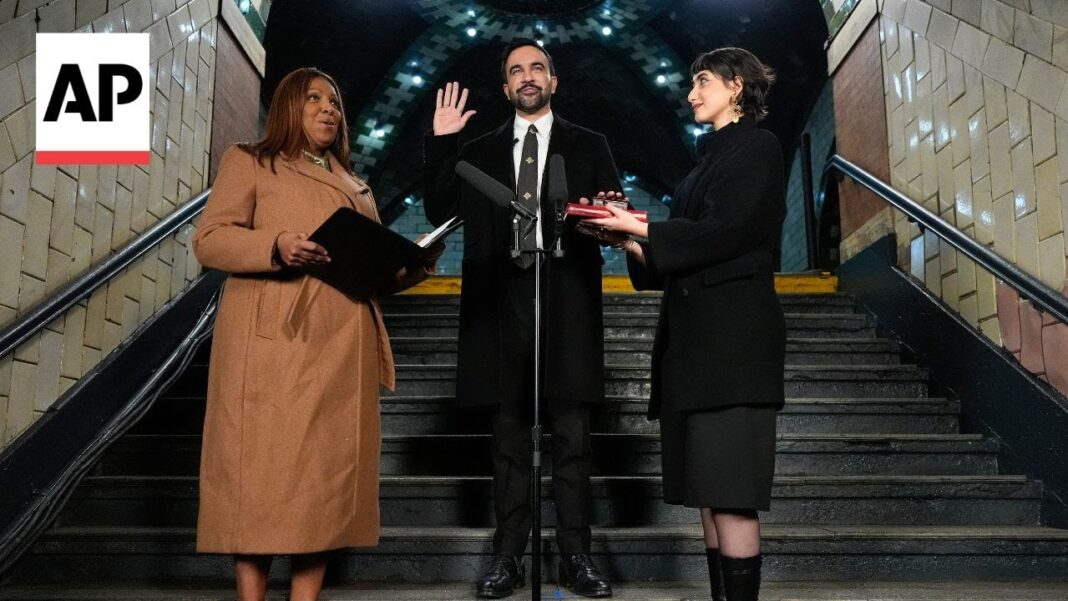
As the final seconds of 2025 evaporated into the subterranean darkness beneath Lower Manhattan, a scene unfolded that even veteran New York watchers could scarcely have imagined. In the cavernous, shuttered chambers of the Old City Hall subway station—once the crown jewel of the original IRT line—Zohran Mamdani raised his right hand, placed his left on a Quran and became the 112th mayor of New York City.
CBS News, which first reported the details of the clandestine ceremony, described a moment that was at once cinematic and historically charged: a 34-year-old democratic socialist, born to immigrant parents, sworn in by Attorney General Letitia James in a station sealed off from daily commuters for nearly eight decades. With the echo of distant trains rumbling through the active tunnels nearby, Mamdani officially assumed the most powerful municipal office in the United States.
“This is truly the honor and the privilege of a lifetime,” Mamdani said in brief remarks carried by CBS News New York, adding that the abandoned station was “a testament to the importance of public transit to the vitality, the health, and the legacy of our city.”
The report at CBS News emphasized that Mamdani’s inauguration marks several unprecedented milestones. He is the youngest mayor New York City has had in more than a century, the first Muslim to hold the post, and the first mayor of South Asian descent. Just four years ago, Mamdani was a first-term state assemblyman representing Astoria in Queens. Now, he occupies the office once held by legends such as Fiorello La Guardia, John Lindsay, Ed Koch, and Michael Bloomberg.
His rapid ascent—from grassroots organizer to Albany legislator to City Hall executive—has become a case study in modern political mobilization. The CBS News report noted that Mamdani’s campaign was powered by volunteers rather than consultants, with a shoestring budget amplified through social media, community organizing, and a populist message focused on affordability, housing security, and mass transit reform.
The Old City Hall subway station, hidden beneath the civic buildings of Lower Manhattan, has long been a forgotten marvel: vaulted Guastavino tiles, brass chandeliers, and skylights that once filtered sunlight onto marble platforms. CBS News called it “one of the most beautiful spaces most New Yorkers will never see.”
For Mamdani, the choice was not mere theatrics. It was a political thesis rendered in architecture.
“He sees transit as the bloodstream of the city,” said one transition official, speaking to CBS News. “This is his way of saying: before we talk about luxury towers or corporate headquarters, we need to talk about how people actually move.”
Within minutes of taking the oath, Mamdani announced his first major appointment: Mike Flynn as commissioner of the Department of Transportation.
CBS News reported that Flynn’s appointment is widely interpreted as the opening salvo in Mamdani’s war on what he has termed “transport inequality.” Flynn, a veteran of both public and private sector transportation planning, brings more than two decades of experience to the role.
According to CBS News, Flynn previously served for nearly a decade inside the Department of Transportation, including stints as Director of Capital Planning and Project Initiation, where he oversaw major street redesigns, safety upgrades, and bus-priority corridors. Most recently, he worked as vice president and sector manager at TYLin City Solutions, leading multidisciplinary teams tackling urban mobility challenges across the metropolitan region.
In a statement quoted by CBS News, Flynn said: “Transportation is essential to affordability and quality of life. It determines how people get to work, school, and home safely. I look forward to building a DOT that moves faster, puts safety first, and delivers real wins for working New Yorkers.”
Transportation experts quickly lined up behind the appointment. The Regional Plan Association applauded the choice, with executive vice president Kate Slevin telling CBS News that Flynn is “a well-respected expert and leader in city transportation policy.” Former DOT commissioner Janette Sadik-Khan added that Flynn “knows the agency, the city, and its streets from the inside out.”
While the midnight swearing-in was deliberately intimate, CBS News New York confirmed that Mamdani’s public inauguration will unfold in full daylight on Thursday afternoon. At 1 p.m., on the steps of City Hall, he will take the oath again—this time administered by Sen. Bernie Sanders of Vermont, a political mentor and ideological lodestar.
A broader block-party celebration running from 11 a.m. to 3 p.m. along Broadway’s Canyon of Heroes, from Liberty Street to Murray Street will take place. The route, synonymous with ticker-tape parades for returning astronauts, championship athletes, and wartime heroes, will be transformed into what Mamdani’s team has branded “The Inauguration of a New Era.”
CBS News reported that Mamdani wasted no time staffing his administration. In the 48 hours leading up to the swearing-in, he named five high-ranking officials, including Kamar Samuels as chancellor of New York City schools.
Insiders say the mayor’s breakneck pace is intentional. “He’s signaling that the campaign is over and governance has begun,” one aide told CBS News. “Every appointment is a statement about priorities.”
Among those priorities: free bus service, expanded bike lanes, congestion-pricing reinvestment, and a complete overhaul of how street space is allocated.
At the heart of Mamdani’s platform is a radical redefinition of what city government owes its residents. CBS News has consistently highlighted his proposal for fare-free buses, which he frames not as a perk but as a public good akin to libraries or public schools.
In his midnight remarks, Mamdani called on New Yorkers to imagine a city where “movement is not a privilege but a right.”
Under Flynn’s leadership, the DOT is expected to accelerate bus-priority corridors, reconfigure dangerous intersections, and fast-track capital projects long stuck in bureaucratic limbo.
CBS News observed that Mamdani’s ascent has become a national story. Media outlets from London to Lahore have covered the phenomenon of a Muslim democratic socialist now governing America’s largest city.
Supporters see him as a harbinger of a new urban politics—one that rejects corporate capture and prioritizes the working class. Skeptics question whether his ideas can survive the brutal arithmetic of budgets, unions, and Albany politics.
But in the quiet of the Old City Hall station, those debates momentarily receded. For a few minutes, it was simply a man, a promise, and a city waiting above ground.
CBS News noted that Mamdani’s choice of venue also invoked a lineage of New York mayors who used symbolism to define their eras: La Guardia reading comics to children during a newspaper strike, Bloomberg biking across the Brooklyn Bridge, de Blasio dancing at Gracie Mansion.
Mamdani’s statement is subterranean but expansive: New York’s future will be built not only in boardrooms and council chambers, but in the hidden arteries beneath its streets.
One thing is already clear: the age of quiet transitions at City Hall has ended. The Mamdani era began not in a ballroom or a courtroom, but on forgotten tracks—where the city once dreamed its biggest dreams.