



|
Getting your Trinity Audio player ready...
|
By: Jeff Gorman
When Mayor-elect Zohran Mamdani strode before cameras on Tuesday to unveil the latest additions to his incoming administration, he framed the moment as a declaration of values: a recommitment to what he called “the rule-of-law” as the fulcrum of governance in a city long burdened by inequality and institutional mistrust. Yet within minutes of the announcement, the reaction from political insiders, civic watchdogs and community leaders made clear that Mamdani’s appointments were less a routine staffing decision than a lightning rod.
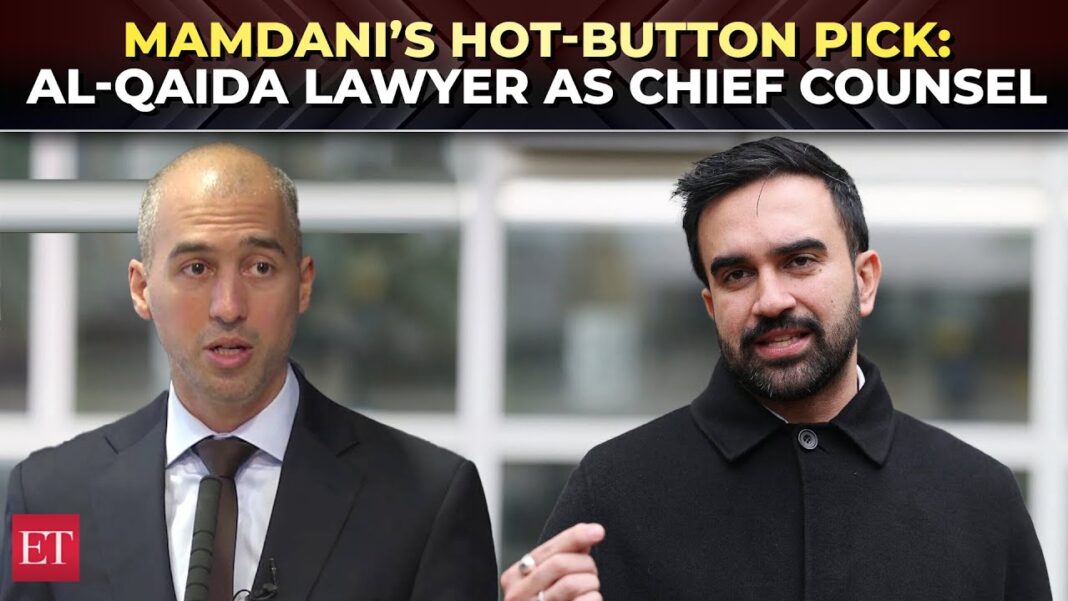
As reported by The New York Post on Tuesday, Mamdani named two highly polarizing figures to some of the most powerful legal positions in City Hall: Steven Banks, a veteran “social justice attorney” and former top aide in the de Blasio administration, to serve as corporation counsel, and Ramzi Kassem, a City University of New York law professor and former Biden policy adviser, to become the mayor’s chief counsel.
The choices, celebrated by Mamdani as proof that his administration will “employ the law as a critical tool in the fight for working people,” have instead ignited a fierce debate over whether New York City is about to entrust its legal apparatus to ideologues whose past records raise profound questions about judgment, priorities, and the city’s relationship with the rule of law itself.
Steven Banks is no stranger to City Hall. As The New York Post has chronicled over the years, his fingerprints are all over the social-policy architecture of the Bill de Blasio era. He previously served as commissioner of the Department of Social Services and head of the city’s homeless services apparatus, a period marked by ballooning costs, persistent shelter scandals and — according to multiple audits — a culture of lax oversight.
Banks, who bills himself on LinkedIn as a “public interest social justice attorney,” spent much of his four-decade legal career at the Legal Aid Society. There, he was instrumental in shaping and expanding the city’s controversial “right to shelter” framework, a policy that guarantees every unhoused individual a bed — a noble aim in theory, but one that critics argue has metastasized into a fiscal and logistical nightmare.
The New York Post notes that Banks later reprised this role during the Adams administration, joining Legal Aid in a 2024 lawsuit that fought efforts by Mayor Eric Adams to roll back elements of the shelter mandate in order to address the spiraling migrant crisis. For Mamdani’s supporters, that record proves Banks’ commitment to the vulnerable. For his critics, it underscores an unwillingness to acknowledge that the policies he helped design have strained the city’s finances to the breaking point.
Outgoing Queens Councilman Robert Holden, a moderate Democrat, minced no words when asked about the appointment. As quoted in the New York Post, Holden warned that Banks’ tenure as corporation counsel “would be a disaster, but not a surprise,” adding: “He didn’t just have a hand in these policies, he helped design them. The architects of the failed de Blasio era are back for more certain failures.”
Holden’s warning is not hyperbolic. During Banks’ stewardship of the Department of Social Services, an audit by then-Comptroller Scott Stringer found egregious misspending at a nonprofit shelter partner. Residents were subjected to squalid conditions, while bloated administrative costs flowed unchecked. The New York Post has repeatedly highlighted these findings as emblematic of a system more attuned to bureaucratic self-preservation than to the people it was meant to serve.
Yet Mamdani appears undeterred by this history. His embrace of Banks is part of a broader resurrection of de Blasio alumni, including incoming First Deputy Mayor Dean Fuleihan, Office of Budget Management director Sherif Soliman, and intergovernmental affairs chief Jahmila Edwards. To critics, it signals not a new era but a regression — a reassembly of the very team whose policies left New York with a housing crisis, a homelessness crisis, and a ballooning deficit.
If Banks’ appointment raised eyebrows, the selection of Ramzi Kassem has set off a full-blown alarm. As the New York Post report detailed, Kassem is not only a former Biden administration policy adviser but also a defense attorney whose client roster includes figures that many New Yorkers consider anathema to the city’s values.
Kassem was part of the legal team representing Mahmoud Khalil, a Columbia University activist who became a flashpoint during last year’s chaotic anti-Israel campus protests. When the Trump administration moved to deport Khalil, Kassem’s team fought the effort, casting him as a free-speech martyr rather than as a leader of what many Jewish groups described as an environment of intimidation and antisemitism.
More troubling still is Kassem’s role in the defense of Ahmed al-Darbi, an al Qaeda operative convicted in 2017 for his role in the 2002 bombing of a French oil tanker off Yemen’s coast. The New York Post reported that Kassem worked on al-Darbi’s case, a fact that has provoked fury among lawmakers who view the appointment as a moral affront.
State Assemblyman Kalman Yeger, a Brooklyn Democrat, was unsparing. “Mamdani is telegraphing to America-haters that they have a place in his City Hall,” Yeger told the New York Post. “In a city as great as New York, there are any number of brilliant legal minds willing and able to serve who have not previously defended terrorists as an Al Qaeda lawyer.”
Yeger went further, speculating that Mamdani deliberately chose to appoint Kassem as chief counsel — a role that does not require City Council confirmation — because he knew such a nomination would never survive scrutiny as corporation counsel. “Even the City Council doesn’t hate America that much,” Yeger said, a line that has since ricocheted across social media.
To understand the gravity of these appointments, one must appreciate the scope of the Law Department’s authority. As the New York Post report explained, the corporation counsel serves as the city’s top lawyer, representing agencies, the mayor and other officials in litigation that can reshape policy for decades. The department handles juvenile delinquency cases, code enforcement proceedings, and the defense of the city in high-stakes constitutional challenges.
The chief counsel, meanwhile, is the mayor’s most intimate legal adviser, shaping the strategy behind every executive order, legislative push and courtroom battle. It is a position of enormous influence, often operating in the shadows, but with the power to set the administration’s moral compass.
Mamdani, for his part, insists that he has chosen precisely the people he needs. In a statement cited by the New York Post, he said: “The rule-of-law is the bedrock of good governance, effective leadership, and a city that works for working people. With Steve Banks and Ramzi Kassem as my Corporations and Chief Counsel, our City will not only operate in accordance with the law, but will understand and employ it as a critical tool in the fight for working people and to protect their safety and fundamental freedoms.”
Yet for many observers, those words ring hollow against the backdrop of Banks’ and Kassem’s pasts. Banks’ tenure is associated with fiscal recklessness and bureaucratic inertia; Kassem’s career includes defending figures that large swaths of the city view as emblematic of extremism and hostility to American values.
Mamdani also announced that Elmhurst Hospital CEO Helen Arteaga would join his administration as deputy mayor for health and human services. Arteaga, who previously spent 15 years at Urban Health Plan Inc. before taking the helm at Elmhurst in 2021, is widely respected in public-health circles.
Still, the New York Post report noted that her appointment has been overshadowed by the controversy surrounding the legal picks, leaving unanswered questions about how the new administration will integrate its health, housing and legal strategies into a coherent whole.
With Mamdani set to be sworn in on January 1, New York City finds itself at a familiar but perilous juncture. The rhetoric of reform is intoxicating, particularly in a city battered by inequality, rising crime and a migrant crisis that has tested every social-service system. But the personnel choices now emerging from the mayor-elect’s camp suggest a governing philosophy that prioritizes ideological alignment over pragmatic stewardship.
As the New York Post report emphasized, these appointments are not merely about résumés; they are about the moral and legal architecture of the city itself. Will New York’s Law Department become a bastion of activist litigation, re-litigating the battles of the de Blasio era? Will City Hall’s chief legal adviser bring a worldview shaped by the defense of radical figures into the heart of municipal governance?
Those questions will not be answered in press releases or inaugural speeches. They will be answered in courtrooms, in settlement agreements, in the policies that either stem or exacerbate the crises facing the city. For now, the alarm bells are ringing, and — as the New York Post report made abundantly clear — a growing chorus of New Yorkers fears that Mamdani’s legal dream team may prove less a triumph of justice than a prelude to renewed dysfunction.