




|
Getting your Trinity Audio player ready...
|
By: Fern Sidman
A harrowing antisemitic confrontation aboard a Brooklyn subway train on Monday has sent fresh tremors through New York’s Jewish community, spotlighting fears that hatred long relegated to the margins is becoming disturbingly emboldened in the city’s most public spaces. According to a detailed report on Tuesday in The New York Post, two unidentified attackers were captured on video threatening to kill a group of young Jewish men, grabbing one of them by the collar, and mimicking a gun with their fingers during a menacing tirade that left victims and witnesses shaken.
Orthodox Jewish passengers were violently choked, assaulted, and threatened with death on a crowded New York City subway train after a group of attackers deliberately targeted them in public.
According to a firsthand account, the attackers began hurling curses at the victims at… pic.twitter.com/xBqdTEYQDS
— The Jewish Voice (@TJVNEWS) December 16, 2025
The incident occurred Monday night as a group of eight boys and young men were returning to the Chabad-Lubavitch headquarters in Crown Heights following a Hanukkah celebration in Union Square. What should have been a peaceful journey home during the Festival of Lights instead devolved into a nightmare of slurs, threats, and terror—an episode that The New York Post reports is now under investigation by the New York Police Department as a possible hate crime.
Mendy Asraf, a 20-year-old yeshiva student visiting from Israel, recounted the ordeal to The New York Post with palpable distress. The confrontation began as the group transferred to the No. 3 train at the Franklin Avenue stop. There, Asraf said, the attackers—believed to be a father and son—began hurling obscenities, including the explicit chant “F–k the Jews.”
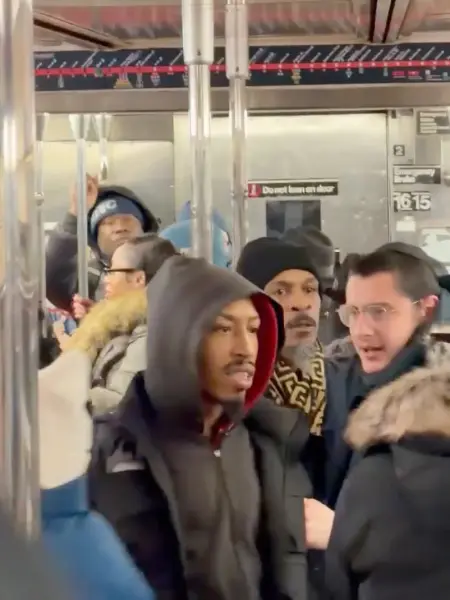
The verbal abuse escalated once the group boarded the train. When one of the Jewish men began filming the incident, the hostility intensified. Social media footage, widely circulated and cited by The New York Post, shows one of the aggressors seizing a victim by the collar while the other points his finger like a gun at the young man’s head, repeatedly threatening, “I’ll kill you.”
“I was really afraid,” Asraf told The New York Post. “When he made his fingers the sign of a gun towards me, I didn’t know what he had in his pockets.”
The fear was not hypothetical. In a post–October 7 world, where antisemitic violence has surged globally, such threats carry a chilling plausibility that transcends mere intimidation.
Asraf said the group remained largely silent during the encounter, paralyzed by fear as other passengers attempted to intervene. In the video referenced by The New York Post, one straphanger can be heard pleading, “Chill!” in a desperate effort to defuse the situation. But the threats continued until the group made a split-second decision to flee.
Disembarking at the next stop—Norwood Avenue—the young men ran directly to the nearest police precinct to file a report. Police later confirmed to The New York Post that they received a report around 8:41 p.m., stating that “unidentified individuals initiated a verbal dispute with two victims, grabbed them by their jackets, and made verbal threats.”
No physical injuries were reported, but the psychological toll was evident. “I thought it could be a very dangerous situation,” Asraf said, emphasizing that he and his companions feared for their lives.
The victims believe they were singled out because of their visible Jewish identity—a conclusion echoed in The New York Post’s reporting. “We look like religious Jews,” Asraf explained. “They recognized our appearance along with the menorahs,” which the group was carrying as part of their Hanukkah outreach.
Instagram/jewishlivesmatter
Police have not yet publicly identified the suspects, but authorities say they are reviewing surveillance footage from train cars and stations. MTA Chair and CEO Janno Lieber condemned the incident in a statement quoted by The New York Post, saying, “This kind of hateful behavior has no place on the subway or anywhere, and is deeply offensive to New Yorkers.” Lieber added that the MTA would work closely with the NYPD to identify and apprehend the perpetrators, urging that they face “maximum consequences from the justice system.”
The Brooklyn incident has reverberated far beyond the subway line where it occurred, amplified by the shadow of a far deadlier antisemitic attack just days earlier. As The New York Post noted, the confrontation comes in the immediate aftermath of a terrorist assault at a Hanukkah celebration in Sydney’s Bondi Beach, where gunmen killed 15 people and wounded dozens more, including children.
For Asraf, the timing intensified the terror. “After Sydney, it’s not realistic to try to even fight with these people,” he told The New York Post. “You don’t know what they have in their pockets.”
That global context has transformed what might once have been dismissed as a verbal altercation into something far more ominous. Jewish communities worldwide are grappling with the realization that threats—once abstract—are increasingly being acted upon.
View this post on Instagram
Asraf’s mother, he said, had warned him before he began his year of yeshiva studies in New York. “It’s going to be dangerous—keep your eyes open,” she cautioned. Four months into his stay, Asraf told The New York Post that he had encountered antisemitism before, but never at this level of intensity.
“I felt a little antisemitism,” he said. “But nothing like this.”
His experience mirrors a broader trend documented by The New York Post and other outlets: a sharp rise in antisemitic incidents across New York City since the outbreak of the Israel-Hamas war, with Jews increasingly reporting harassment, vandalism, and threats in neighborhoods and transit systems once considered safe.
New York’s subway has long been a symbol of the city’s diversity—a place where millions of people from every background intersect daily. But incidents like the one described by The New York Post raise urgent questions about safety and enforcement in a system already strained by concerns over crime and disorder.
Civil rights advocates warn that public transportation, with its enclosed spaces and transient populations, can become a flashpoint for hate crimes if perpetrators believe they can act with impunity. The fact that this incident occurred in the presence of other riders, some of whom attempted to intervene, highlights both the vulnerability of victims and the critical role of bystanders.
Community leaders say the Brooklyn subway attack must be understood not as an isolated episode but as part of a wider pattern. The New York Post has chronicled numerous recent incidents involving antisemitic graffiti, assaults, and threats across the city. Together, they paint a troubling picture of a metropolis struggling to contain a resurgence of one of history’s oldest hatreds.
Jewish advocacy groups are calling for stronger enforcement of hate crime statutes, increased police presence in sensitive areas, and public education campaigns to counter antisemitism. They argue that failure to act decisively risks normalizing behavior that, left unchecked, can escalate from words to violence.
Despite the fear generated by the subway incident, Asraf and others insist that retreat is not an option. Carrying menorahs through the city, they say, is not merely tradition—it is an assertion of identity and resilience.
Yet resilience should not be confused with resignation. As The New York Post has emphasized in its coverage, the expectation that Jews must simply endure threats as the price of visibility is unacceptable in a city that prides itself on pluralism and tolerance.
As of Tuesday, the suspects remained at large, and the investigation was ongoing. The NYPD has urged anyone with information to come forward, while reiterating that hate crimes will be pursued aggressively.
For now, the video of the confrontation continues to circulate, serving as both evidence and warning. It is a stark reminder that antisemitism is not a relic of history but a present and persistent danger—one that can surface without warning, even on a crowded New York City subway.
As The New York Post has reported, the victims escaped unharmed, but the psychological scars—and the broader implications for communal safety—linger. The question confronting New York is no longer whether antisemitism exists within its borders, but whether the city has the will and capacity to confront it before threats turn into something far worse.
Krav Maga time, folks. I know of one studio in Park Slope and there must be others.