



|
Getting your Trinity Audio player ready...
|
By: Fern Sidman – Jewish Voice News
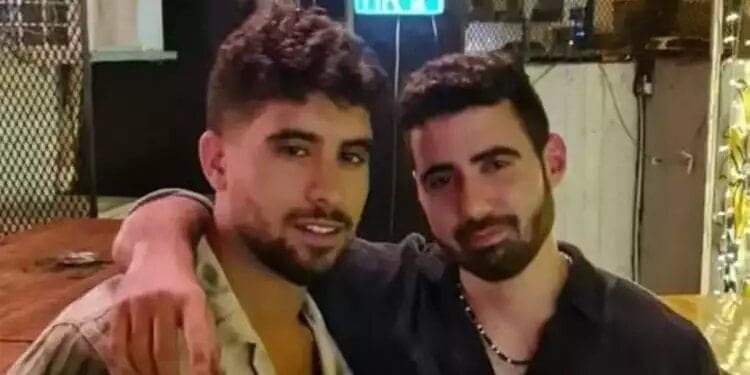
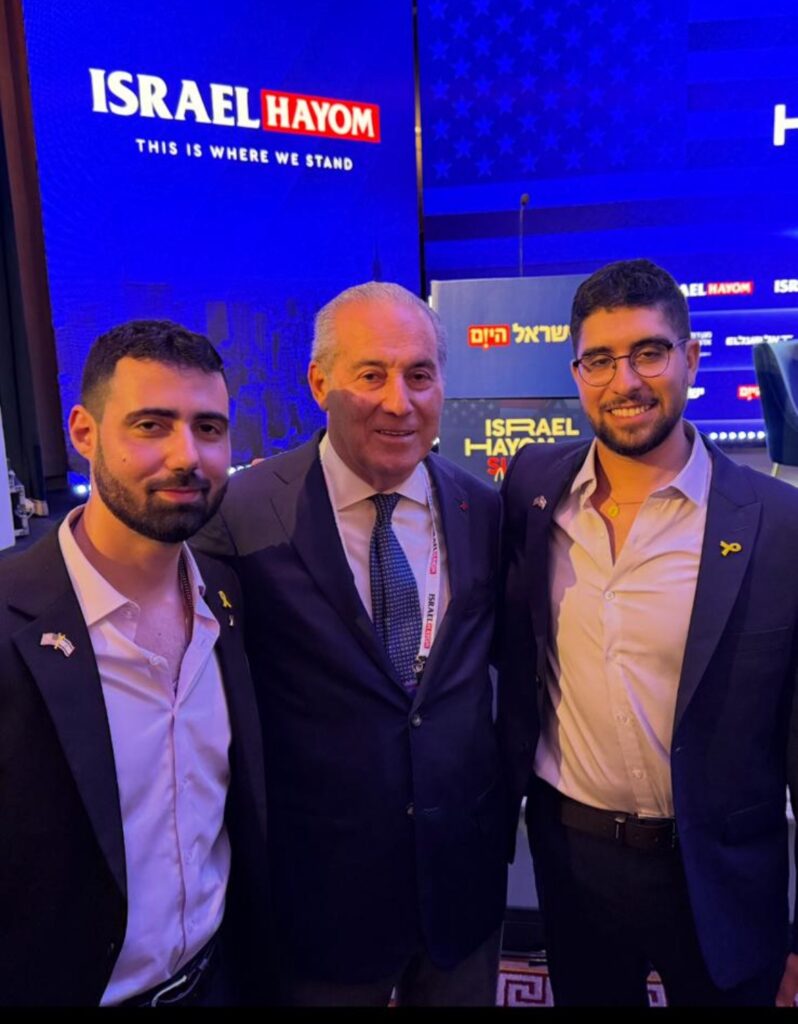
In a hall pulsing with reverent silence at the Israel Hayom Summit in New York City, an audience that had arrived expecting difficult truths instead found themselves witnessing something far rarer: a living testament to the triumph of human connection over deliberate cruelty. The testimonies of former hostages Guy Gilboa Dalal and Evyatar David—two young Israeli men who survived more than two years in Hamas captivity—became the emotional epicenter of the summit, casting a long shadow over the day’s discussions on geopolitics, antisemitism, and global security. Their appearance, reported extensively by Israel Hayom, was less a speech than an act of collective witnessing: a community bearing emotional record of what terrorists intended to erase.
The two men, best friends since infancy, spoke slowly and carefully, each word weighed against memories still raw. Their bond, several speakers noted, seemed less like friendship than a shared nervous system—a quality that journalist Yoav Limor, moderating the session, described as “speech through the eyes.” As the Israel Hayom report detailed, they had known each other since age one, had spent childhoods in parallel, and maintained a relationship that might have, under less brutal circumstances, remained a story of ordinary lifelong companionship.
But captivity reshaped everything. “It just got upgraded to a new level,” Guy said softly, echoing a line that has since been widely quoted in Israel Hayom’s coverage and social media. What had been brotherhood became survival.
From the stage the two men painted, without dramatization or embellishment, a portrait of captivity that left even seasoned diplomats and journalists at the summit visibly shaken. The tunnels that Hamas fighters had carved beneath Gaza were not — as some foreign commentators have naively characterized them — strategic corridors or infrastructure. In Guy’s and Evyatar’s telling, they were tombs suspended in ambiguity: dark, air-starved rooms where food arrived sporadically, hygiene was nearly nonexistent, and hope oscillated between flicker and extinction.
“We were skeletons,” Guy said. That line, too, is already circulating widely via Israel Hayom’s reporting. His shoulders had atrophied so severely that even minor movements became impossible. He described sitting hunched for weeks, unable to straighten himself. For a full month, he said, “I couldn’t move my shoulders—it was too painful even to try.”
Evyatar filled in the detail that friendship requires of the witness. His voice quieted. “He couldn’t even pull his pants up after going to the bathroom,” he said. He described cleaning his best friend’s body—“including his crotch,” Guy added—because the cold and physical deterioration had made showers impossible. They survived by virtue of wipes that arrived perhaps once a week, sometimes less.
What stood out in their testimony was not the degradation—although that alone drew gasps from the crowd—but the seamlessness of their mutual care. “Everything we got, we split in two,” Evyatar said. Their captors starved them to the brink of death, but the two men engaged in an act of quiet rebellion: the distribution of survival itself.
As Israel Hayom reported, the audience appeared stunned into stillness when Guy revealed that he had been sexually assaulted—twice—by a Hamas guard. In a summit dominated by geopolitical analysis, policy debates, and survival testimonies, that moment brought the human cost crashing back into the foreground. “Everything was difficult,” Guy said, “but this was the most difficult time. I was stuck there in the same tunnel, with nowhere to run.” The audience erupted into applause not out of triumph but solidarity—an affirmation that disclosure is not humiliation, and that courage is a form of reclaiming one’s selfhood.
When asked why he chose to speak openly, Guy’s answer—carried prominently by Israel Hayom—was as articulate as it was searing. “Many women and men get sexually attacked,” he said. “I want them to hear my story. If this empowers people, this is a great honor for me. It is not a shame to talk about this… It is important they know they are not alone.”
If there had been any illusion that Hamas’ tunnels represented anything short of systematic barbarity, the next part of their testimony shattered it.
At one point the men were held with two other hostages in what Guy described as “a septic drain field.” The phrase, first reported by Israel Hayom, does not adequately convey the hellishness he detailed. It was a literal pit filled with human waste. They were forced to dig inside it. The tunnel in which they lived had a ceiling just four feet high and a width no broader than Guy’s chair on stage. A single stench dominated the air, worsened by the lack of ventilation.
“Maggots grew into flies,” Guy said, “and they would climb our food. It was not human.” The four hostages rotated positions each night, deciding which of them would sleep closest to the human waste. That they made such decisions democratically is itself a testament to their capacity for dignity under conditions engineered precisely to strip it away.
The audience hung on every word, and the careful documentation by Israel Hayom ensures that future generations will not be able to claim ignorance.
Journalist Yoav Limor asked the question that everyone in the room appeared to be silently wondering: How did you not go mad?
Evyatar answered with clarity that belied the chaos he described. “You have to find some routine,” he said. “To keep yourself busy.” Their friendship served not merely as emotional support but as cognitive ballast—something to grip as the world narrowed to claustrophobic darkness.
They talked constantly: about people they knew, about memories, about music. This last element—music—became the emotional heartbeat of their survival. They did not have access to actual recordings, but as they told Israel Hayom, they survived on the memory of it. They recited melodies aloud, replayed beloved songs in their heads, described performances to one another, recited favorite lyrics. “That is what saved us,” Guy said.
Beyond starvation and forced confinement, Hamas employed psychological warfare. The hostages were fed manufactured narratives designed to erode hope: Israel was not fighting for them; their families had abandoned them; the country was collapsing; the Arab world was bombarding Israel.
For more than a year, Guy had no idea what had happened to his own brother—also abducted from the Supernova festival. “Not knowing was so difficult,” he said. He recalls meeting survivor Omer Wenkert in captivity and learning fragments of what had happened at the rave, in the shelters, in the kibbutzim. The shock of that knowledge stayed with him in a way he described as “devastating.”
Evyatar recalled the crushing emotional blow that followed early hostage exchanges, when they were not among those released. “I started to panic,” he said. “I told Guy that I won’t see my family again.”
Limor asked bluntly: Did you cry? “Yes,” Evyatar answered. “Because it’s liberating.”
After surviving nearly the entire ordeal together, the men were separated for the final two months of captivity. Guy turned to Evyatar during the panel and asked when he realized their separation was permanent. “I waited three days,” Evyatar said, “but there were no signs you were coming back. Eventually, I coped.”
“Coped” was an understated word. Israel Hayom reported that the silence in the room deepened while he spoke.
Neither man had any idea that intense international efforts to secure their release had been underway for months.
“When Trump was elected, we heard about it,” Evyatar said, “and we were sure it would help. And of course it did help. We are immensely indebted to him. I don’t know how we could have stayed longer were it not for Trump.”
The audience, as Israel Hayom reported, erupted in applause.
Asked what it feels like now to be “wrapped with love,” the answer was simple. Guy: “We are in heaven.” Evyatar: “Every day waking up and realizing you are not in a tunnel is great.”
They recalled how, even in captivity, they would talk at night about their dreams of food—the dishes they missed, the meals they would eat if they ever escaped.
Today, those dreams are real.
At the Israel Hayom Summit, where statesmen, diplomats, scholars, and journalists debated strategy and policy, it was two young men who crystallized the stakes of the global Jewish conversation. Their story, carried prominently by Israel Hayom, provided a counterweight to abstractions about “regional dynamics” and “postwar realities.” In their story, there was only the raw human truth: what Hamas asks of its captives, and what Israelis ask of one another.
They survived because they had each other. The world now knows their names because they refuse to let silence serve as the final chapter.
Their testimony is not merely a recounting of torture. It is, as Israel Hayom emphasizes, a rallying cry — a reminder of the stakes, a memorial for those still underground, and a declaration that even under the weight of unimaginable cruelty, humanity can persist.
And sometimes, it persists in the form of two boys, now men, sharing a scrap of rice in a tunnel and whispering the memory of a song neither can hear — but both can still feel.