



|
Getting your Trinity Audio player ready...
|
By: TJV News
A thwarted assassination plot targeting a polarizing New York City activist has cast a stark and unsettling light on the volatile intersection of political extremism, public safety, and ideological agitation in America’s largest metropolis. According to multiple officials cited by The New York Times in a report on Friday, federal and local law enforcement authorities intervened in what they described as an imminent threat against Nerdeen Kiswani, a prominent and controversial pro-Palestinian organizer.
Federal authorities said they arrested Alexander Heifler on Thursday at his home in Hoboken, New Jersey, as he was assembling Molotov cocktails that he planned to throw at Kiswani’s home, NPR reported.
An official who was briefed on the investigation said Heifler, 26, identified as a member of the JDL 613 Brotherhood, a New Jersey-based group founded in 2024 that describes its membership as “Jewish warriors” fighting back against rising antisemitism. The group’s website describes thie organization as being inspired by the original Jewish Defense League,
For weeks, he had discussed the plot with an undercover NYPD detective who had infiltrated a group chat used by Heifler, according to a police department spokesperson.
The episode, unfolding in the densely populated corridor straddling Hoboken and Lower Manhattan, has ignited both alarm and scrutiny—not only regarding the nature of the alleged plot, but also concerning the broader ecosystem of activism, rhetoric, and radicalization that has increasingly defined the discourse surrounding the Israeli–Palestinian conflict in the United States.
The intervention itself, as reported by The New York Times, was decisive and coordinated. Agents from the Federal Bureau of Investigation, working in tandem with the New York City Police Department, conducted court-authorized operations in the vicinity of Willow Avenue and Clinton Street in Hoboken. The action culminated in at least one arrest, though authorities have yet to publicly disclose the identity of the suspect or the precise charges being contemplated.
Law enforcement officials characterized the threat as imminent—a distinction that underscores both the seriousness of the situation and the urgency with which it was addressed. Kiswani, who was notified late Thursday evening, stated that investigators informed her the plot was “about to” be carried out.
Such language, if borne out by subsequent disclosures, suggests a level of operational preparedness that moves beyond mere rhetoric into the realm of actionable violence. It is precisely this transition—from incendiary language to concrete planning—that law enforcement agencies have increasingly identified as a critical inflection point in the prevention of politically motivated attacks.
Nerdeen Kiswani has been a radical activist for decades, as seen above a video from years ago
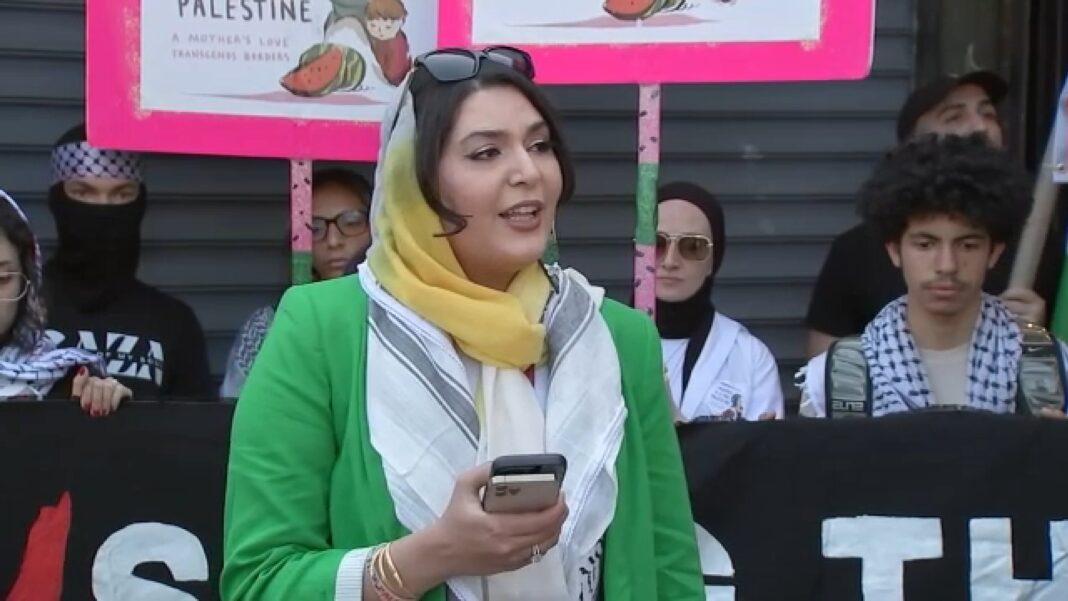
At the center of this unfolding drama stands Nerdeen Kiswani, co-founder of the activist organization Within Our Lifetime. Over recent years, Kiswani has emerged as a highly visible and often contentious figure within pro-Palestinian advocacy circles in New York City.
Her public persona, as documented in numerous reports—including those by The New York Times—has been marked by a strident and uncompromising critique of Israel. Demonstrations associated with her organization have frequently drawn attention not only for their intensity but also for the rhetoric employed, which critics argue crosses the line from political advocacy into inflammatory provocation.
This distinction is neither trivial nor merely semantic. In an environment already fraught with tension, the tone and content of public discourse can serve either to de-escalate or to inflame. While Kiswani and her supporters frame their activism as a necessary expression of solidarity and resistance, detractors contend that such rhetoric risks normalizing hostility and fosters an atmosphere in which visceral antisemitism can take root.
The alleged plot, therefore, cannot be viewed in isolation. It exists within a broader context in which ideological fervor, amplified by social media and mass mobilization, increasingly intersects with the darker currents of political violence.
Late last night the FBI Joint Terrorism Task Force informed me that a plot against my life that was “about to” take place, and that agents had conducted an operation in Hoboken related to this plot. For months, Zionist organizations like Betar and politicians like Randy Fine have…
— Nerdeen Kiswani (@NerdeenKiswani) March 27, 2026
According to The New York Times report, authorities have not yet disclosed a motive for the planned attack. This absence of clarity leaves open a range of possibilities, from personal grievance to ideological retaliation. What is clear, however, is that the mere existence of such a plot reflects a troubling escalation in the stakes of political engagement.
In recent years, the boundaries between activism and antagonism have grown increasingly porous. Demonstrations that once might have been confined to peaceful protest have, in some instances, evolved into arenas of confrontation—both rhetorical and physical. The result is a feedback loop in which heightened tensions beget further polarization, creating conditions that can incubate acts of violence.
For law enforcement agencies, this evolving landscape presents a formidable challenge. The imperative to protect individuals from credible threats must be balanced against the equally fundamental obligation to safeguard constitutional rights, including freedom of speech and assembly.
The actions described by The New York Times report suggest that authorities believed they had reached a threshold where intervention was not only justified but necessary. Court authorization, a prerequisite for such operations, indicates that investigators were able to present evidence sufficient to establish probable cause.
Yet the broader question remains: how can authorities effectively monitor and mitigate threats without encroaching upon the very liberties they are sworn to defend? In an era of rapid information dissemination and decentralized networks of activism, the line between vigilance and overreach is increasingly difficult to delineate.
Any serious examination of this incident must also grapple with the role of rhetoric in shaping both perception and behavior. Kiswani’s declaration—“I will not stop speaking up for the people of Palestine”—is emblematic of a broader ethos that prioritizes unyielding advocacy.
While such resolve is a hallmark of many activist movements, it also raises questions about the responsibility that accompanies public influence. Words, particularly when delivered to large and receptive audiences, carry weight. They can inspire, mobilize, and, in some cases, radicalize.
Critics of Kiswani have long argued that her rhetoric, while framed as political expression, often adopts a tone that exacerbates division rather than fostering dialogue. In a climate already strained by global conflict, such an approach may contribute to the very tensions that give rise to acts of violence.
New York City, with its diverse population and its status as a global hub, has long served as a microcosm of broader geopolitical dynamics. The Israeli–Palestinian conflict, though geographically distant, resonates deeply within its communities, often manifesting in protests, counter-protests, and heated public debate.
The events described by The New York Times underscore the extent to which these global tensions have permeated local realities. The prospect of an assassination plot—particularly one targeting a high-profile activist—introduces a new and troubling dimension to this dynamic.
It is a reminder that the consequences of political polarization are not confined to abstract discourse. They can, and sometimes do, translate into tangible threats to safety and stability.
As the investigation continues, additional details will undoubtedly emerge, shedding light on the identities, motivations, and methods of those involved. Yet even in the absence of a complete factual record, certain conclusions can be drawn.
First, the prompt and coordinated response by law enforcement likely prevented a potentially catastrophic event. This underscores the importance of intelligence gathering, interagency cooperation, and proactive intervention in addressing emerging threats.
Second, the incident highlights the need for a more nuanced and responsible approach to political activism. Advocacy, particularly on issues as charged as the Israeli–Palestinian conflict, must be conducted with an awareness of its potential consequences.
Finally, the episode serves as a cautionary tale about the dangers of unchecked polarization. In a society where ideological divides are increasingly pronounced, the risk of escalation—from words to actions—cannot be ignored.
The disruption of the alleged plot against Nerdeen Kiswani, as reported by The New York Times, is both a testament to the effectiveness of law enforcement and a stark warning about the fragility of the current moment. It reveals a landscape in which activism, rhetoric, and violence are perilously intertwined.
For New York City—and indeed for the nation—the challenge lies in navigating this terrain with both vigilance and restraint. It requires a commitment not only to security but also to the principles of responsible discourse and mutual respect.
In the absence of such a commitment, the line between protest and peril may continue to blur, with consequences that extend far beyond any single incident.
