



|
Getting your Trinity Audio player ready...
|
By: Hadassa Kalatizadeh
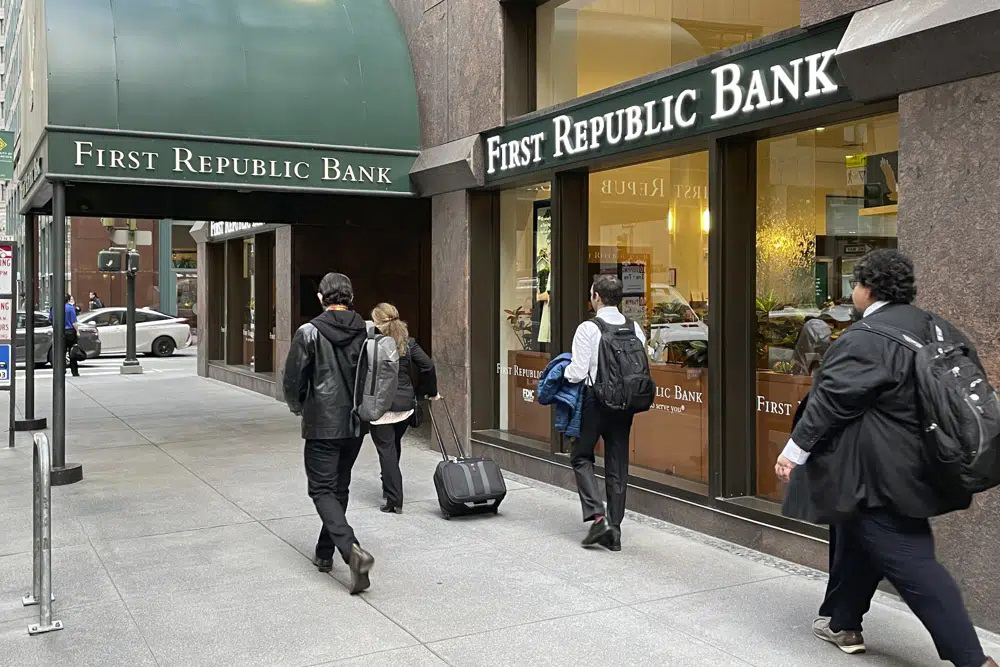
First Republic Bank has joined the list of troubled lenders, with regulators racing to seize and sell the bank.
As reported by the NY Times, federal regulators are working to end the banking crisis by swiftly seizing and selling off the ailing bank. Last week, it became obvious that large banks were weary of rescuing the bank, without federal intervention, for fear of taking on billions of dollars in losses.
Since last Monday, when First Republic disclosed that over half of its deposits (or roughly $102 billion in deposits) were withdrawn by customers in just three weeks. The company’s stock price has collapsed some 75 percent. The Federal Deposit Insurance Corporation has been in talks trying to try to forge a sale agreement with banks, including JPMorgan Chase, PNC Financial Services and Bank of America.
By Friday, potential bidders were given access to details about the bank’s finances and federal officials had asked bidders to submit binding offers by Sunday. The Times reported that at least a few bidders had been told that they had till noon Sunday to submit their offers. Sources for the paper, said a deal could potentially be announced as early as Sunday, although the situation is still fluid and changing by the minute. Any prospective buyer would probably assume First Republic’s deposits, so as to first eliminate the need for a government guarantee of deposits in excess of $250,000 — which is the limit for deposit insurance. The Federal Deposit Insurance Company, also known as the F.D.I.C. has tapped financial advisory firm Guggenheim Partners to help with the process, sources for the Times said.
Usually, regulations would ban large financial institutes like JPMorgan Chase or Bank of America from taking over another deposit-taking bank, citing the risks of the banks growing too big. In this case, however, because of the desperate need, regulators would need to grant an exemption, in order to get a deal approved. Some progressive Democrats are not keen to making this kind of exception and would lean towards making a deal with PNC or another smaller regional bank.
If no deal is reached, the F.D.I.C. will be on the hook to decide whether it will seize First Republic anyway and take on ownership itself. In that way, federal officials would invoke a systemic risk exception, similar to what they did in March following the failures of Signature Bank and Silicon Valley Bank, to protect large deposits. “The government needs to act in a way where the uninsured depositors get their money out in whole,” said Lawrence Summers, a former Treasury secretary now at Harvard, in an interview on Saturday. He warned that if the federal officials decide not to act it could lead to dire consequences. Failing to guarantee the large deposits “runs a substantial risk of setting off a wave of further withdrawals from all but the largest of institutions,” Summers added.
First Republic, the San Francisco based bank which caters to affluent customers mostly in tech and finance with most of its branches on the coasts, already got a lifeline last month. A consortium of 11 large banks, including JPMorgan Chase, PNC and Bank of America, temporarily deposited $30 billion into First Republic, as part of an industry effort to help the bank, per the Times. Unfortunately, the boost didn’t greatly alter the bank’s sustainability.
