



|
Getting your Trinity Audio player ready...
|
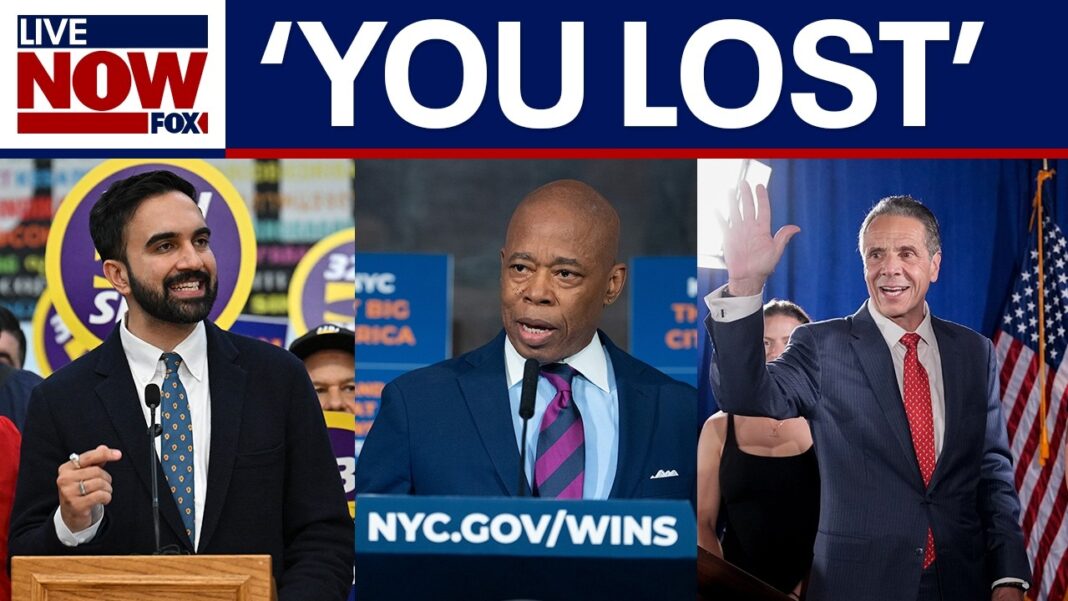
Eric Adams Plummets in Polls as Mamdani Surges, Cuomo Falters, and NYC Voters Search for a Savior
By: Fern Sidman
In a seismic shift that pinpoints the volatility of New York City’s 2025 mayoral race, a new poll released by Slingshot Strategies paints a sobering picture for incumbent Mayor Eric Adams: he’s barely registering with voters. According to a report that appeared on Wednesday in The New York Post, Adams sits at a meager 11% in a four-way contest — an astonishing political collapse for a sitting mayor once hailed as a centrist antidote to far-left politics.
The poll places Democratic nominee Zohran Mamdani in a commanding lead with 35% of voter support, followed by former Governor Andrew Cuomo at 25%, Republican Curtis Sliwa at 14%, and Adams lagging in fourth place. As The New York Post report astutely noted, these numbers not only reflect a mayor in crisis but also a broader identity struggle within the city’s Democratic electorate.
“Mamdani doesn’t have a majority, but the path to stopping him is narrow,” said Evan Roth Smith, founding partner of Slingshot Strategies. “The ballot is set, and Cuomo — his strongest general election opponent — already lost to him decisively in the Democratic primary.”
Indeed, Mamdani’s primary victory over Cuomo, with a margin of nearly 125,000 votes, sent shockwaves through the city’s political establishment. The New York Post has chronicled the fallout, reporting growing anxiety among moderate Democrats and community leaders who view Mamdani’s democratic socialist platform as a potential existential threat to the city’s economic and social fabric.
Adams, meanwhile, finds himself politically marooned. Once backed strongly by Black voters, law enforcement unions, and outer-borough moderates, the mayor’s support has cratered across nearly all demographic lines. According to the poll, only 16% of Black voters — once a linchpin of his 2021 victory — say they plan to back him in the general election. Even more damning, Adams’ highest support came not from his own party, but from Republicans, with 26% of GOP voters saying they would vote for him — a number that, in this city, is more liability than asset.
As The New York Post reported, Republican candidate Curtis Sliwa has attempted to harness the discontent surrounding Mamdani’s polarizing rise, particularly among disaffected moderates who see Adams and Cuomo as yesterday’s men. “Mamdani’s opponents are doing more to alienate his supporters than win them over,” Sliwa recently told the Post, suggesting his campaign will focus on converting anger into political opportunity.
But while Sliwa’s 14% is notable for a Republican in deep-blue New York City, it’s not enough to mount a serious challenge unless Mamdani’s support hemorrhages further. And although the poll reveals vulnerabilities in Mamdani’s coalition — including underperformance among male voters, non-college-educated residents, and those aged 45 to 64 — these gaps have not yet coalesced into a viable opposition front.
Smith emphasized this point to The New York Post: “You have a large number of largely white, largely outer-borough homeowners who are skeptical of Mamdani. But uniting those voters behind either Cuomo or Adams — especially with both still in the race — is a tall order.”
Cuomo’s continued presence on the ballot, after losing the Democratic nomination, further muddies the waters. The former governor has mounted an aggressive media blitz, portraying himself as a pragmatic alternative to Mamdani’s ideological zeal. But many Democratic voters remain wary of Cuomo’s past scandals and erratic political comeback. And as the Post report noted, his primary defeat was not narrow — it was decisive.
Adams, for his part, seems increasingly politically isolated. Once seen as a shrewd operator who could bridge New York’s many divides — between progressives and centrists, outer boroughs and Manhattan elites, police and protesters — Adams now finds himself without a clear constituency. “There’s simply not enough Republican support for someone who is a sitting Democratic mayor of New York,” Smith told The New York Post. “So it’s really, really difficult when someone is polling at 11% and the ballot isn’t changing to see what the path to victory is.”
The broader implications for the city are profound. As Mamdani — a self-described democratic socialist — prepares for the general election, his critics are growing louder. His platform, which includes radical housing proposals, an overhaul of NYPD oversight, and controversial foreign policy stances, has alarmed Jewish community leaders, real estate stakeholders, and business associations alike.
The New York Post has been particularly vocal in its criticism, highlighting Mamdani’s past associations with anti-Israel activists, his support for divestment campaigns, and his flirtation with far-left academic figures who’ve drawn rebuke for inflammatory rhetoric. Editorials in the paper have warned that a Mamdani mayoralty would be “the most ideologically extreme experiment in modern New York City history,” capable of upending decades of economic growth and community stability.
And yet, Mamdani continues to draw strong support from younger voters, progressive activists, and disenchanted working-class residents — especially in Queens and parts of Brooklyn — who see in him a symbol of political renewal. His campaign has tapped into frustration with homelessness, housing costs, police misconduct, and the perceived coziness of City Hall with elite interests.
For now, Adams’ hopes seem to rest on a political miracle: a last-minute consolidation of the anti-Mamdani vote around his name. But as The New York Post report makes clear, the chances of that happening are slim.
“Even if Adams were to drop out and endorse Cuomo, or vice versa, it’s unclear that their support would transfer cleanly,” Smith explained. “The electorate is fractured. Mamdani’s base is highly energized. And the rest of the field is out of sync.”
As the general election approaches, New York City finds itself at a crossroads. With its once-ascendant mayor languishing in fourth place, and a democratic socialist on the cusp of power, the 2025 race could reshape the city’s political landscape for a generation

This article is written from a clinical perspective, without a Jewish moral stance. Is TJV not horrified by this muslim antisemite?
“the 2025 race could reshape the city’s political landscape for a generation”, is the TJV summary.
How about something like, “ if New York Jews do not organize and marshal themselves and their purportedly “Jewish” religious and political institutions to defeat this vicious antisemite and his followers, they will disastrously lose the antisemites’ war being wage against us.”