



|
Getting your Trinity Audio player ready...
|
By: Carl Schwartzbaum
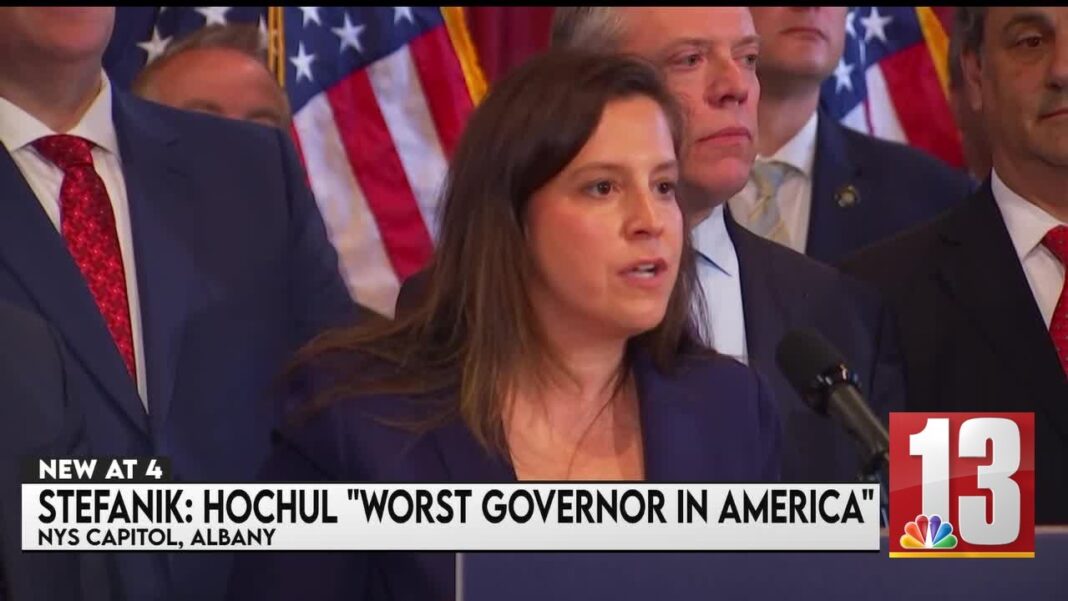
Rep. Elise Stefanik (R-N.Y.), the high-profile House Republican Conference Chair and close ally of President Donald Trump, is preparing to enter the 2026 New York governor’s race, according to multiple sources cited by The Hill on Thursday. While no formal announcement has yet been made, two individuals with direct knowledge of Stefanik’s planning confirm that her decision is firm. “It’s not a matter of if, but when,” one insider told The Hill, emphasizing that the congresswoman will launch her campaign “at a time and place of her choosing.”
This long-anticipated move signals a significant realignment in New York’s political dynamics and could usher in the most serious Republican challenge to Democratic control of the state in over a decade. Stefanik’s candidacy would likely mobilize both conservative voters upstate and Trump-aligned constituencies in suburban districts that have shifted rightward in recent elections.
Stefanik’s entry into the race would instantly make her the GOP frontrunner, a status supported by new polling data cited by The Hill. A GrayHouse poll found Stefanik commanding 44 percent support among likely Republican primary voters, dwarfing potential rivals such as Rep. Mike Lawler (R-N.Y.) and Nassau County Executive Bruce Blakeman, who polled at 7 percent and 5 percent, respectively. The poll’s 5-point margin of error further underscores Stefanik’s advantage.
What’s more, President Trump’s recent endorsements of Lawler and Blakeman for their reelection bids in Congress and county office, respectively, are widely interpreted—as The Hill noted—as a strategic gesture to “clear the field” for Stefanik’s gubernatorial ambitions. Her loyalty to Trump, punctuated by her prominent role during his impeachments and in GOP House leadership, has positioned her as a natural standard-bearer for a Trump-aligned Republican challenge in New York.
Despite New York’s longstanding reputation as a Democratic stronghold, recent electoral trends suggest a subtle but notable shift. The Hill report highlighted that in 2022, Republican candidate Lee Zeldin closed the gap in the gubernatorial race to just six points against incumbent Kathy Hochul—an improvement that shocked many Democratic strategists. Meanwhile, Donald Trump narrowed his loss in New York to just over 12 points in 2024, improving his margin by a dramatic 23 points compared to 2020.
These figures, while not predictive of a GOP victory in 2026, have emboldened Republican operatives and donors who believe the Empire State’s political calculus may be shifting—especially as issues such as crime, taxes, and migration dominate public discourse.
“Elise Stefanik is uniquely positioned to capitalize on that momentum,” a Republican strategist told The Hill. “She’s got name recognition, fundraising chops, and the backing of the most powerful voice in the GOP.”
Still, any Republican running statewide in New York faces formidable obstacles. As the report at The Hill pointed out, the nonpartisan Cook Political Report continues to rate the race as “likely Democratic,” reflecting the state’s voter registration advantage for Democrats and its historical voting patterns.
Moreover, Stefanik’s hard-right image—carefully cultivated through years of Trump advocacy and vocal critiques of Democrats on issues ranging from education to immigration—may alienate moderate and urban voters. Her support for investigating elite universities over antisemitism and her defense of law enforcement in the face of progressive criminal justice reforms have earned her fierce loyalty on the right, but may prove divisive in general election matchups.
Democratic strategists are already preparing for battle. “She’s too extreme for New York,” a Hochul campaign adviser said anonymously to The Hill. “Voters here don’t want culture war politics in the Governor’s Mansion.”
Still, Stefanik’s allies are quick to counter that argument, pointing to her electoral resilience in New York’s 21st Congressional District—a seat she has won handily since 2014, including during Democratic wave years.
As speculation swirls, the report at The Hill emphasized that Stefanik’s timing is strategic. By waiting to officially launch, she avoids an early target on her back while building out the infrastructure of a statewide campaign, including staffing, donor engagement, and media outreach. Her team is reportedly in the early stages of assembling a veteran campaign staff and is in regular communication with high-level GOP figures and Trump operatives.
“Elise has always played the long game,” one source told The Hill. “She’s deliberate, disciplined, and has been laying the groundwork for this run for years.”
Should Stefanik declare, she would instantly become the most prominent Republican candidate for governor since George Pataki, the last GOP leader to hold statewide office in New York, serving three terms from 1995 to 2006. A Stefanik governorship would not only symbolize a political renaissance for the GOP in New York—it would elevate her national profile even further, perhaps setting the stage for future federal aspirations.
For now, eyes across the state—and the nation—are watching and waiting. If Stefanik launches as expected, she will do so with the full weight of the Republican establishment behind her, amid rising conservative hopes that the Empire State may, once again, be within reach.
