



|
Getting your Trinity Audio player ready...
|
By: Tzirel Rosenblatt
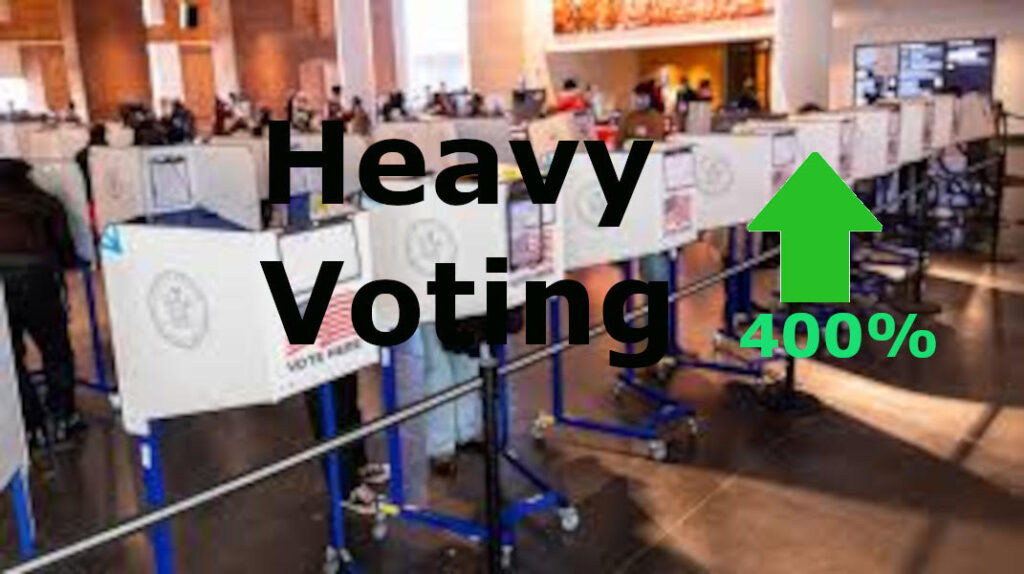
New Yorkers turned out in droves on Saturday for the opening day of early voting in the city’s heated mayoral race — a dramatic surge that election officials described as nearly five times higher than 2021’s kickoff, underscoring the extraordinary stakes of the contest to replace outgoing Mayor Eric Adams.
According to data cited in a report on Saturday in The New York Post, the New York City Board of Elections reported 79,409 early voter check-ins by the time polls closed Saturday night — an astonishing leap from the mere 15,418 who cast ballots on the first day of early voting four years ago. Political insiders immediately seized on the turnout as evidence that New Yorkers are bracing for a high-stakes showdown that could reshape the political identity of the five boroughs for years to come.
“This is a blockbuster turnout for a first day,” one longtime Democratic strategist told The New York Post. “It means voters are paying attention — and they’re nervous about what’s coming next.”
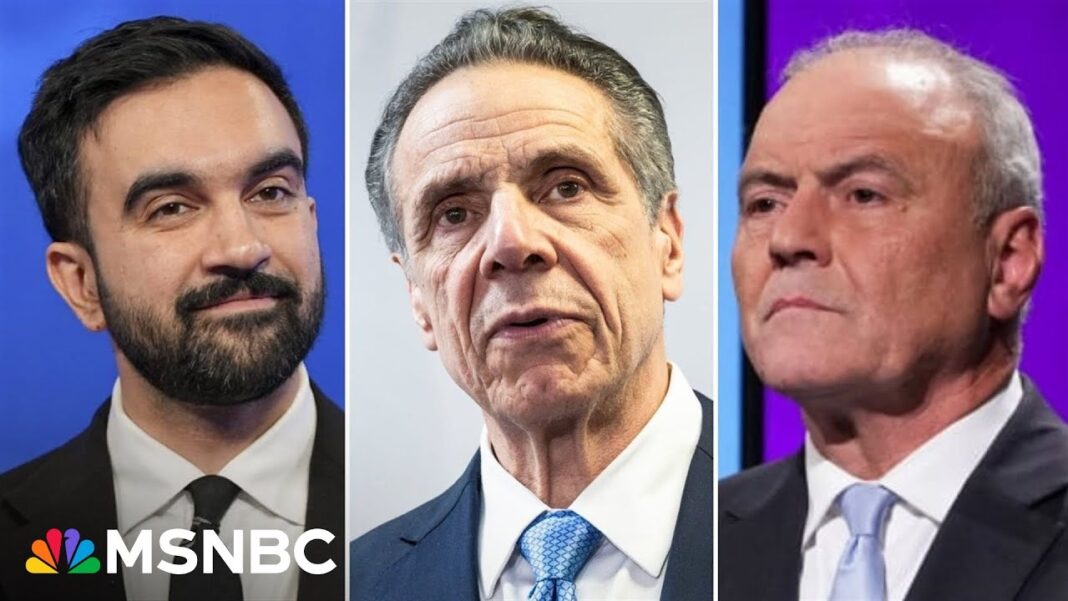
The 2025 mayoral election has evolved into a political drama unlike any in recent memory. As The New York Post reported, the race pits former Governor Andrew Cuomo, running as an independent in his first major political comeback attempt, against Zohran Mamdani, the Democratic Party’s official nominee and self-identified socialist from Queens, and Curtis Sliwa, the red-bereted founder of the Guardian Angels representing the Republican ticket.
The trio’s competing visions for New York City could not be more divergent. Mamdani, a 34-year-old Assemblyman of Ugandan descent, has campaigned on a radical reimagining of city governance, calling for deep cuts to the NYPD, rent control expansion, and sweeping criminal justice reforms. Cuomo has positioned himself as a pragmatic centrist, warning against what he terms the “socialist experiment” unfolding in New York politics. Sliwa, ever the populist, has waged a law-and-order crusade, seeking to revive the spirit of the city’s 1990s crime-fighting era.
As The New York Post report detailed, the election comes at a moment when voters appear torn between nostalgia for the stability of prior decades and anxiety over soaring costs, rising crime, and a polarized political climate that has left many moderates politically homeless.
The Board of Elections data paints a vivid picture of civic engagement on overdrive. The New York Post reported that Manhattan led all boroughs with 24,046 ballots cast, followed closely by Brooklyn’s 22,105 and Queens’ 19,045. The Bronx logged 7,793, while Staten Island contributed 6,420 to the tally.
Each borough’s numbers dwarfed those of 2021, when Mayor Adams easily bested Sliwa in a largely uncompetitive general election. That year, Manhattan drew only 4,563 early voters on opening day, Brooklyn 3,751, Queens 3,441, the Bronx 2,079, and Staten Island 1,584.
Cuomo’s former aide, Melissa DeRosa, celebrated the turnout on social media, writing, “If these numbers hold, we could see 1.9 million person turnout.” The New York Post report noted that such an outcome would represent one of the highest participation rates in a non-presidential election in modern city history — a sign, analysts say, that voters across the political spectrum view this election as existential.
Despite the unprecedented voter enthusiasm, recent polling suggests that Zohran Mamdani continues to command a formidable advantage. According to a Victory Insights poll cited in The New York Post report, Mamdani leads with 46.7% support citywide, far ahead of Cuomo’s 28.6%, while Curtis Sliwa trails at 16.2%.
Mamdani’s dominance among younger, progressive voters mirrors the insurgent energy that propelled him to victory in the Democratic primary earlier this year, where he defeated multiple establishment candidates. Yet as The New York Post report emphasized, his ascent has alarmed many traditional Democrats, including party leaders and major donors who withheld endorsements over his radical positions — particularly his pro-Hamas activism and calls to “defund and disarm” the NYPD.
Mamdani’s most incendiary statement came during a campaign event last month, when he vowed that, if elected, he would “arrest Israeli Prime Minister Benjamin Netanyahu as a war criminal if he sets foot in New York City.” The remark drew international condemnation and was featured prominently in The New York Post’s coverage of the race, which has increasingly become a referendum on ideology as much as governance.
For Andrew Cuomo, who resigned as governor in 2021 amid scandal and has spent years rehabilitating his public image, this race represents both a redemption arc and a test of political viability. Framing himself as the “voice of common sense,” Cuomo has sought to appeal to centrist and independent voters wary of the city’s leftward drift.
“This is the most important election of our lifetime,” Cuomo spokesperson Rich Azzopardi told The New York Post. “Most voters don’t want New York City to be a socialist experiment — with a diminished police force, no jails, decriminalized prostitution, and a weakened education system that encourages mediocrity.”
Cuomo’s campaign, though short on traditional party infrastructure, has leaned heavily on name recognition and a statewide donor network built over decades. Still, critics question whether his independent run can overcome both Mamdani’s energized progressive base and the Republican Party’s organizational machinery behind Sliwa.
For his part, Curtis Sliwa remains undeterred by his third-place polling. A representative for his campaign told The New York Post that they were encouraged by early voting numbers, claiming, “We actually have a solid get-out-the-vote effort. I’m positive a lot of this activity is ours. Cuomo has no ground game — doubt it’s much in his favor.”
Sliwa has campaigned on a relentless platform of restoring order, supporting police, and tackling homelessness head-on. His red beret and fiery speeches have made him a fixture of New York political theater for decades, but even allies admit his path to victory in a city with a 6-to-1 Democratic voter registration advantage remains exceedingly steep.
As The New York Post report observed, the 2025 mayoral race has become a microcosm of the nation’s broader political divide — a clash of visions for urban America’s future. The issues dominating the campaign — crime, affordability, homelessness, and foreign policy — are deeply intertwined with questions of identity, class, and belonging in a post-pandemic New York.
Cuomo has accused Mamdani of promoting policies that would “destroy the city’s economy and public safety,” while Mamdani has painted Cuomo and Sliwa as “agents of a failed system.” The debates have been heated, with fiery exchanges over the role of policing, the housing crisis, and the city’s strained relationship with President Trump.
As The New York Post report noted, Mamdani’s critics view his socialist platform as dangerously naïve, while his supporters see it as a moral awakening. Meanwhile, Cuomo’s independent candidacy has fractured the traditional Democratic coalition, pulling moderates away from Mamdani but also splitting the anti-socialist vote with Sliwa’s base.
Mayor Eric Adams’ decision to suspend his re-election campaign last month opened the field for this volatile three-way race. Although later cleared in the federal corruption probe that derailed his fundraising, Adams’ centrist administration — characterized by pragmatic but uneven progress on crime and housing — left both left-wing and conservative voters dissatisfied.
Now, as The New York Post report explained, the contest to replace him has become not merely about leadership but about defining the soul of the city itself.
“New York is at a crossroads,” wrote a New York Post editorial on Friday. “Will it continue down a path of ideological extremism and economic decline, or rediscover the practical, safety-first spirit that once made it great?”
With Election Day set for Tuesday, November 4, and polls open from 6 a.m. to 9 p.m., the momentum generated by this historic early turnout could prove decisive. The coming days will test whether the energy of progressives translates into actual votes — or whether moderates and independents will rally behind Cuomo or Sliwa to halt Mamdani’s march to City Hall.
Either way, as The New York Post has repeatedly emphasized, this year’s election is shaping up to be the most ideologically charged contest New York City has seen in a generation — one that may determine not only who governs the city, but what kind of city New York chooses to become.