



|
Getting your Trinity Audio player ready...
|
By: Fern Sidman
(JEWISH VOICE NEWS) With less than a week to go before New Yorkers head to the polls to elect their next mayor, the city is witnessing a dramatic surge in early voting — a turnout spike that has stunned political observers and injected new uncertainty into one of the most closely watched municipal elections in decades. According to the latest figures released by the New York City Board of Elections and reported widely across local outlets, 74,617 voters cast their ballots on Day 5 of early voting, marking a nearly 900 percent increase over the comparable day in 2021, when only about 8,000 voters turned out.
The cumulative early vote total has now climbed to 331,000 ballots cast — a figure that already eclipses the total number recorded by this point in the city’s 2021 election cycle, and is 160,635 higher than the fifth day of early voting in the 2022 gubernatorial race. While still 230,281 votes below the early pace of the 2024 presidential contest, the numbers underscore the heightened intensity surrounding this year’s three-way mayoral battle between Zohran Mamdani, the progressive Democratic socialist who captured his party’s nomination in June; Andrew Cuomo, the former governor running as an independent; and Curtis Sliwa, the Republican nominee and founder of the Guardian Angels.
The unprecedented early turnout, analysts say, reflects not only the city’s deeply polarized electorate but also growing voter anxiety over the direction of New York’s political and economic future.
According to NewsNation’s Marcus Espinoza, voters aged 55 and older are leading the charge at early voting sites across the five boroughs. This demographic — historically the most consistent and civically engaged — is proving decisive in shaping the momentum of the race. “What we’re seeing is a return of the older, more traditional New York electorate,” Espinoza reported, noting that seniors and middle-aged voters “appear to be turning out in record numbers, driven by concerns over public safety, affordability, and leadership stability.”
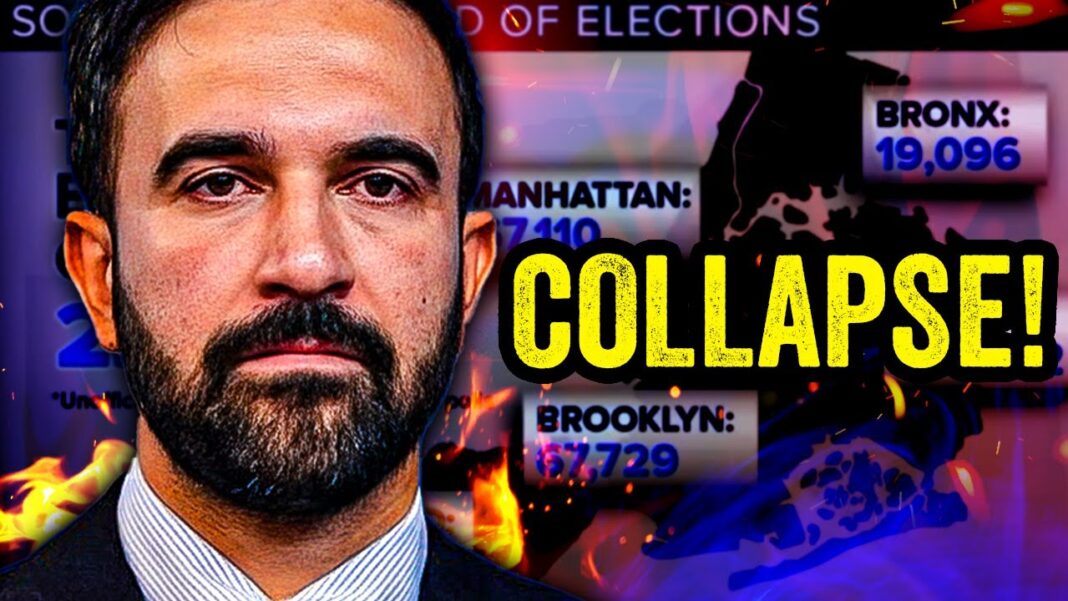
The city’s Board of Elections released borough-by-borough data showing significant participation across all regions: Manhattan led with 24,046 ballots, followed by Brooklyn (22,105), Queens (19,045), the Bronx (7,793), and Staten Island (6,420). Observers have noted particularly heavy turnout in moderate-to-conservative enclaves such as Bay Ridge, Forest Hills, and Staten Island’s South Shore — areas that could favor Cuomo or Sliwa, depending on final Election Day patterns.
A new Suffolk University poll, corroborated by additional data from Quinnipiac University, paints a picture of a tightening race. While Zohran Mamdani continues to lead with 43 percent of likely voters, Andrew Cuomo has climbed steadily to 33 percent — narrowing the gap from double digits earlier in the month. Curtis Sliwa, though trailing at 14 percent, remains a wildcard capable of siphoning critical votes from disaffected moderates and outer-borough independents.
According to Quinnipiac’s October 23–27 poll, 6 percent of voters remain undecided — a margin that could easily swing the election in a city historically prone to late shifts in momentum. “With margins like these, turnout — not persuasion — will decide this race,” said political consultant Michael Oliva, a former Democratic strategist who spoke with The New York Post earlier this week. “If the current pace continues, we could see one of the highest municipal voter turnouts in New York City in two decades.”
For Mamdani, a 34-year-old state assemblyman from Astoria and an outspoken member of the Democratic Socialists of America, the surge in turnout presents both opportunity and risk. His campaign, built around promises to expand rent control, defund police tactical units, and redirect city funds toward social housing and climate programs, has galvanized young, progressive voters but alienated many centrists and older Democrats.
Political analysts writing in The New York Post and amNY.com have noted that Mamdani’s left-wing platform — once considered fringe in citywide politics — has drawn sharp rebukes from establishment Democrats. Cuomo has used Mamdani’s record to frame the race as a referendum on ideological extremism.
At campaign events in Brooklyn and Queens this week, Cuomo emphasized “restoring balance, safety, and sanity to city government.” He has positioned himself as the voice of pragmatism — a seasoned executive running outside the party system, promising to rebuild trust with law enforcement, stabilize rents through zoning reform rather than rent freezes, and expand economic incentives for small businesses.
“This isn’t about left or right,” Cuomo told a crowd in Flushing on Tuesday. “It’s about whether New York will remain a city of opportunity or become a city of dysfunction.”
His strategy appears to be working: internal polling reviewed by The New York Post shows Cuomo making gains among registered Democrats over 50 and independent voters disillusioned with both major parties.
Meanwhile, Curtis Sliwa, the charismatic radio host and public safety advocate who shocked many with his strong showing in 2021, finds himself struggling to maintain momentum in a race dominated by two higher-profile figures. Sliwa’s campaign has focused heavily on law-and-order messaging, calling for increased NYPD staffing, the reinstatement of cash bail, and a crackdown on subway crime.
While Sliwa maintains a loyal base among working-class outer-borough voters — especially on Staten Island and in parts of southern Brooklyn — strategists warn that the growing Cuomo coalition could blunt his appeal. “Sliwa’s base overlaps with Cuomo’s law-and-order Democrats,” one GOP operative told The New York Post. “If older Democrats start crossing over to Cuomo instead of voting Republican, Sliwa’s ceiling gets much lower.”
The flood of early voters has transformed libraries, community centers, and high schools into civic battlegrounds. At Brooklyn College’s early voting site, poll workers reported steady lines stretching around the block. In Queens, where Mamdani’s campaign has deployed hundreds of volunteers to canvass and provide rides to polling stations, turnout among younger voters has climbed, though it still trails older age groups.
Political scientists told The New York Post that the pattern suggests a complex electorate — energized but fragmented. “There’s a palpable urgency this cycle,” said Baruch College political scientist Mitchell Moss. “New Yorkers feel that the city is at a crossroads — between safety and reform, between pragmatism and ideology. The turnout reflects that tension.”
The timing of the vote may also play a role. Early voting concludes on Sunday, November 2, leaving just two days before Election Day on Tuesday, November 4, 2025. Experts anticipate a final weekend surge that could push the total well past half a million ballots — potentially matching turnout levels not seen since the Bloomberg era.
While public safety remains a dominant theme, economic unease continues to animate voters across the political spectrum. High rents, rising property taxes, rising anti-Semitism and post-pandemic inflation have converged into what The New York Post described as “a perfect storm of urban anxiety.”
As early voting enters its final days, both major campaigns are bracing for an unpredictable finish. Mamdani’s team has announced an aggressive get-out-the-vote push targeting first-time voters and students, while Cuomo’s campaign is banking on a late-breaking surge among independents and disaffected Democrats.
Election Day will determine whether the city’s experiment with progressive politics continues or whether a former governor, now recast as an independent reformer, can stage one of the most improbable comebacks in New York’s storied political history.
One thing, however, is certain: New Yorkers are engaged. After years of pandemic fatigue and political division, the surge in early voting represents something rare in contemporary city politics — a reawakening of civic energy and belief that the future of New York still lies in the hands of its voters.
As one election official told The New York Post amid the long lines at a Manhattan polling site, “You can feel it this year — people know their vote actually matters.”
Mamdani at Debate: “I Refuse To Recognize Israel as A Jewish State” – JFeed
https://www.jfeed.com/news/mamdani-israel-jewish-state-stance
David Ben Hooren and his TJV newspaper should NOW be printing OUTRAGED EDITORIALS against every “Jewish” organization and “rabbi” who refuses to PUBLICLY excoriate Mamdani and any “Jew” who does not aggressively publicly oppose him! You should have no concern whatsoever about alienating any of these evil ENEMIES of the Jewish people. If any of your readers don’t like it, tell them to GO TO HELL! You should be publicly identifying these antisemites!
THIS is your crucial moment for personally standing up for the Jewish people Mr. Ben Hooren!
New York Jews committed suicide. Not by a majority vote, but with massive antisemite defections. Non-enemy surviving Jews should recognize that in effect American Jews are now in an existential civil war. This is the equivalent of 1930’s German Jews voting with the Nazis. Jewish institutions and leaders whom did not publicly stand strongly against the enemy Jews should be abandoned, or entirely reformed from the top down. Families and community organizations should divorce themselves from the antisemites in order to survive.