



|
Getting your Trinity Audio player ready...
|
By: Abe Wertenheim
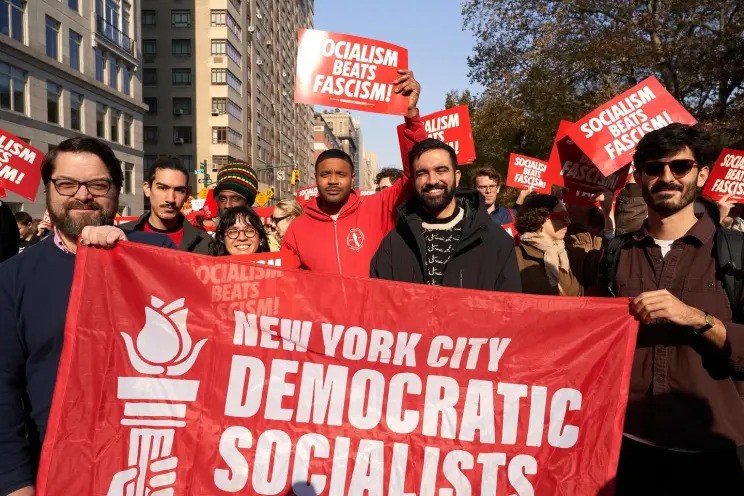
Astoria, once known primarily as a working-class enclave of Greek tavernas, mom-and-pop storefronts, and union households, is fast becoming something very different: a proving ground for New York City’s most ascendant political faction, the Democratic Socialists of America. According to a report that appeared on Saturday in The New York Post, the race to replace Mayor-elect Zohran Mamdani in the State Assembly is shaping up to be one of the clearest illustrations yet of how dramatically the ideological center of gravity has shifted in northwest Queens.
The contest to claim Mamdani’s soon-to-be-vacant seat in the 36th Assembly District—which includes Astoria and parts of Long Island City—features three candidates, all women, all committed members of the DSA, and all running on platforms that push the boundaries of political radicalism even by New York City’s left-wing standards. For an area sometimes jokingly dubbed “the People’s Republic of Astoria,” the race marks not merely a special election but a referendum on what kind of politics will define the neighborhood’s future.
And if The New York Post’s coverage is any indication, the choices before voters will be stark.
Zohran Mamdani, who has represented the district since 2021, will vacate the seat on January 1 when he is sworn in at City Hall. Under state law, Governor Kathy Hochul will have ten days to call a special election, with the race to occur within two months.
There are no Republicans running. There are no moderate Democrats running. There is only the left—and the further left.
Mamdani’s tenure as a state legislator was marked by ideological fervor but not legislative diligence. As The New York Post reported, he was absent for an astonishing 50 percent of legislative votes this year, including the one vote on the only bill he managed to pass. Yet his record has not deterred his loyalists; if anything, it appears to have emboldened them.
His close ally Diana Moreno—widely considered the frontrunner among the DSA-backed trio—dismissed concerns about Mamdani’s attendance record. She told The New York Post that Mamdani “exceeded [her] expectations” as a legislator. Moreno, who worked on Mamdani’s 2020 Assembly campaign, spoke fondly of him personally as well, recalling that the son of millionaire filmmaker Mira Nair and Columbia professor Mahmood Mamdani once regularly texted her to borrow $20 to do laundry when he ran out of cash.
The anecdote, which raised eyebrows even among seasoned political observers, encapsulates the curious intersection of privilege and performative austerity that has come to characterize much of the DSA’s political class in New York—a dynamic that The New York Post has scrutinized with increasing intensity.
Perhaps the most ideologically extreme of the three candidates is Meherunnisa “Mary” Jobaida, a 45-year-old first-generation Bangladeshi American whose criminal justice platform pushes beyond even the most radical planks of the DSA’s preferred policies.
Jobaida explicitly calls for “decriminalizing all forms of poverty,” a phrase that may strike sympathetic ears but which, as The New York Post report noted, translates in practice to eliminating arrests for fare evasion, unlicensed vending, and food theft. Her platform portrays such activities not as infractions but as desperate acts of survival. “Countless residents… are punished simply for trying to survive,” she writes.
But the most controversial aspect of Jobaida’s agenda is her call to “abolish prison except in cases of violent crime.” She describes nonviolent offenses as “mistakes,” a formulation so sweeping that even Zohran Mamdani—himself no moderate—distanced his campaign from similar DSA-backed proposals to decriminalize all misdemeanors.
Jobaida’s vision would effectively dismantle vast portions of the criminal justice system and has drawn criticism from law enforcement officials, prosecutors, and community organizers concerned about quality-of-life issues. Yet among a segment of Astoria’s electorate—typically younger, college-educated, and politically hyper-progressive—her ideas have deep resonance. She is working vigorously to secure the DSA’s formal endorsement.
Diana Moreno, at 38, is a seasoned DSA organizer, Queens mother, immigrant activist, and the candidate most deeply embedded in the city’s socialist political machinery. She has served as the communications director and co-chair of the Queens chapter of the DSA, giving her deep ties to the faction’s operational base.
Moreno’s rhetoric mirrors the movement’s maximalist language. In explaining her decision to run, she declared: “This is a moment of political crisis… As a mamá, I have no choice but to fight.” She referenced what she described as a “rising tide of fascism,” citing ICE raids and cuts in social services as motivating factors.
Her campaign narrative, as reported by The New York Post, is one part personal story and one part apocalyptic warning. She casts herself as a frontline defender against authoritarianism, a role that resonates with the DSA base but raises concerns among more moderate Queens residents wary of ideological catastrophism.
Moreno’s early advantage in organizational support became clear when she secured an endorsement from Socialists in Office, the DSA-aligned slate that includes State Senator Julia Salazar, Senator Jabari Brisport, and Assembly Member Emily Gallagher. These endorsements give her a built-in fundraising and volunteer network, as well as instant credibility with movement voters.
She is also the candidate most likely to carry forward Mamdani’s political legacy—not just ideologically, but temperamentally. Those close to the movement describe her as loyal, consistent, and unflinchingly committed to DSA priorities.
The third contender, Rana Abdelhamid, brings a distinctly different kind of public profile. A 32-year-old Harvard-educated activist and former Google employee, Abdelhamid spent years earning a six-figure salary while simultaneously denouncing corporate America—a contradiction The New York Post report highlighted with characteristic bite.
Abdelhamid came to prominence for her activism against post-9/11 anti-Muslim hate. She has founded two organizations—Hijabis of New York and Malikah, a self-defense and women’s empowerment program. These organizations emerged following an incident she says occurred when she was 16, in which a man attempted to pull off her hijab in Queens. Although she never reported the assault to the NYPD, the story has become the narrative foundation of her political and activist identity.
She previously ran an ambitious but unsuccessful congressional campaign in 2022, in which she described herself as a transformative figure. She told supporters that many consider her “the mayor of Queens,” a remark that The New York Post covered with a mixture of fascination and skepticism.
Her political orientation aligns closely with the DSA, and she has not shied away from public activism reflecting the organization’s most controversial positions. Weeks after the October 7, 2023 Hamas terrorist attack, Abdelhamid shared video of her own arrest at a pro-Palestinian protest held at Grand Central Terminal—a demonstration that led to dozens of arrests and generated condemnation from Jewish groups across the city.
The absence of any moderate or center-left candidates is perhaps the most defining feature of the special election. As The New York Post report pointed out, there is simply no ideological counterweight in the race. The electorate—dominated by younger, transient, heavily renter-based populations—has become a reliable incubator for socialist organizing and a burial ground for challengers from traditional Democratic factions.
This reality raises profound questions for the future of the district. What happens when an entire neighborhood’s political spectrum shifts so far left that terms like “radical” or “extreme” lose their meaning? What becomes of local governance when every viable candidate takes positions once confined to the margins of American politics?
Whoever wins the special election will not merely inherit a legislative seat. She will inherit a movement—and the responsibility to either escalate or temper its ambitions. The outcome will reveal whether the DSA’s grip on Astoria is tightening, stabilizing, or beginning to fragment under the weight of its own internal diversity.
As The New York Post reported, Astoria’s political realignment is no longer an anomaly. It is a signpost for the direction in which the city’s younger, left-leaning neighborhoods are heading: toward uncompromising ideological experimentation, toward candidates who frame every local issue as a struggle against structural oppression, and toward a politics that increasingly sees moderation not as prudence but as betrayal.
In the next several months, Astoria will choose not just a representative. It will choose the next stage of its identity.
And in doing so, it will offer the rest of New York a glimpse—perhaps a warning—of the city’s political future.