



|
Getting your Trinity Audio player ready...
|
By: Ronald J. Edelstein
On a day steeped in historical memory and moral gravity, New York’s gubernatorial race took on a sharply symbolic dimension as Nassau County Executive and Republican gubernatorial frontrunner Bruce Blakeman issued an uncompromising demand: that New York State formally adopt the International Holocaust Remembrance Alliance’s (IHRA) definition of antisemitism into law. Speaking on Tuesday in commemoration of International Holocaust Remembrance Day which marks the liberation of Auschwitz by Soviet armies, Blakeman transformed a solemn day of remembrance into a pointed political and cultural confrontation, one that, as The New York Post reported, directly targeted both Governor Kathy Hochul and New York City Mayor Zohran Mamdani.
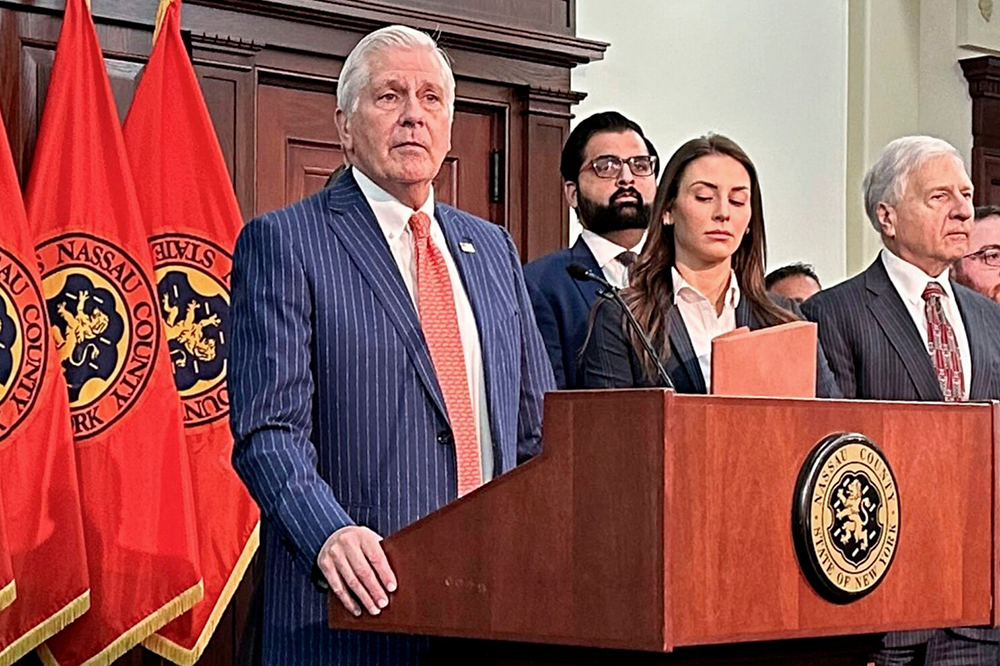
Standing in a yarmulke, flanked by Israeli Consul General Ofir Akunis, Blakeman delivered his remarks with the cadence of a man framing not merely a policy debate, but a moral reckoning. According to the report on Tuesday in The New York Post, he accused state and city leadership of failing the Jewish community at a moment when antisemitism is surging nationwide, insisting that symbolic gestures and proclamations are no longer sufficient in the face of an escalating crisis.
“New York State has not adopted the definition,” Blakeman declared, his voice sharpened by indignation, as The New York Post report recounted. “On top of that, Mayor Adams, who adopted the definition, was overturned by the new mayor, Zohran Mamdani. We believe this is a disgrace, it’s an injustice, and we’re demanding our elected officials adopt that definition.”
At the center of the controversy is the IHRA’s working definition of antisemitism, which describes antisemitism as “a certain perception of Jews, which may be expressed as hatred toward Jews.” The definition, which has been adopted by dozens of countries, governments, and institutions worldwide, also includes illustrative examples that address contemporary manifestations of antisemitism, including certain forms of demonization and delegitimization of Israel. Supporters argue it provides clarity in an era when antisemitism increasingly appears in coded language and ideological frameworks rather than overt slurs. Critics, however, argue it risks conflating legitimate criticism of Israeli government policy with hatred of Jews.
As The New York Post has extensively documented, antisemitic incidents in the United States have risen dramatically since the Hamas attacks of October 7, 2023. Jewish civil rights organizations have recorded spikes in synagogue vandalism, physical assaults, campus harassment, online incitement, and threats against Jewish institutions. Blakeman framed his demand for formal adoption of the IHRA definition as a necessary legal tool to confront this new wave of hostility with clarity and force.
But his remarks were not aimed solely at abstract policy. They were sharply personal and political. Blakeman directed particular ire at Mayor Zohran Mamdani, whose first executive order after taking office on January 1 reversed a series of executive actions issued by former Mayor Eric Adams. As The New York Post reported, Mamdani overturned nine of Adams’ orders, including the city’s formal adoption of the IHRA definition and a separate directive barring city agencies from participating in the BDS (Boycott, Divestment, Sanctions) movement targeting Israel.
Blakeman characterized these reversals not as administrative housekeeping, but as a moral retreat. He labeled them “an injustice” to New York’s Jewish community and accused Mamdani of dismantling hard-won protections at a time when Jewish New Yorkers feel increasingly vulnerable. Although Mamdani retained the city’s Office to Combat Antisemitism—an institution created under Adams—the symbolic removal of the IHRA definition from city law became, in Blakeman’s framing, a defining act.
Governor Hochul, too, found herself in Blakeman’s crosshairs. While Hochul signed a 2022 proclamation recognizing the IHRA definition as a guidance tool—a move she later described to The New York Post as part of her broader commitment to protecting Jewish New Yorkers—Blakeman dismissed the proclamation as insufficient. In his view, symbolic recognition without statutory adoption amounts to moral ambiguity at a moment when clarity is needed most.
The tension surrounding the IHRA definition reflects a deeper fault line in American political discourse. Opponents argue that the definition is overly broad and could chill speech, particularly criticism of Israel’s policies in Gaza. Supporters, by contrast, argue that antisemitism has evolved into forms that often masquerade as political critique, making clear definitional boundaries essential.
Asked whether criticism of Israel’s government could be considered antisemitic under the definition, Blakeman said that criticizing Israel for acting in self-defense after October 7 “defies logic.” His answer underscored the emotional and moral weight that now surrounds the debate, where legal definitions intersect with trauma, fear, and identity.
What elevates this confrontation beyond routine political sparring is its historical framing. By choosing International Holocaust Remembrance Day for his statement, Blakeman explicitly linked contemporary antisemitism to the catastrophic consequences of political silence and moral relativism in the 20th century. The symbolism was deliberate: remembrance, in his view, must translate into policy, not just commemoration.
The New York Post has framed this moment as emblematic of a broader cultural struggle unfolding in New York politics, where issues of identity, ideology, and historical memory increasingly collide. The city and state’s Jewish population—among the largest in the world outside Israel—occupies a unique position in this debate, both as a demographic reality and as a moral constituency shaped by collective memory.
For Blakeman, the adoption of the IHRA definition is not merely a bureaucratic act but a declaration of civilizational values. He has cast it as a line in the sand, a statement that New York will not tolerate ambiguity when it comes to hatred directed at Jews, regardless of the political language in which that hatred is expressed.
Yet the controversy also reveals the complexities of governing a pluralistic society where definitions of hate, speech, and political criticism are deeply contested. The New York Post has chronicled how these debates have intensified since the Gaza war, as accusations of “genocide,” calls for boycotts, and ideological polarization have reshaped public discourse. In that environment, the IHRA definition has become both a shield and a lightning rod.
Blakeman’s remarks signal that antisemitism will not be a peripheral issue in the gubernatorial race, but a central moral and political fault line. By directly challenging Hochul and Mamdani, he has positioned himself as the candidate of legal clarity and moral absolutism on this issue, framing his campaign as a referendum on how New York defines and confronts hatred.
As The New York Post has repeatedly emphasized, this is not an abstract debate. It is unfolding in a city where Jewish schools require security guards, synagogues operate under constant threat assessments, and communities live with the memory of attacks that are no longer confined to history books. Against that backdrop, Blakeman’s demand resonates not simply as political rhetoric, but as an attempt to anchor policy in moral memory.
In the end, the clash over the IHRA definition is about more than language. It is about whether the state will codify a shared understanding of antisemitism in law or leave it to interpretation and political discretion. It is about whether remembrance remains ceremonial or becomes institutional. And it is about whether New York’s leaders will draw firm boundaries against hatred—or continue to navigate the ambiguities of a fractured political landscape.
On International Holocaust Remembrance Day, Blakeman offered a stark proposition: that memory without action is hollow, and that definitions matter because they shape what societies choose to protect. Whether New York embraces that vision or resists it may help define not only the upcoming gubernatorial race, but the moral architecture of the state’s response to antisemitism in the years ahead.
