



Decentralize NY’s Failed Government and Politics to Save the City: Mayor Wagner Did, Mayor Lindsay Tried
By Gary Tilzer
40% of employees who reside in Manhattan said they’re thinking of leaving as did 48% — nearly half — of workers who live in the city’s other four boroughs, the online Morning Consult poll of 9,386 employees found. It was commissioned by the Partnership for The City of NY.
People and businesses leaving NYC say it is because the government is out of control, nobody is in charge, even those not moving agree NY’s Government is not solving its major problems and that voting for change is useless. Right now, the city’s elected officials are ignoring the reasons for the mass move out, as they divide the spoils of the city and state budget to funnel billions to the nonprofits, developers, and unions who help them fund their reelection campaigns. We currently have a dysfunctional election system where incumbent elected officials almost always win reelection; in other words, they get away with not serving the public. The media and the public expect the new mayor to lower crime and bring back NY’s economy, political talking heads say his reelection depends on it. But there has been no media or public discussion on responsibilities and blame of NY’s other elected officials, who are equally responsible as the mayor for: the crime crisis, homelessness, bad schools, and New Yorkers leaving the city.
It is clear that the average NY voter has no ability to make their local elected officials accountable. Even activists on the Eastside who fought unsuccessfully on Twitter and Facebook to pressure elected officials to save the trees in their local park, now understand that they have no power to influence the government, to protect their community. It is sad that these Eastside activists, those groups fighting crime and others upset with NY’s government inability to solve problems, never think of working together to use their voices to reorganize the government to make elected officials reelected depend on listening to the voters. It is not even clear the so-called community leaders understand that the special interests have taken over the NY’s elections system, cutting their and the voters’ interests and concerns out.
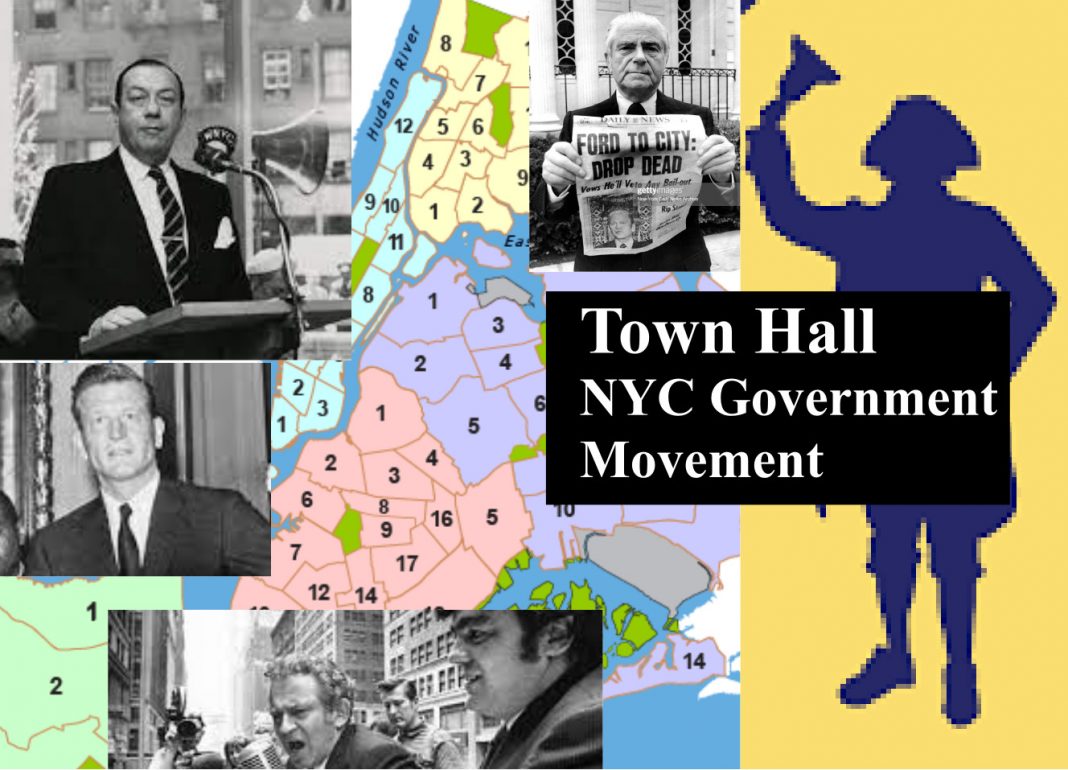
What today’s New Yorkers do not understand, empowering the public and city’s neighborhoods against the power brokers, has historically been done and proposed before by past mayors and mayoral candidates. In 1963, after Mayor Robert Wagner won a third term against Tammany Hall who elected him for his first two terms, created a new citywide layer of government called Community Boards, to go around the political machine control of government, to give the public and city’s neighborhoods a voice in City Hall.
It has been widely accepted that NYC will not restore its economy and get residents and businesses to move back to the city, until the crime crisis ends. Unfortunately, it will take more. To bring back NYC’s swag and attitude culture that made people want to live here, and do business here, the city has to make people confident that they control the future of NYC, not the special interests. Mayor John Lindsay used to call NYC “Fun City” where people want to live, work, and enjoy life. Lindsay, who fought to create “Mini City Halls” in each of the 62 Community Board Districts, understood that to make the city successful, government power has to be in the hands of the people and the city’s neighborhoods. Decentralizing government increases participation and makes it easier for the public to place blame on specific local elected officials and put their political future in jeopardy if they continue to allow bad city services and problems to continue in their neighborhood.
Elected Officials Only Care About Getting Reelected, They Use A Team of Special Interests Insiders to Do So
Elected officials are protected by political insiders who are in total control of NY’s dysfunctional political system. Their campaigns depend on special interests like developers and city contractors for financial help, and political insiders like lobbyists consultants, unions, and nonprofit PACs to run and staff their reelections. It is clear that their campaigns are run and controlled by lobbyists and groups that want something from the government and don’t care about the problems facing the city or the average New Yorker. Rank Choice Voting (RCV) pushed by the Good Government groups like Common Cause only helps the organized insiders, like unions, progressives, and lobbyists who already control who get elected, elect more of their chosen candidates. RCV does nothing to make government function better for the average New Yorkers, or accountable to the needs of the average voter, who are now basically cut out of the election process. Politicians are very simple. If you’re not involved or necessary in getting them elected or reelected, your needs will be ignored, by those running the government.
Lobbyists who now run and help fund most of NY campaigns interests, was best described in a quote in a 2010 article written by the late journalist Wayne Barrett in the Village Voice. The great investigative reporter quoted long-time lobbyists and NY Post filler Hank Sheinkopf, “Lobbyists elected kings, so they can eat the king’s meat.” Unions like the UFT spend millions on elections to win big contracts and favorable work rules from the candidates they elected to run the government. Even President Roosevelt, who brought us modern progressive labor laws, was against government unions, for their unfair leverage to get sweetheart contracts from the elected officials they helped to get into office. Developers who employ the lobbyist campaign consultants, spend millions on local campaigns to have the power in City Hall to change zoning and rip apart neighborhoods to build tall buildings and push the poor and minorities out with such ease, even making the late Robert Moses jealous. Today’s special interest-controlled government allows the mayor’s safety plan to be blocked by Albany politicians who refuse to reform the bail laws that over 65 percent of New Yorkers support, give state judges more discretion favored by 82 percent of New Yorkers, according to recent polls. Even Tammany Hall listened, and protected voters and protected neighborhoods more than today’s special interests elected officials, their get out the vote operation depended on it.
Tammany Hall Functioned From the Bottom Up Empowering and Protecting Voters and Neighborhoods
Terry Golway in his book “Machine Made” explained how Tammany Hall used a network of neighborhood leaders called district captains to turnout voters to win elections. To make sure the voters came out on election day to vote for Tammany’s candidates, the Tammany captains provided a safety net of social services and favors for the voters and their families, like jobs, provided food and shelter for the poor, health care for the sick and help to find housing. The district captains who needed the voters on election day, would never allow their voters to be pushed out by gentrification, they protected the communities where their votes came from.
Two Attempts to Decentralize NYC Government Were Defeated by New York’s Political Class Insiders
During his administration Mayor John Lindsay created a plan for a network of Little City Halls as a counterpart to what the political clubhouse used to do but did not do anymore. Lindsay wanted to transfer power to the city’s 62 community boards to decentralize the city government into a system of “Little City Halls, to speed up services and give the communities and the average New Yorker a voice on making sure those services are properly run and problems like poverty are addressed. The democratic majority City Council blocked Republican Lindsay’s Little City Halls plan because they said it would function as a political clubhouse for the mayor. The City Council did not want the community boards to have power over them and decades later in one-party NYC they still control appointments to the Community Boards today along with the Borough Presidents.
NYC in 1969 was eerily in similar bad shape, as it is today. In the late 60’s the city was also suffering from sinking finances, rising crime rates, an expanding dysfunctional insider-controlled City Hall, and Albany legislature, as millions of middle-class residents fled to the suburbs. The award-winning author Norman Mailer ran for mayor along with journalist Jimmy Breslin on his ticket for the discontinued office of the Council President. Both men ran on the platform seeking to transfer City Hall and Albany power into the hands of the neighborhood’s leaders and the voters. They both believed that power centralized with insiders in government, party bosses and other special interests, blocked the “energies of the people of New York” whose only interest was to make the city a better place to live, work and enjoy.
Mailer and Breslin believed that decentralizing city government into self-ruling neighborhood municipalities would offer creative solutions to long term problems and enable the public by making local government and elections more connected to the neighborhoods. They wanted neighborhoods to put pressure on City Hall and Albany to act more responsibly to solve problems and elect more community leaders to elective office, who were already serving the public and solving the neighborhood’s problems.
Is Adams Being Forced By NY’s Dysfunctional Government to Become the Next Mayor Beame? Who’s Only Remembered for the 70s Fiscal Crisis
Today, like in 1969 New Yorkers have no other purpose than to watch with certain gallows humor and hopelessness, the progressive deterioration of their city or join the group leaving it. The special interests who gamed the election system, NYC’s one-party political control, no recall option and even the recent partisan redistricting, has not only weakened the public’s ability to influence their government. Charter Changes to empower the public and the neighborhoods like Mayor Wagner accomplished with the creation of local Community Boards, is impossible and very troublesome. If NYC does not start functioning better, the economy will continue to fail, deep cuts in city programs and workforce will become necessary. If NYC falls into a recession like during the 70’s financial crisis the governor will have to step in to take control of city government and reorganize NY’s dysfunctional political system that only serves insiders, while ignoring everyone else. NY Times 3/27/22 Federal Covid Cash Kept New York State Afloat. That Could End Soon. “All I know is that when the federal money runs out, it is highly likely that the state and the city are going to face budget crises of significant proportion,” said Richard Ravitch, the former state official who helped mastermind the rescue of New York City’s finances in the 1970s.
Only by restoring power to the city’s neighborhoods and its residents can New Yorkers put pressure on elected officials to really fix the homeless, bad schools, build more affordable housing and help small businesses succeed. Until we decentralize NY’s political system, the UFT political machine has more influence over the elected officials, than parents. Developers and city contractors with their pay to play lobbyists who double as campaign consultants own the elected officials. Nonprofits who wasted billions of the taxpayer’s monies, while their high paid board members fund elected official’s reelection campaigns, are not going to give up their power and control over elected officials without a fight. The city economy is not recovering, its unemployment rate is more than double the national average. New Yorkers continue to move out, businesses like Right Aid on the Upper Eastside closed because of continued looting, the mentally ill homeless continue to prey on the innocent, and the city’s poor are being economically squeezed because of rising prices, including rent, caused by inflation. It is time for the city leaders to adopt Mayor Wagner and Lindsay’s strategy to decentralize the city’s government, to make it work better and restore NYC Swager and Attitude.
Tammany Hall Decentralized Governing Style Can Be Incorporated into NY’s Government to Put the Voters in Charge and Neighborhoods Strong Again
- A New Board of Estimate
Replace Borough Presidents and the Public Advocate with a reconstituted Board of Estimate (BOE) whose members would be elected from same size districts. The new BOE would take over the function of passing the budget from the City Council and all the duties of the Borough Presidents. The size of the new BOE district would be equal to the population of Staten Island. SI would get one member, Queens 4.5 members, Brooklyn 5 members, the Bronx and Manhattan 3 members. Each borough member of the BOE would have one vote. The mayor would have 3 Votes, the Comptroller, and the City Council Majority Leader both would have 1 vote. The new BOE would function like the British house of Parliament with transparency in clear debates on budget and other city issues that are done in secret now.
Each large NYC borough is made up of many diverse very different neighborhoods. It is impossible for Borough President to represent communities in her or his borough that compete with each other for city services. Homeowners in Southern Brooklyn have nothing in common with the progressive left-wingers in Northern Brooklyn and both have little in common with Afro-Americans in Central Brooklyn. They all have different wants, needs and problems that a Boro President that wins with 27% of the borough, cannot possibly represent. A New BOE would divide large boroughs into neighborhood districts that have common wants and needs, giving voters and neighborhoods more power in City Hall.
The old NYC Board of Estimate was a governmental body in NYC responsible for numerous areas of municipal policy and decisions, including the city budget, land-use, contracts, franchises, and water rates. The BOE was composed of eight ex officio members: the Mayor, the Comptroller, and the President of the City Board of Aldermen (City Council) the borough presidents. In 1957, the Charter was amended to raise the number of votes on the Board to twenty-two. Twelve of these votes were held by the three citywide officials, and the five borough presidents were allotted two votes each.
In 1989, the Supreme Court of the United States unanimously declared the Board of Estimate was unconstitutional on the grounds that Brooklyn, the city’s most populous borough, had no greater effective representation on the board than Staten Island, the city’s least populous borough, and that this arrangement was a violation of the Fourteenth Amendment’s Equal Protection Clause pursuant to the high court’s 1964 “one man, one vote” decision. The NYC Charter Revision Commission drew up changes to the municipal government, which were approved 55% to 45. The Charter abolished the BOE and assigned most of its responsibilities to an enlarged New York City Council.
- Replace Community Board with Town Halls
Members who vote in the Town Halls would not be appointed like the Community Boards. They would be elected like the political party’s County Committee member by election districts contained inside each Town Hall. All of the meetings would be broadcast live on the internet, which would allow the public to vote and comment on the major issues like zoning and land use, and other major issues that the Town Hall would address. City Council Members would function more like Tammany Hall District Leaders or city managers of the Town Halls hiring half the staff for the Town Hall. The council district offices would be located inside the Town Hall building. During the Tammany Hall era elected officials worked inside the political clubhouses, to make them more accountable to the party, public and community’s needs. The mayor would hire the Town Hall District Manager and technical staff. Council Members would be given the same powers of the Controller to monitor, and audit city agencies, making decisions regarding proposed contracts, issuing monthly reports on the state of the Town Hall’s economy. The City needs a second set of eyes doing audits on city agencies and nonprofit funded programs and government services, including the schools. City Comptrollers always seem to run for higher office, never doing any oversight over the nonprofits who waste millions operating corruptly, lobbyists, city contractors and developers who would be expected to fund the city’s top accountant mayoral campaign.
- Democracy Vouchers Replaces the 8 to 1 Matching Fund Public Finance System
Under the Democracy Voucher public finance system (begun in Seattle), the government gives four $25 vouchers to registered voters and asks voters to assign their vouchers to their preferred candidates. Democracy Vouchers are the most democratizing and egalitarian method of public funding for a campaign that has been invented, according to former councilman member Sal Albanese, who believes “It would force those running for elective office to respond to the needs of the public to obtain public funding.” Switching to the Democracy Vouchers system will stop the city from wasting millions, funding candidates created by lobbyists and other outside groups, who have no grass roots support, just to collect a government paycheck. If the city no longer funded candidates with no community support, consultant, machine, and left-wing machine created candidates would drop out, allowing voters to support candidates who were already working in the community to make it a better place to live.
- Open Elections Replace Democrat Primaries
95% of the city’s elected officials are selected during the Democratic Primary. General Elections in one-party NYC are low turnout rubber stamps, except in Staten Island and one area in Brooklyn and Queens. Open elections would allow two million moderated registered voters to vote for the candidate they want to represent them. The current system suppresses the votes of those two million city registered voters, giving progressives unfair and undemocratic advantage to elect who represents the city in City Hall and in Albany. Open elections would increase the number of competitive elections which would increase voter turnout, which remains very weak even in the 2021 mayoral primary. Open elections would do away with Rank Choice Voting and bring back the runoff system of elections. The runoffs in the old system gave power to the voters to learn more about the top two candidates by extra debates in citywide runoff races. There were two problems with the old runoffs, they did not include council candidates, and low turnout. The first problem: no council or a new BOE runoff could easily be fixed by a charter commission change requiring runoffs in all city elections. The problem with low turnout can be fixed with early voting and mailing absentee ballot applications to everyone like the BOE did during the height of the pandemic.
- Judge and District Attorney Elected From the New BOE Districts
Judges and DAs should reflect community values. Judges should not be an arm of the political machines or political insiders chosen by the mayor and govern selection committees. DAs like Bragg should not be chosen by George Soros, they should be selected by the voters in small districts. As the Governor reorganizes the state’s court system the control of electing judges, including Supreme Court Judges, should be removed from the political machines, elected officials and given to the voters.
Can NYC That Historically Helped Immigrants Become the Best They Could Be, Continue? If Not, What Does the City Lose?
Progressives who tell us today that we have to reimagine NYC government, have no understanding that historically strong immigrant neighborhoods of decentralized government help make NYC the greatest city in the world. Where teaming members of immigrant neighborhoods with power to influence local elected officials with help of the Tammany machine made NYC great, economically strong and built the richness in character, the NY swag that of growing up strong neighborhoods gave New Yorkers. The strong neighborhoods gave immigrant families, and millions like them the ability to climb up the ladder to have extraordinarily successful lives, to live the American Dream. It gave Colin Powell’s immigrant family the ability to raise a son to become Secretary of State, a possible presidential candidate. The secret magic of NYC is that the welcome of the Emma Lazarus poem on the Statue of Liberty did not end with immigrants’ ships arriving at NYC’s shores. We are losing that NYC. A few years ago, the late journalist Pete Hamill said developers were sucking the life out of NYC’s neighborhood eco-system, causing New Yorkers to lose a sense of themselves as people in control of their own lives. Hamill further said the richness of character of growing up in the city’s neighborhoods, was being determined by some other standard but not by the standard that had shaped him and the generations that made New York City a special place. What Hamill did not see was that as the city’s neighborhood weakened, the greedy special interests took over the political system and their greed was breaking the immigrant’s Golden Goose. If the special interests remain in control and the NYC economy continues to fail, that important NYC immigrant ladder will be broken and so will our city.
