



|
Getting your Trinity Audio player ready...
|
By: Fern Sidman
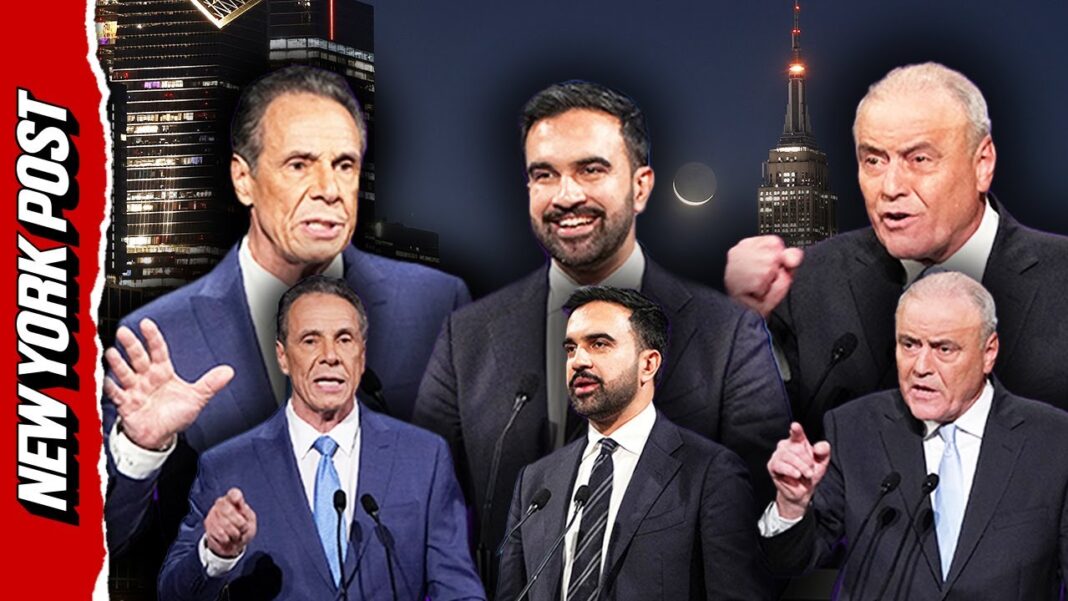
It was billed as the final clash before New York City voters head to the polls — but what unfolded Wednesday night at LaGuardia Community College was less a debate than a political brawl. With less than two weeks before the November 4 mayoral election, Democratic frontrunner Zohran Mamdani faced an unrelenting onslaught from both Andrew Cuomo, the scandal-scarred former governor running as an independent, and Curtis Sliwa, the ever-combative Republican candidate and founder of the Guardian Angels.
According to a report on Wednesday evening in The New York Post, the 90-minute debate — televised live by NY1 and attended by a boisterous audience of supporters from all three camps — proved the most bruising night of Mamdani’s campaign. The 34-year-old socialist assemblyman from Queens, known for his calm demeanor and progressive rhetoric, appeared visibly rattled as Cuomo and Sliwa teamed up to expose what they characterized as his lack of experience and evasive approach to policy. Sweat glistened on Mamdani’s forehead as the moderators pressed for clarity on public safety, housing, and education, and his opponents pounced on every pause, every vague platitude, every non-answer.
“Don’t be a politician,” Sliwa snapped at one point, when Mamdani dodged a question about local ballot proposals. “You’re not fooling anyone.” Cuomo piled on: “Oh, what a shocker,” he sneered, mocking Mamdani’s response with a theatrical hand gesture. The Post described the exchange as “Rock ’Em Sock ’Em politics at its rawest” — and the young frontrunner, usually so fluent in progressive talking points, struggled to keep his footing.
Throughout the evening, Mamdani — a democratic socialist who has campaigned on rent freezes, defunding the police, and sweeping reforms to public housing — found himself pressed for specifics he seemed unwilling or unable to provide. Asked about his proposal to abolish mayoral control over public schools, Mamdani repeated generalities about “the crisis in front of us” but failed to articulate any concrete plan for improving student outcomes or teacher accountability.
The New York Post reported that his response on public safety fared no better. Asked to explain how his proposed “Department of Community Safety” — which would dispatch social workers instead of police to handle domestic violence or mental health calls — would work in practice, Mamdani vaguely asserted that “such approaches have worked elsewhere in the U.S.” but could not name any cities or results. “I trust the dispatchers to make that determination,” he said, prompting groans from the audience.
On housing, the issue that has defined much of the campaign, Mamdani repeated his mantra about “streamlining private sector construction” but offered no concrete mechanism for cutting through New York’s notorious bureaucracy. Even the ballot measures — relatively straightforward topics for a citywide candidate — left him fumbling. Asked for his position on proposals to move local elections to coincide with presidential years, Mamdani replied, “I have not reviewed the proposals.” Cuomo seized the moment, exclaiming, “You’re running for mayor and you haven’t read your own ballot?”
For Mamdani, whose campaign has leaned heavily on youthful enthusiasm and ideological purity, the debate’s format — quick, pointed, adversarial — seemed to expose a vulnerability. “He’s a good actor, but he missed his calling,” Cuomo jabbed later in the night, accusing his rival of “performing progressivism without understanding how to govern.”
For Andrew Cuomo, Wednesday’s showdown was a shot at redemption. The New York Post report noted that the 67-year-old former governor appeared sharper and more controlled than in last week’s debate, when his defensive tone and lingering resentment over his 2021 resignation had overshadowed his message. This time, Cuomo came armed with policy experience and barbed one-liners — turning his own political baggage into ammunition against Mamdani’s inexperience.
“He thinks he’s a kid and he’s going to knock [Trump] on his tuches,” Cuomo quipped, referring to President Donald Trump’s recent mockery of Mamdani as “my little communist.” Cuomo, boasting of his record on infrastructure, reminded voters of his achievements — including the redevelopment of LaGuardia Airport and the completion of the first leg of the Second Avenue Subway — as evidence that he could deliver results, not slogans.
The Post reported that Cuomo repeatedly challenged Mamdani’s rent-freeze proposal, calling it “political theater.” “Freeze the rent sounds great, yeah,” he said. “It affects about 25% of the city’s housing units. It’s not a new idea — Bill de Blasio did it. And by the way, the mayor doesn’t even have the power to do it. The Rent Guidelines Board does. So nothing is going to happen. It’s just the old political blather, Mr. Mamdani.”
When Mamdani attempted to reassure Jewish voters that he would represent them fairly despite his well-documented hostility toward Israel, Cuomo interrupted: “You are the savior of Jewish people?” The Post reported audible gasps in the audience. Cuomo, long known for his combative style, seemed to relish the moment, sensing that Mamdani’s ideological rigidity — particularly his refusal to condemn antisemitic slogans such as “Globalize the Intifada” — had left him exposed.
Yet Cuomo himself was not immune from attacks. His past scandals, including the sexual harassment allegations that forced his resignation, resurfaced when Mamdani accused him of hypocrisy and corruption. One of Cuomo’s accusers, Charlotte Bennett, sat in the front row — a stunt arranged by Mamdani’s campaign, as later confirmed by The New York Post. Cuomo, visibly rattled for the first time all evening, stumbled through a vague defense about “lessons learned” and “a new chapter.”
While Cuomo and Mamdani traded blows, Curtis Sliwa proved a wild card, alternating between attack dog and comic relief. The New York Post report described the Guardian Angels founder — his signature red beret perched atop a sun-tanned forehead — as “a man enjoying his moment on stage.”
Sliwa wasted no time attacking Mamdani’s inexperience. “Your resume could fit on a cocktail napkin,” he barked. But in the next breath, he turned his fire on Cuomo: “You fled from being impeached!” he shouted, reminding viewers of the ex-governor’s 2021 downfall. The dynamic gave Mamdani some breathing room — but also reinforced the image of a young candidate outmatched by two seasoned brawlers.
When asked how he would vote in a ranked-choice election, Mamdani surprised everyone by responding, “Myself number one, and Curtis number two.” Sliwa laughed, replying, “Oh, please don’t be glazing me here, Zohran.” The Post noted that it was one of the few light moments in an otherwise brutal exchange.
Still, Sliwa’s presence may have complicated Cuomo’s strategy. As political consultant Andrew Kirtzman told The New York Post, “It was Mamdani’s weakest performance this cycle — both his opponents were in rare form. But the problem for Cuomo is that he needed both of them to have a bad night. If Sliwa’s numbers don’t fall, there’s no way Cuomo can win.”
Indeed, polls show Sliwa’s base of loyal conservative voters — many of whom see him as a symbol of old-school New York grit — remains intact. His populist attacks on crime and his promise to “refund the NYPD” have resonated beyond traditional Republican enclaves, particularly in Staten Island and southern Brooklyn.
With early voting days away, the stakes could not be higher. As The New York Post has reported, Mamdani enters the final stretch of the campaign as the clear frontrunner, buoyed by progressive enthusiasm and a fractured opposition. Yet Wednesday’s debate revealed the vulnerabilities beneath that momentum: a candidate who can rally crowds but struggles to answer basic governance questions.
For Cuomo, the challenge is different — to convince voters that his experience outweighs his controversies. “The issue isn’t that we don’t know your experience,” Mamdani jabbed during the debate. “The issue is that we’ve all experienced your experience.” The line drew laughter from parts of the audience but also underscored the lingering resentment that still shadows Cuomo’s comeback bid.
Sliwa, meanwhile, faces pressure from some GOP insiders to drop out and consolidate the anti-Mamdani vote behind Cuomo. But as the Post noted, his performance Wednesday — fiery, humorous, unrepentantly populist — may have strengthened his resolve to stay in the race. “I’m not going anywhere,” he said afterward. “New Yorkers deserve a fighter, not another backroom deal.”
If the debate proved anything, it’s that New York’s 2025 mayoral race is as volatile — and as deeply personal — as any in recent memory. Mamdani, the charismatic yet polarizing socialist; Cuomo, the fallen titan seeking redemption; and Sliwa, the streetwise populist who thrives on chaos, represent three radically different visions of the city’s future.
The New York Post reported that the debate may have altered the race’s tone more than its trajectory. Mamdani remains ahead, but his aura of inevitability has been dented. Cuomo delivered his strongest performance yet, reminding viewers of his command of detail and his ability to dominate a stage. And Sliwa, ever the insurgent, showed once again that charisma and bluntness still have currency in a city hungry for authenticity.
As the candidates left the stage — Mamdani still dabbing his brow, Cuomo clasping his wife’s hand, Sliwa tipping his beret — the sense in the air was that the next 13 days will decide more than an election. They will determine whether New York’s next chapter is written by a socialist idealist, a scandal-tested veteran, or a street fighter with nine lives.
In the words of The New York Post, “It was the night New York’s mayoral race finally broke a sweat — and so did its frontrunner.”
