



|
Getting your Trinity Audio player ready...
|
Cops Nab Two Teenagers in Borough Park Playground Swastika Attack, City Confronts a Chilling New Face of Antisemitism
By: Fern Sidman
By any measure, the desecration of a children’s playground is an act that cuts to the moral core of a community. But when that vandalism is carried out with Nazi symbols—scrawled across slides, handball courts, and play structures in the heart of one of New York City’s most prominent Jewish neighborhoods—it becomes something far more than juvenile delinquency. It becomes a searing symbol of hatred, historical trauma, and a deeply unsettling cultural drift.
As The New York Daily News reported on Thursday, police arrested two 15-year-old teenagers and charged them in connection with a two-day vandalism spree that left 57 swastikas and Nazi slogans defacing Gravesend Park in Borough Park, Brooklyn. The playground, located at 56th Street and 18th Avenue in a heavily Orthodox Jewish neighborhood, became the epicenter of what city officials, community leaders, and residents have described as one of the most disturbing antisemitic incidents in recent memory.
According to the information provided in The New York Daily News report, the graffiti—painted in vivid red, yellow, and blue—covered playground slides, climbing structures, pavement, and the handball courts. The vandals returned to the park on consecutive nights, escalating the attack after the initial discovery. By Wednesday morning, the park had transformed into a grotesque gallery of hate symbols, including swastikas and the words “Adolf Hitler,” drawn brazenly in public view.
The timeline of the incident underscores its calculated nature. Community Board 12 first alerted the NYPD’s 66th Precinct on Tuesday after discovering antisemitic graffiti scattered throughout the playground. Officers and board members toured the site, documenting the damage and initiating an investigation.
But instead of retreating, the vandals returned Tuesday night.
As reported by The New York Daily News, more than 25 additional swastikas were added overnight—sprayed across equipment, sidewalks, and courts—bringing the total to 57 over two days. The escalation transformed what might have initially been perceived as isolated vandalism into a deliberate campaign of intimidation.
Photos shared by Community Board 12 showed the stark imagery: bright red and blue swastikas splashed across play areas where children gather daily, alongside explicit references to Adolf Hitler—symbols of genocidal ideology placed in a space meant for innocence and safety.
“Same park, different day,” the board wrote on social media, according to The New York Daily News report. “We are requesting that @NYPDHateCrimes pull out all the stops to catch these vile Jew haters.”
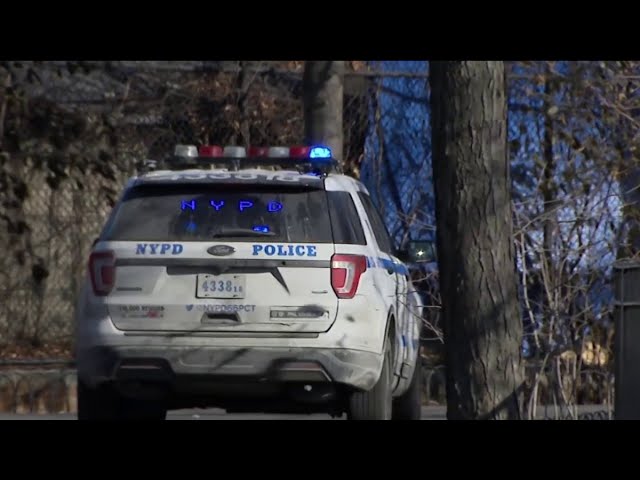
The NYPD Hate Crimes Task Force moved quickly. Using digital evidence and social media intelligence, officers from the 66th Precinct’s field intelligence unit identified two teenage suspects.
Both are 15 years old.
As detailed in The New York Daily News report, one teen is charged with multiple counts of aggravated harassment as a hate crime and criminal mischief. The second teen faces multiple counts of aggravated harassment. Police say one youth carried out the actual painting, while the other was present but did not physically draw the symbols—though both are alleged to have participated in the incident.
Officials have not publicly disclosed what specific evidence was found on social media, but authorities confirmed that online activity provided sufficient grounds to connect the teens to the vandalism.
The arrests brought a measure of accountability—but not closure.
The response from city leadership was immediate and forceful. In a statement cited by The New York Daily News, Mayor Zohran Mamdani wrote: “I am sickened by this antisemitic vandalism in Borough Park. Antisemitism has no place in our city, and I stand shoulder to shoulder with the Jewish New Yorkers who were targeted.”
He added that his administration is working closely with the NYPD Hate Crimes Task Force and the Parks Department, vowing that “those responsible will be investigated and held accountable.”
Former Governor Andrew Cuomo, now a mayoral hopeful, also condemned the act in blunt terms. As reported by The New York Daily News, Cuomo wrote: “This hateful defacement of a children’s playground isn’t just vile – it’s criminal. The person or people responsible must be found and held accountable to the fullest extent of the law. Inaction only emboldens antisemitic hate, and it’s getting worse by the day.”
New York City Comptroller Mark Levine framed the incident as part of a broader cultural threat.
“There is a concerted effort underway to normalize Nazi symbols and slogans,” Levine said, according to The New York Daily News report. “NYC can’t let that happen.”
City Council Speaker Julie Menin echoed those concerns, calling the vandalism “unconscionable” and emphasizing the psychological harm inflicted on children.
“The fact that children are playing here… and they see not one swastika, not two swastikas, but 57 swastikas, day after day — when is enough enough?” Menin said. “It is completely unacceptable.”
Menin also highlighted a chilling statistic that places the vandalism in a broader cultural context.
“Thirty-four percent of young people believe the Holocaust is a myth or exaggerated,” she said, as reported by The New York Daily News. “When you have that kind of disinformation and misinformation, that is what fuels hate.”
This is perhaps the most disturbing dimension of the story: the perpetrators are teenagers. Children themselves.
The defacement of the playground is not merely an act of hatred—it is a reflection of ideological contamination, historical illiteracy, and the erosion of moral boundaries. The symbolism of Nazi imagery in a Jewish neighborhood cannot be divorced from the educational vacuum that allows such symbols to become tools of provocation rather than universally recognized emblems of genocide.
Menin noted that the City Council recently introduced a package of anti-antisemitism bills, including proposals to create “safe zones” around houses of worship and schools—allowing protest, but at respectful distances. These measures, she said, are direct responses to rising hate incidents and escalating tensions.
Local residents told The New York Daily News that the vandalism struck at their sense of belonging.
“I was very saddened by the news,” said a 23-year-old college student who aspires to become a rabbi. “We’re living in a country where we celebrate freedom of all religions… and it’s very sad to see that in today’s world, we still don’t get the priorities right.”
For many families in Borough Park, this was not abstract hatred—it was personal. Children who come to Gravesend Park to play encountered Nazi symbols where they should find swings and slides. Parents were forced to explain imagery associated with mass murder and genocide to young children.
The psychological violence of that reality cannot be overstated.
Ironically, citywide hate crime statistics show an overall decline. According to figures cited by The New York Daily News, hate crime investigations across New York City decreased by 12% last year, from 657 in 2024 to 576 in 2025.
Antisemitic incidents dropped by 3%.
And yet, Jews—who represent about 10% of the city’s population—accounted for 57% of all reported hate crimes.
The data reveals a paradox: fewer total incidents, but a disproportionate concentration of hate targeting Jewish communities. This statistical reality reinforces what many Jewish New Yorkers already feel—that antisemitism remains the dominant form of hate violence in the city.
What happened at Gravesend Park is not simply a case of graffiti. It is an ideological act. A symbolic assault. A public ritualization of hate.
The placement of Nazi imagery in a Jewish neighborhood transforms playground equipment into political symbols. It converts public space into contested space. It tells Jewish families—explicitly—that they are targets.
And when those acts are carried out by teenagers, it raises a far more disturbing question: Where is this hatred being learned?
From social media? Online subcultures? Peer networks? Disinformation ecosystems? Historical ignorance?
The vandalism forces the city to confront not just criminal accountability, but cultural responsibility.
Law enforcement has acted. Political leaders have condemned the acts. Charges have been filed. The graffiti has been removed.
But as The New York Daily News emphasized in its coverage, this incident exposes deeper fractures—educational, cultural, and moral.
Antisemitism does not begin with spray paint. It begins with ideas. With narratives. With symbols stripped of historical meaning and repurposed for provocation. With ignorance that becomes ideology.
If hate can be written on playground walls, then the response must extend far beyond criminal charges.
It must involve education, cultural literacy, moral clarity, and sustained communal defense of democratic values.
Because when a children’s playground becomes a canvas for Nazi symbols, the issue is no longer vandalism alone—it is the corrosion of civic conscience.
And that is a crime no city can afford to ignore.
