



|
Getting your Trinity Audio player ready...
|
By: Ariella Haviv
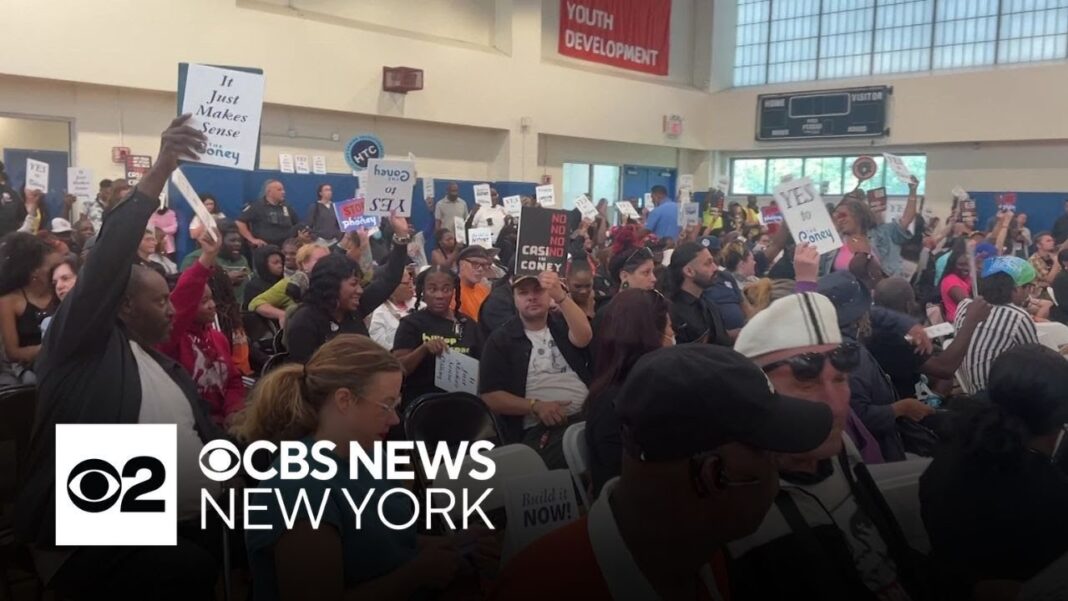
At 10 a.m. on Tuesday morning, the sidewalks outside the Coney Island YMCA were lined with residents eager—if not desperate—to make their voices heard. The occasion was the first public hearing of the newly-formed Community Advisory Committee (CAC), a six-member panel tasked with determining whether “The Coney,” a proposed 1.6-million-square-foot casino and entertainment complex, should move forward for consideration by the state’s Gaming Facility Location Board.
The hearing, as reported on Wednesday by The Brooklyn Paper (brooklynpaper.com), revealed a neighborhood at war with itself. Nearly 90 speakers registered to testify. By the end of the marathon session, it was clear that Coney Islanders remain deeply divided on what is being described as a once-in-a-generation gamble: whether to embrace a massive casino-hotel-retail development as the long-sought economic engine for the People’s Playground—or to resist it as a threat to Coney’s identity, culture, and fragile stability.
Dozens of residents were still lined up outside when security announced that not everyone would be permitted to enter the packed multipurpose room. The frustration boiled over as some would-be attendees shouted in protest. Inside, committee chair Council Member Justin Brannan tried to restore order as 90 voices, half-angry and half-pleading, prepared to dominate the morning.
According to the information provided in the brooklynpaper.com report, nearly two-thirds of those who testified opposed the project. Of the 90 speakers, 54 declared outright opposition, while 32 spoke in favor. The imbalance underscored a community wrestling with deep anxieties: economic despair on one hand, and fears of displacement and over-commercialization on the other.
The team behind The Coney, led by developer Thor Equities—owned by longtime Brooklyn real estate figure Joe Sitt—envisions nothing short of a transformation. Their proposal calls for a 1.6-million-square-foot mega-complex featuring a casino, luxury hotel, retail stores, restaurants, and entertainment venues, intended to draw tourists year-round rather than seasonally.
Developers have promised 4,000 temporary construction jobs and 4,500 permanent jobs, with at least 25% reserved for Coney Island residents. To bolster their case, they have pledged to create a $200 million Community Trust for neighborhood reinvestment and have vowed to lobby for long-awaited infrastructure improvements, including express subway service, increased bus lines, and even ferry access to the boardwalk.
As The Brooklyn Paper report noted, the developers’ framing of the project as an economic panacea resonated with some who argued that Coney Island has languished in “decades of disinvestment.”
Supporters argued that Coney Island needs bold investment to secure its future.
“This is a once-in-a-generation opportunity,” said Ron Greenberg, president of the 60th Precinct Community Council. Quoted in brooklynpaper.com, he described the casino as a vehicle for reviving the amusement district and addressing systemic unemployment. “Coney Island has been neglected for decades, and our community has been plagued by poverty and violence. The Coney casino will bring sustainable economic, social, and cultural improvements.”
Others echoed Greenberg’s optimism. Bob Ferazi, who leads the nonprofit Thompson Drive, told attendees that local youth see Coney Island as a dead end. “The number one goal of many of the kids living here today is to graduate high school and get the hell out,” he lamented. For Ferazi, The Coney offers a chance to anchor those kids with jobs and pride in their neighborhood.
Tenant association leaders also weighed in. Paula Jenkins, president of the Marlboro Houses association, pledged support if the promises hold. “I want you to be with us. We are with y’all, as long as you’re with us,” she told the developers directly.
Barbara McFadden, representing Sheepshead Bay/Nostrand Houses, made a pragmatic argument. “If we vote it down, is Luna Park going to fix the boardwalk? Is the Mermaid Parade going to donate its proceeds to infrastructure?” she asked rhetorically, according to The Brooklyn Paper. For her, the $200 million trust could address projects that otherwise languish in bureaucratic limbo.
While supporters heralded the developers’ job projections, skeptics remained unconvinced. Several speakers doubted whether permanent, well-paying jobs would actually be secured for Coney Island residents. Critics estimated that only a fraction—perhaps a few hundred—would benefit directly, while union construction jobs and service positions might largely go to outsiders.
Although members of local construction unions testified in favor of the project, The Brooklyn Paper report noted that it was unclear how many union members actually live in Coney Island.
Residents worried that the promises amounted to overblown projections designed to win votes. A recurring theme in the opposition testimony was distrust: distrust of developers, distrust of politicians, and distrust of promises made in exchange for gambling licenses.
Much of the criticism zeroed in on Thor Equities and Joe Sitt, who has owned large parcels of land in Coney Island for decades. Longtime resident Michael, who spoke at the hearing, blasted the proposal as “30 years too late.” According to the report at brooklynpaper.com, he recalled Thor’s acquisition of property in the late 1970s and early 1980s. “That was the time to build something,” he said. “Now that the area is finally coming back, you want to take those businesses and raze them.”
Opposition also came from those who view a casino as fundamentally at odds with Coney’s character. Joseph Bonsignore, whose family once ran the iconic bobsled ride, condemned the idea: “I’m against destroying what was the Playground of the World and the biggest tourist attraction in the United States.”
Artists and performers, who give Coney Island its distinctive cultural identity, fear the casino would displace their work. “Traffic, crime, and addiction is what this casino will bring, not family-friendly fun,” warned Adam Rinn, artistic director of Coney Island USA. His comments, quoted by The Brooklyn Paper, captured the anxiety that an influx of gambling tourism could erase the quirky, grassroots spirit that has defined the neighborhood for over a century.
As testimony dragged on, tensions in the YMCA hall flared. According to the information contained in the report at brooklynpaper.com, attendees shouted over each other, heckled speakers, and chanted slogans both in favor and against the casino.
Maxim Ibadov, a member of Brooklyn Community Board 13, accused developers of “shenanigans and marketing tricks to create the illusion of community support.” Some claimed pro-casino speakers from the Hotel and Gaming Trades Council relied on pre-written scripts.
The atmosphere grew so heated that one opponent told The Brooklyn Paper she had been threatened by a supporter during the meeting: “Someone said, ‘I’m going to smack the shit out of you.’ They said it twice, then left. This is the kind of violence that this is bringing.”
Proponents also described harassment. Marie Mirville-Shahzada, founder of Alfadila Community Services and a vocal casino supporter, told brooklynpaper.com that she and her family had been slandered online and boycotted by opponents. “My support has come at a personal cost,” she said.
The bitterness on both sides reflects how the casino debate has become a referendum not only on the future of Coney Island but also on who gets to define its identity.
What emerged from Tuesday’s hearing is a portrait of a neighborhood sharply divided. On one side are residents and community leaders who believe The Coney represents the last, best chance to generate year-round economic vitality in a place that empties out every winter. On the other side are artists, performers, small business owners, and longtime residents who fear that the project would erase Coney Island’s uniqueness and replace it with generic corporate glitz.
As The Brooklyn Paper reported, even within the pro-casino camp there is cautious hope rather than unqualified enthusiasm. Many supporters emphasized that their backing depends on developers fulfilling their pledges—on jobs materializing, infrastructure being repaired, and the $200 million community fund delivering tangible results.
Under the state’s licensing framework, The Coney’s fate lies first with the Community Advisory Committee. Comprised of six members—Portia Henry, State Sen. Jessica Scarcella-Spanton, Marissa Solomon, Brooklyn Borough President Antonio Reynoso, Alex Sommer, and Council Member Justin Brannan—the CAC must vote on whether to approve the application by Sept. 30. Four votes are needed for the proposal to advance to the Gaming Facility Location Board.
Tuesday’s hearing was the first of two scheduled public meetings. The next, Brannan promised, will be held in the evening to accommodate working residents.
The Brooklyn Paper report emphasized the stakes: without CAC approval, The Coney’s bid will end before it reaches Albany. If approved, however, the proposal will compete with other high-profile projects vying for one of three coveted downstate casino licenses.
Coney Island’s battle is part of a broader race for casino expansion across New York. Developers in Times Square, Hudson Yards, and Queens are also angling for licenses. Each project is pitched as an economic boon, each faces stiff community opposition, and each must first secure CAC approval.
As the report at brooklynpaper.com noted, the Coney Island bid carries symbolic weight. For more than a century, Coney Island has been a laboratory of American leisure culture, from roller coasters and hot dogs to freak shows and the Mermaid Parade. The question now is whether gambling fits into that legacy—or distorts it beyond recognition.
Tuesday’s hearing did more than showcase a controversial development proposal. It revealed the deep fissures within Coney Island itself—between hope and distrust, nostalgia and pragmatism, tradition and transformation.
As The Brooklyn Paper (brooklynpaper.com) reported, supporters see The Coney as a long-overdue injection of investment to a community that has waited decades for renewal. Opponents fear that the project will overwhelm local culture, accelerate gentrification, and reduce Coney Island to just another gambling corridor.
The CAC’s decision, due by the end of September, will determine whether this gamble on Coney Island’s future advances to Albany. But for residents, artists, and business owners, the stakes are not just economic—they are existential.
For now, the People’s Playground stands at a crossroads: poised between its storied past and an uncertain future, with its soul hanging in the balance.