



|
Getting your Trinity Audio player ready...
|
By: Fern Sidman
Columbia University’s long-promised reckoning with antisemitism has once again collided with a reality that many Jewish students, alumni, and lawmakers say the institution still struggles to confront with moral clarity. According to court filings reviewed and first reported by other outlets and examined in detail by The Algemeiner in a report that appeared on Friday, the Ivy League university has denied the reapplication of Khymani James, a former student and prominent anti-Israel protest leader who publicly declared that “Zionists don’t deserve to live” and said people should be “grateful” he had not resorted to killing them himself.
Yet even as Columbia refused his immediate return, the university left open the possibility that James could one day re-enroll—an ambiguity that has reignited fears the school is retreating into equivocation after vowing to confront antisemitic extremism head-on.
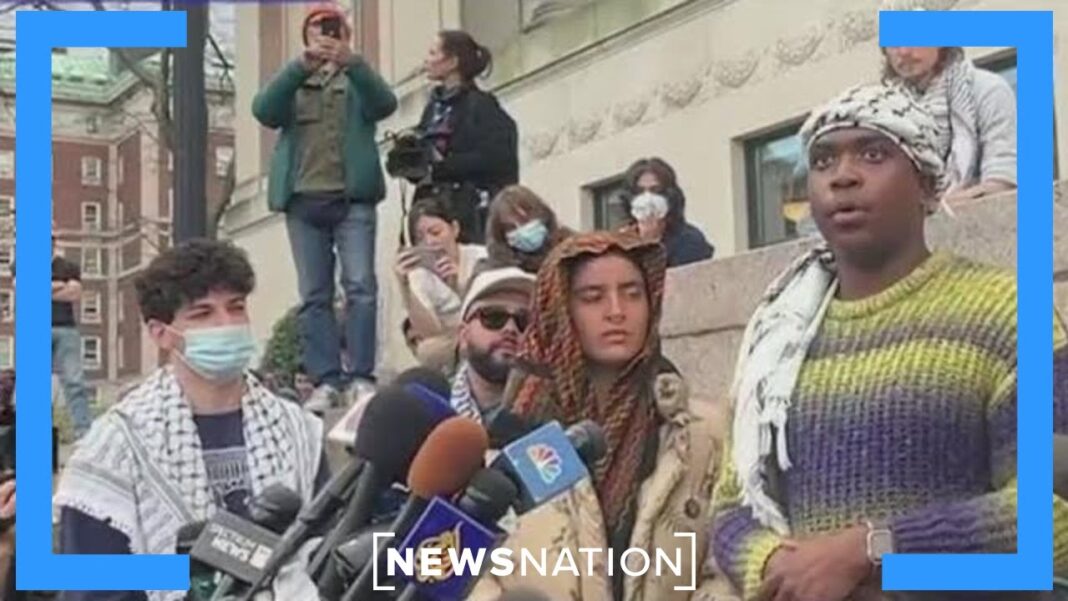
The case of Khymani James has become emblematic of the broader crisis that engulfed Columbia during the 2023–2024 academic year, when hundreds of students erected a so-called “Gaza Solidarity Encampment” on campus. As The Algemeiner has repeatedly documented, the encampment emerged in the immediate aftermath of Hamas’s October 7, 2023, massacre across southern Israel, an attack that included mass murder, sexual violence, and kidnappings. While organizers framed the protest as an act of solidarity with Palestinians, Jewish students and faculty described an atmosphere of intimidation, harassment, and open glorification of a U.S.-designated terrorist organization.
James was among the most visible figures associated with that protest movement. During the academic year, he filmed himself delivering a series of statements that went far beyond harsh political rhetoric and into explicit advocacy of violence. In footage that circulated widely online, James asserted that Zionists were “all the same people” whose very existence—and the existence of Israel itself—was “antithetical to peace.” “Yes, I feel very comfortable, very comfortable, calling for those people to die,” he said in 2024. He went further still, declaring, “Zionists don’t deserve to live,” and adding that others should be “grateful that I’m not just going out and murdering Zionists.” In one of the most chilling moments captured on video, James proclaimed, “I don’t fight to injure or for there to be a winner or a loser. I fight to kill.”
The statements provoked outrage from lawmakers and Jewish advocacy organizations, many of whom questioned why Columbia appeared slow to impose discipline. As The Algemeiner reported at the time, critics argued that had similar language been directed at any other protected group, the university’s response would have been swift and uncompromising. Under mounting pressure, Columbia suspended James in April 2024, announcing that he would be eligible to return in the fall of 2025.
James responded not with contrition, but with litigation. He sued Columbia University, alleging that his suspension was racially discriminatory and designed to “privilege a subset of Jewish people.” The lawsuit charged—twice—that Columbia favored Jews over “nonJews [sic],” and portrayed James as a victim of institutional bias rather than a perpetrator of hate. “James as a person of color is squarely within a protected class of black and brown-skinned students who have been the major targets of Columbia’s disciplinary actions arising from pro-Palestinian expression,” the suit claimed. It further asserted that Columbia had engaged in “reverse discrimination” by privileging “self-described ‘Zionist Jewish’ people” over others on campus.
As The Algemeiner report noted, the framing stunned many legal observers, who pointed out that U.S. civil rights law protects individuals from harassment and threats regardless of the political justifications offered by the speaker. The lawsuit did not deny James’s statements; instead, it argued that they constituted protected political expression. That argument became increasingly difficult to sustain as James continued to endorse political violence even after his suspension.
In September 2024, while barred from campus, James publicly expressed support for the assassination of conservative activist Charlie Kirk at Utah Valley University, calling for further killings and declaring, “MORE. MORE!!! … Down with all fascists.” For critics cited by The Algemeiner, this episode underscored that the issue at stake was not merely offensive speech, but a persistent pattern of endorsing lethal violence against ideological opponents.
It was against this backdrop that new documents filed in New York court revealed Columbia’s evolving stance. In a letter dated December—submitted as an exhibit in the lawsuit—the university rejected James’s request to return to campus in the fall of 2025. A second letter, dated August 2025 and also included in the court filings, again denied his re-enrollment. Both letters were first reported by the Washington Free Beacon.
The August letter, written by a college dean whose name was redacted, offered a blunt assessment. “Your written submissions do not demonstrate a clear understanding of the impact of your conduct,” it stated. The dean explained that James’s online activity since his suspension showed “insufficient ‘reflection on your activities’ that resulted in your suspension.” The letter cited James’s continued defense of his earlier remarks and his public insistence that “anything I said, I meant it.”
“Your use of language tending to reaffirm those statements during your suspension raises serious concerns about your readiness to return to Columbia and engage with others appropriately,” the letter continued. “That only reinforces our concerns, rather than alleviates them.” For many readers, the language represented a rare moment of institutional candor—an acknowledgment that advocacy of violence, even when couched in political rhetoric, is incompatible with campus safety.
Yet the same letter also left the door ajar. Columbia informed James that he would be “eligible to reapply to return for the fall 2026 semester” under the conditions outlined in his original suspension. “It is our hope that you will use the months ahead to engage in more substantive and careful reflection on the behaviors that led to your suspension,” the university wrote.
That conditional openness has alarmed critics who fear Columbia may be sliding back into what they describe as a cavalier posture toward antisemitism. As The Algemeiner has reported, Jewish students at Columbia were assaulted, harassed, and intimidated during the height of the anti-Israel protests, with some afraid to wear visible symbols of their identity. Against that history, the idea that a student who explicitly called for the killing of Zionists could one day return has struck many as a betrayal of the university’s stated commitments.
“Universities should take responsibility for the students they admit to their campuses,” U.S. Rep. Tim Wahlberg, chairman of the House Committee on Education and the Workforce, told The Algemeiner. “Under federal civil rights law, Columbia has the duty to prevent antisemitic harassment on its campus. I expect that Columbia’s incoming president will take this responsibility seriously.” Wahlberg’s comments reflect a broader willingness among lawmakers to scrutinize elite universities that receive federal funding while allegedly failing to protect Jewish students.
The James controversy does not stand alone. Columbia continues to face intense scrutiny for its broader handling of pro-Hamas activism and antisemitic rhetoric. As The Algemeiner report detailed, the university retained Joseph Massad, a professor of modern Arab politics, who publicly celebrated Hamas’s October 7 atrocities. Writing in The Electronic Intifada on October 8, 2023, Massad lauded the massacre as “astounding,” “awesome,” and “incredible,” and described the Hamas paragliders who descended on a music festival to slaughter young people as the “air force of the Palestinian resistance.” Despite widespread condemnation, Columbia allowed Massad to continue teaching a course on the history of the Israeli-Palestinian conflict—a decision that sent shockwaves through the Jewish community.
In July, then-interim president Claire Shipman attempted to signal a course correction. She announced plans to hire new coordinators to oversee civil rights complaints, introduce deeper education on antisemitism, adopt the International Holocaust Remembrance Alliance definition of antisemitism, and form new partnerships with the Anti-Defamation League and other Jewish groups. Shipman also vowed never to “recognize or meet with” Columbia University Apartheid Divest, a pro-Hamas student organization that had repeatedly disrupted academic life.
Whether those pledges will survive a leadership transition remains uncertain. Columbia has since installed a new president, Jennifer Mnookin, whose record has drawn careful scrutiny. As chancellor of the University of Wisconsin–Madison, Mnookin struck a deal with pro-Hamas protesters that included commitments to hire Palestinian instructors and issued land-acknowledgment statements emblematic of progressive academic culture. In 2020, she endorsed the Black Lives Matter movement, even as some of its supporters engaged in riots, promoted antisemitic narratives, and vilified law enforcement—positions that critics, quoted by The Algemeiner, say raise questions about how she will navigate Columbia’s current crisis.
For many observers, the Khymani James case has become a litmus test. It asks whether Columbia truly recognizes that calls for violence against Zionists—who make up the overwhelming majority of Jews worldwide—are not abstract political critiques but direct threats to a protected community. The university’s refusal to immediately readmit James suggests an awareness of that reality. Its willingness to contemplate a future return suggests lingering hesitation.
As The Algemeiner report emphasized, the stakes extend beyond one student or one campus. Universities shape not only academic discourse but the moral boundaries of civic life. When institutions appear unable—or unwilling—to draw clear lines against rhetoric that celebrates murder, they risk normalizing the unthinkable. Columbia now finds itself at a crossroads, its decisions watched closely by students, lawmakers, donors, and the broader public.
Whether the university will fully confront the implications of its choices, or once again retreat into procedural ambiguity, remains an open question. What is clear is that the controversy surrounding Khymani James has forced a painful reckoning—one that will define Columbia’s reputation long after the encampments have vanished and the court filings have been archived.