



|
Getting your Trinity Audio player ready...
|
Ciattarelli Slams Sherrill’s Energy Emergency Plan as “Unworkable Gimmick” in Heated NJ Gubernatorial Debate
By: Carl Schwartzbaum
The race for New Jersey’s governor turned sharply confrontational this week as Republican candidate Jack Ciattarelli accused Rep. Mikie Sherrill, the Democratic frontrunner, of pushing an “illegitimate and unworkable” plan to declare a state of emergency to lower energy prices—a proposal he said was legally dubious, economically reckless, and politically contrived.
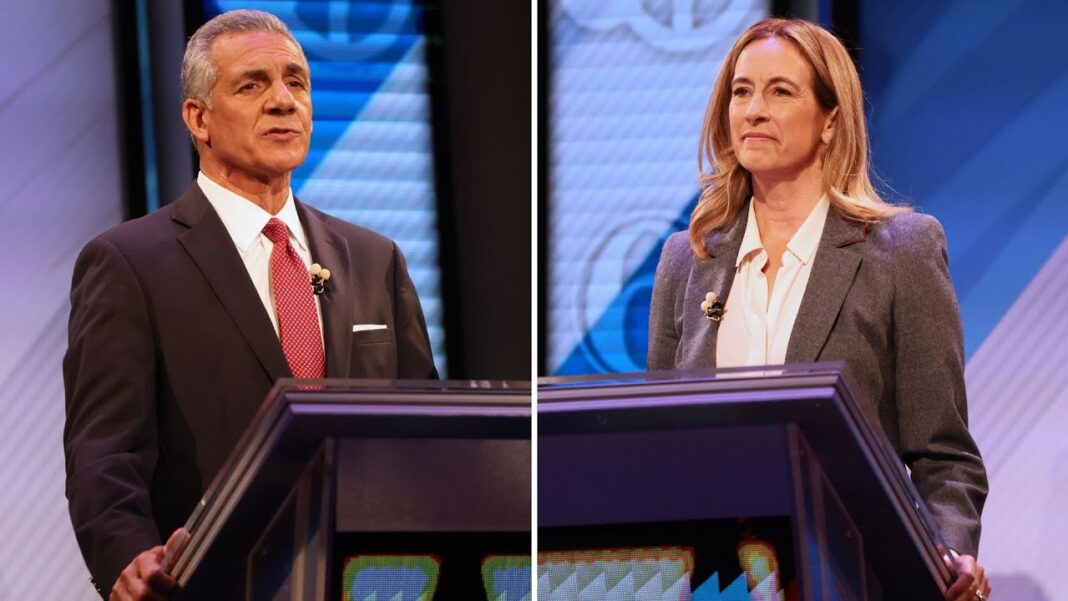
The clash, covered by The New York Post on Wednesday, took center stage during the candidates’ second debate at the New Brunswick Performing Arts Center, where energy affordability and environmental policy dominated the discussion. Ciattarelli, a former state assemblyman and two-time gubernatorial contender, dismissed Sherrill’s emergency declaration proposal as a political stunt designed to mask Democratic failures on cost-of-living issues that have increasingly defined the 2025 campaign.
“My opponent has put forth an illegitimate plan that isn’t feasible,” Ciattarelli said, as quoted in The New York Post report. “Even the governor, a member of her own party, has said, ‘I don’t think you can do that.’” He was referring to outgoing Gov. Phil Murphy, who publicly expressed skepticism about Sherrill’s proposal earlier this month.
Sherrill, who has made energy affordability one of her signature campaign themes, has proposed using executive powers under a state-of-emergency framework to cap electricity and heating costs for residents struggling with record-high bills. She argues that New Jersey families are being “crushed by utility costs” and that decisive, temporary government intervention could provide immediate relief while the state transitions toward renewable energy sources.
In interviews cited in The New York Post report, Sherrill has described the measure as a “bold, pragmatic step” to combat what she calls “energy inflation driven by corporate greed and policy inertia.” Her campaign insists the plan would not involve price controls in the traditional sense but rather state-level emergency measures to freeze rate hikes and redirect renewable subsidies toward household relief.
However, legal experts and political observers remain skeptical. As The New York Post report noted, even Murphy—a progressive Democrat and an ally of Sherrill—has said the proposal lacks a clear legal basis. “You can’t simply declare a state of emergency to override market-regulated energy pricing,” one former state regulatory official told the paper. “It’s not a hurricane or a pandemic. It’s economics.”
Ciattarelli pounced on the issue with characteristic bluntness, accusing Sherrill of “grandstanding for headlines instead of governing for results.”
“There are 77 incumbent Democratic legislators, 52 of whom are on the ballot this year,” he said during the debate, as reported by The New York Post, “and not one has endorsed her plan to get electricity rates down on day one.”
He argued that Sherrill’s emergency proposal was symptomatic of what he called a “Democratic addiction to government overreach,” warning that such a move could spook energy investors and worsen long-term price instability. “Declaring an economic emergency doesn’t lower your bill—it just signals panic,” Ciattarelli said. “It’s gimmickry dressed up as leadership.”
Instead, Ciattarelli outlined his own plan centered on pulling New Jersey out of the Regional Greenhouse Gas Initiative (RGGI)—a multistate carbon cap-and-trade program that he denounced as “a failure that has cost New Jersey $300 million to $500 million a year without delivering results.”
“The Regional Greenhouse Gas Initiative has been nothing but a hidden tax on working families,” Ciattarelli told debate moderators, according to the report in The New York Post. “It’s time we get out of it. We can still protect our environment without punishing residents at the meter.”
The energy debate has become a proxy war over Gov. Phil Murphy’s legacy, which looms large over the campaign. Murphy’s clean-energy agenda, anchored by aggressive investments in offshore wind and electric vehicles, has faced growing backlash from voters frustrated by high utility bills and project delays.
Sherrill has sought to walk a careful line, endorsing the state’s green ambitions while signaling a more populist focus on affordability. “We can fight climate change and keep New Jersey livable at the same time,” she said in an earlier statement quoted in The New York Post report.
But Ciattarelli has sought to pin the state’s cost-of-living crisis squarely on Murphy and, by extension, Sherrill. “New Jerseyans are paying the price for the Democrats’ obsession with theoretical climate solutions,” he said. “We’ve seen our energy bills skyrocket, our businesses struggle, and our families fall behind.”
He added that his administration would prioritize deregulation, domestic energy production, and grid modernization over what he called “performative environmentalism.”
As The New York Post report observed, the debate over energy prices cuts to the heart of New Jersey’s political anxieties. Residents face some of the highest property taxes and utility costs in the nation, while middle-class families continue to grapple with post-pandemic inflation and rising home-heating expenses.
For Sherrill, the state of emergency proposal was meant to underscore empathy and urgency. But for many voters—and critics within her own party—it has raised questions about competence. “You can’t govern through press releases,” one Democratic strategist told The New York Post on background. “The optics of this plan are bad. It makes her look desperate.”
The controversy also reveals a deeper tension within the Democratic coalition: the clash between progressive environmental priorities and pocketbook pragmatism. While Sherrill’s base applauds her climate advocacy, moderate voters appear less convinced that sweeping government interventions can bring real relief.
“Energy policy is where the rubber meets the road,” said a Rutgers political science professor quoted in The New York Post report. “You can talk about equity and sustainability all day, but if a retiree in Edison can’t afford to heat their home, none of that matters.”
The debate in New Brunswick was combative from the outset, but the exchange over energy prices provided its defining moment. Ciattarelli’s attack—framed as a defense of fiscal realism against political theatrics—resonated with the audience, drawing applause from business leaders and independent voters in attendance.
Sherrill, however, refused to back down. “Jack Ciattarelli’s solution is to abandon our climate commitments and let corporations dictate prices without oversight,” she shot back. “I will never apologize for fighting for working families.”
Yet, as The New York Post report observed in its post-debate analysis, Sherrill’s response failed to fully dispel doubts about the feasibility of her proposal. Even sympathetic commentators conceded that invoking emergency powers over energy pricing “stretches constitutional authority and public credibility alike.”
With less than a month to go before Election Day, energy affordability has emerged as one of the race’s central issues—alongside property taxes, crime, and education. For Ciattarelli, the confrontation gave him a chance to sharpen his economic message and cast himself as the sober alternative to Sherrill’s populist flair.
“The energy crisis in New Jersey is real,” he told reporters afterward, according to The New York Post, “but the solution isn’t political theater—it’s practical leadership.”
For Sherrill, the challenge now is to reframe her proposal as bold rather than naïve. Her campaign insists that voters want leaders who are willing to “think creatively” about affordability, not recycle partisan talking points.
Still, as The New York Post report observed, the damage may already be done: “In a race defined by kitchen-table economics, Sherrill’s energy emergency may prove less a spark for innovation than a flashpoint of doubt.”
