



|
Getting your Trinity Audio player ready...
|
Caracas to Cuffs: Ousted Venezuelan Tyrant Nicolás Maduro Airlifted to NYC Following U.S. Seizure
By: Fern Sidman
By any measure, Saturday night marked one of the most extraordinary moments in the modern history of U.S.–Latin American relations. Nicolás Maduro — the iron-fisted ruler who for more than a decade turned Venezuela into a narco-state, a humanitarian catastrophe and a geopolitical tinderbox — arrived in New York not as a head of state, but as a federal detainee.
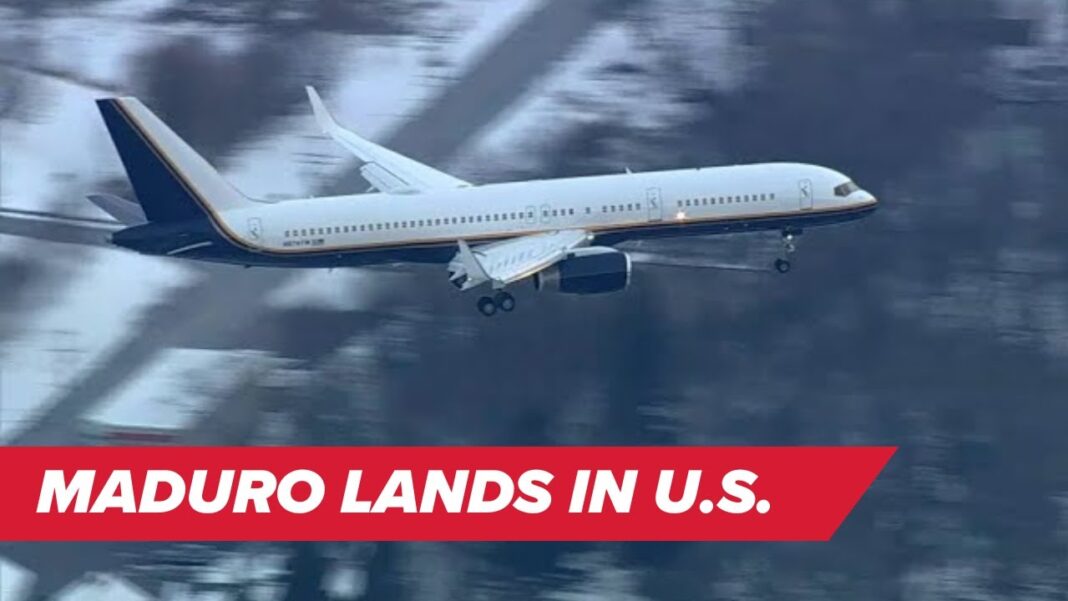
As reported on Saturday evening in The New York Post, the ousted Venezuelan strongman and his wife, former first lady Cilia Flores, touched down at Stewart Air National Guard Base in Newburgh just after 5 p.m., ferried into American custody by U.S. forces following a lightning military operation in Caracas earlier that morning. Their arrival in New York City was not cloaked in diplomatic ceremony, but in the unmistakable choreography of criminal justice: a military helicopter, a heavily armed motorcade, and finally the hulking armored Bearcat vehicle more commonly associated with terrorist takedowns than with foreign leaders.
By 7 p.m., according to The New York Post report, Maduro and Flores were whisked from a Manhattan heliport to the Drug Enforcement Administration’s headquarters in Chelsea, where federal agents processed them like any other high-value suspects in a narcotics conspiracy. From there, the pair were returned to the West 30th Street Heliport and flown under tight escort down the West Side of Manhattan, passing the Statue of Liberty — a jarring tableau that symbolized the grotesque inversion of Maduro’s once-formidable power.
In Brooklyn, they were transferred into another fortified convoy bound for the Metropolitan Detention Center, the same facility that has housed some of the world’s most infamous criminals. As the Bearcat rumbled through city streets, protesters who had gathered in anticipation jeered with unrestrained fury.
“Down with the dictator!” they shouted.
“Shame on you!”
“Dirty scumbag!”
It was the sound of reckoning.
For years, The New York Post has chronicled the steady collapse of Venezuela under Maduro’s regime — from hyperinflation that wiped out the savings of an entire generation to mass emigration that hollowed out whole cities. Yet the final act in this tragic saga unfolded with cinematic abruptness.
At dawn Saturday, U.S. special forces executed a precision operation in Caracas, seizing Maduro and Flores from their heavily guarded compound. The move, sanctioned by the White House, was justified as the enforcement of long-standing criminal indictments in the Southern District of New York, where Maduro has been charged since 2020 with leading what prosecutors describe as a “narco-terrorism enterprise.”
According to the charges, Maduro and his inner circle transformed the Venezuelan state into a logistical arm of the so-called Cartel of the Suns — a criminal network that collaborated with Colombia’s FARC guerrillas to flood the United States with cocaine. The alleged crimes include conspiracy to import thousands of tons of narcotics, possession of machine guns and destructive devices, and the coordination of weapons shipments to foreign terrorist organizations.
Maduro’s wife, Cilia Flores — once known in Caracas as the “First Combatant” for her aggressive political role — now stands accused as a full partner in the scheme. Their son, Nicolás Ernesto Maduro Guerra, nicknamed “The Prince,” has also been charged with facilitating cocaine trafficking, turning the Maduro dynasty into what federal prosecutors portray as a family-run criminal syndicate.
President Trump wasted no time framing the arrest as a moral watershed.
“They will face the full wrath of American justice,” Trump said at a press conference, adding that the United States would temporarily “run the country” until a transition government could be installed in Caracas. As The New York Post report noted, this language was not diplomatic euphemism but an unmistakable declaration of intent: the Maduro era is over.
The administration’s position is that Venezuela’s oil reserves — the largest proven reserves on Earth — were systematically looted under Maduro’s stewardship. U.S. officials allege that billions in American-linked assets were siphoned off through opaque state oil deals, shell companies, and illicit partnerships with China, Russia, and Iran, effectively nationalizing wealth that Washington says was stolen from U.S. investors and bondholders.
For years, Venezuela’s state oil company PDVSA was accused of operating less as a national enterprise and more as a laundering mechanism for the regime. As The New York Post has reported in multiple investigations, entire cargoes of crude were allegedly diverted, misreported, or traded under the table to finance Maduro’s political survival.
The irony of Maduro’s final destination was not lost on the crowd gathered outside the Metropolitan Detention Center.
Here was a man who once addressed the nation from gilded balconies, who ruled through secret police and military patronage, now reduced to a detainee number in a Brooklyn jail.
Sources cited by The New York Post said Maduro could appear in federal court as early as Monday, facing arraignment on charges that carry potential life sentences. His wife is expected to be processed alongside him, a symbolic dismantling of the myth that Venezuela’s first family was untouchable.
Legal experts told the paper that prosecutors are likely to seek pretrial detention, arguing that Maduro’s history of flight, his foreign alliances, and the severity of the charges make him an extraordinary flight risk.
Back in Caracas, the aftermath is chaos. With Maduro gone, Venezuela has plunged into what diplomats are calling a constitutional crisis. Loyalists in the military are reportedly split, some calling for calm, others warning of foreign occupation. Streets that once hosted government-orchestrated rallies are now filled with spontaneous demonstrations — some jubilant, others fearful of what comes next.
The New York Post report noted that this is the first time since the capture of Panamanian strongman Manuel Noriega in 1989 that the United States has seized a sitting Latin American leader and brought him to New York in chains. Then, as now, Washington justified the move as law enforcement rather than regime change, a distinction that may matter legally but carries explosive political consequences.
Yet the symbolism is unmistakable. The world has just watched the most entrenched autocrat in the Western Hemisphere become a defendant in a U.S. courtroom.
The reaction in New York has been visceral. Outside the MDC in Brooklyn, Venezuelan expatriates waved flags and wept openly, some celebrating what they called “the end of the nightmare,” others demanding that the U.S. not merely prosecute Maduro but help rebuild their shattered homeland.
Across the city, political fault lines emerged instantly. While President Trump framed the arrest as overdue justice, New York City Mayor Zohran Mamdani publicly condemned it as an “act of war,” accusing the administration of violating international law. Governor Kathy Hochul echoed those concerns, calling the operation “reckless.”
But the crowd in Brooklyn was unmoved.
“Where was international law when our children starved?” one protester told The New York Post. “Where was Mamdani when Maduro stole our country?”
For decades, Maduro cultivated an image of permanence — a leader molded in the shadow of Hugo Chávez, convinced of his own historical destiny. But history is rarely as forgiving as tyrants believe.
Now he is a federal inmate, processed at DEA headquarters in Chelsea, flown past Lady Liberty under guard, and deposited in a detention center where the clang of steel doors is the only ceremony afforded to disgraced despots.
The New York Post captured the moment succinctly: the fall of Maduro was not a coup. It was a perp walk.
And in the annals of American law enforcement, it may stand as the moment the narco-state finally met its prosecutor.
