



|
Getting your Trinity Audio player ready...
|
By: Jeff Gorman
Mayor-elect Zohran Mamdani’s Hanukkah message to New York was not delivered in the form of a standard holiday greeting or a brief statement of goodwill. Instead, it arrived as a carefully produced, more than three-minute video featuring one of America’s most recognizable Jewish actors, Mandy Patinkin, filmed inside the actor’s New York home. As reported on Saturday in The New York Post, the video has ignited a fresh wave of debate over Mamdani’s fraught relationship with the city’s Jewish community and the authenticity of his outreach.
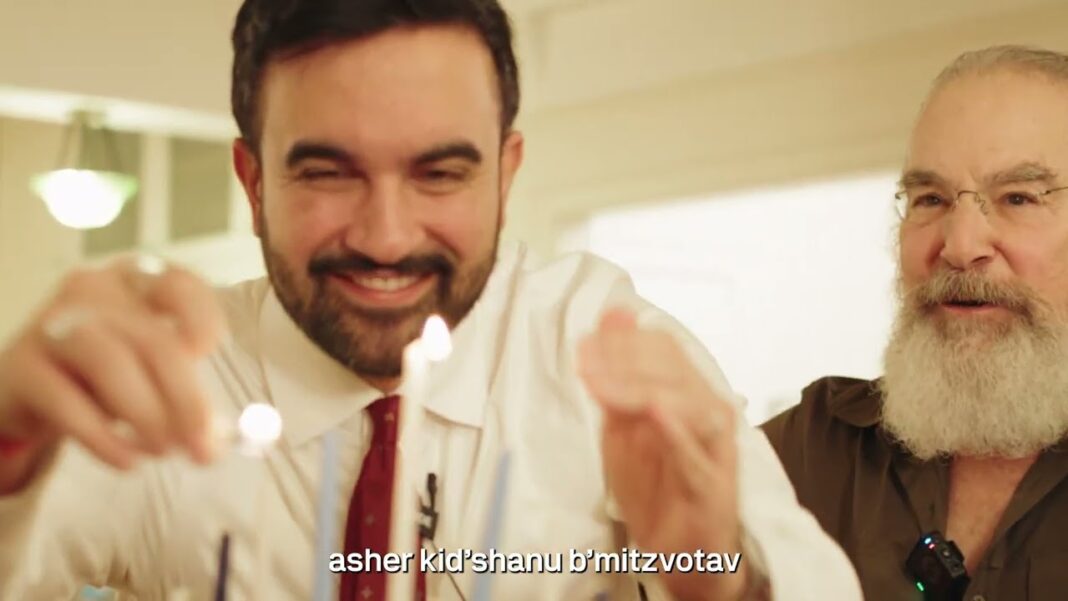
Released Saturday, the video shows Mamdani—an avowed democratic socialist and outspoken critic of Israel—celebrating the Festival of Lights alongside Patinkin, the “Princess Bride” star, his wife Kathryn Grody, and their family. The footage, filmed on the first night of Hanukkah, presents an intimate tableau: Mamdani smiling broadly, helping prepare latkes, participating in Hebrew prayer, and lighting candles as cameras roll.
“Happy Hanukkah from NYC’s anti-Israel, mayor-elect,” The New York Post report noted pointedly in its coverage, encapsulating the tension that underlies the seemingly warm holiday scene. For Mamdani, whose political rise has been accompanied by sharp criticism from Jewish leaders over his anti-Zionist positions, the video appeared to be an attempt to project reconciliation, inclusion, and shared humanity. For many viewers, however, it landed quite differently.
From the opening moments, the video struck some observers as conspicuously staged. Patinkin greets Mamdani with theatrical surprise—“It’s the mayor! What are you doing here?”—while looking directly into the camera, a moment The New York Post described as less spontaneous than performative.
The mayor-elect is then shown seamlessly integrated into the evening’s rituals: frying latkes, reciting prayers, and joining the family at the menorah. At one point, Mamdani intones, “Here’s to more light,” a line clearly designed to echo the symbolic themes of Hanukkah while doubling as a political message.
Patinkin, leaning into the moment, later tells Mamdani, “Your mayoral tenure or whatever it’s called has now been blessed,” before the group sits down to eat. The remark, lighthearted on its surface, carried a deeper resonance given Mamdani’s contentious standing among many Jewish New Yorkers.
The video was not an off-the-cuff snapshot but a polished piece of political communication—released on social media, edited for tone, and clearly intended to travel widely.
The reaction to the video cannot be separated from Mamdani’s political record. The mayor-elect has built his profile as a fierce critic of Israel and an advocate for pro-Palestinian causes, positions that have earned him passionate supporters on the left—and deep skepticism, even hostility, from significant segments of New York’s Jewish population.
That backdrop explains why the Hanukkah video, rather than soothing tensions, intensified them. As The New York Post reported, while some social media users praised Mamdani for extending holiday wishes and appearing alongside a beloved Jewish figure, others were unconvinced, accusing him of performative allyship.
“This has ‘I’m not anti-Semitic, some of my best friends are Jews’ vibes,” one commenter wrote, a remark highlighted in The New York Post report as emblematic of the backlash. Another follower was even more blunt: “Man, he will do anything to make New Yorkers think he supports the Jewish community.”
The criticism underscores a central challenge facing Mamdani as he prepares to assume office: symbolic gestures may no longer suffice in a city where political positions on Israel, antisemitism, and public safety intersect with deeply personal communal concerns.
Patinkin’s presence added a layer of complexity to the moment. The actor, widely admired for both his artistic achievements and his Jewish identity, has in recent years been outspoken on political issues, including criticism of Israeli government policies. His willingness to appear alongside Mamdani lent the video a veneer of cultural legitimacy that Mamdani’s team likely hoped would resonate with skeptical audiences.
Yet, as The New York Post report observed, celebrity endorsement is a double-edged sword. For critics, Patinkin’s participation did little to assuage concerns about Mamdani’s broader worldview. Instead, it reinforced the impression that the video was designed to borrow credibility rather than earn trust through policy commitments.
The optics were unmistakable: a polarizing mayor-elect, a famous Jewish actor, and a holiday rooted in Jewish survival and resistance—all framed within a carefully edited narrative of warmth and unity.
On X, Mamdani shared the video with a message that leaned heavily into inclusivity. “It was such a joy to celebrate Hanukkah with Mandy, Kathryn and their son, Gideon,” he wrote, adding: “As Jewish New Yorkers across our city prepare to light candles and mark the seventh night today, I wish you and your families a Hanukkah full of light and love.”
Supporters applauded the sentiment, with some praising Mamdani for reaching out during a period of heightened anxiety among Jewish communities nationwide. But skepticism quickly drowned out the applause in many corners.
The divide in reactions mirrored Mamdani’s broader political trajectory: admired by activists who see him as a voice for the marginalized, distrusted by others who question whether his rhetoric translates into genuine respect for communities that feel targeted by his policies.
Hanukkah, with its emphasis on light triumphing over darkness, offered a potent metaphor. Mamdani’s line—“Here’s to more light”—was clearly chosen with that symbolism in mind. Yet critics argue that symbolism, without substantive policy shifts, risks ringing hollow.
As The New York Post report noted, many Jewish New Yorkers are less interested in candle-lighting appearances than in concrete assurances on issues such as public safety, antisemitism, and the city’s stance toward Israel-related protests. Against that backdrop, a staged holiday video—however well produced—may do little to bridge the trust gap.
Ultimately, the Hanukkah video may serve as an early preview of Mamdani’s mayoralty: visually compelling, rhetorically inclusive, and politically polarizing. It underscores his belief in the power of narrative and imagery, while also revealing the limits of such strategies in a city as politically sophisticated—and divided—as New York.
As The New York Post report noted, Mamdani enters office under intense scrutiny from communities that feel alienated by his past statements. Whether future actions will soften those perceptions remains an open question.
For now, the candles have been lit, the latkes fried, and the video shared. But as the reaction made clear, light alone may not be enough to dispel the shadows of mistrust that surround New York’s mayor-elect.

I could toss my latkes!
Mondami got plenty of New York Jewish votes. It is obvious that many Jews are Democrats first and Jews second.
Another useful idiot.
The true meaning of Chanukah: Practicing Judaism even if that means revolt against the foreign oppressor – which could lead to Jewish independence in Israel. Does Mamdani want to say something like that? Could the anti-Israel crowd use his lighting of the menorah against him in any way? Only time will tell.