



|
Getting your Trinity Audio player ready...
|
Burning Questions From Last Week’s News: Bail Law, Hudson River Tunnel, Education Funding, & Afro-Americans Fleeing NYC
By Gary Tilzer
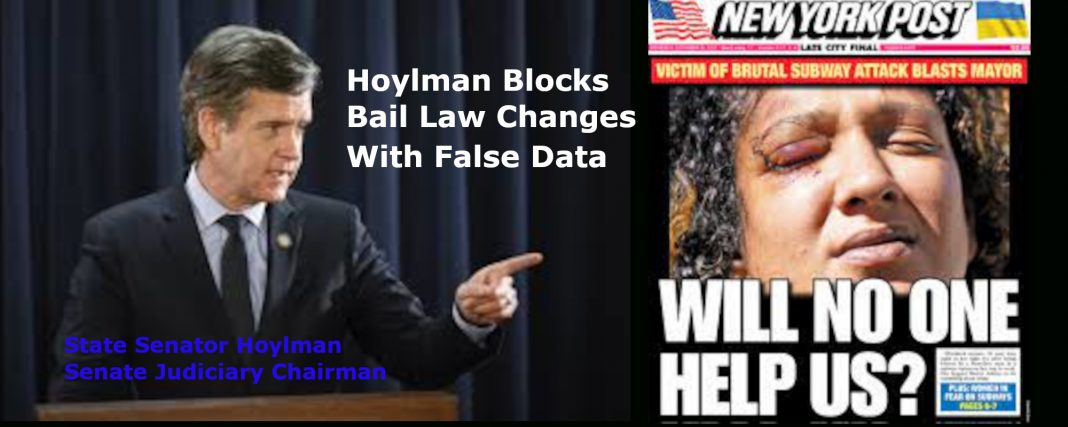
Why Won’t State Senator Hoylman Use the Right Data to Understand his Progressive 2019 Bail Law has Clearly Increased Crime?
Senate Judiciary Chair Brad Hoylman claims the public has been “bombarded” with media campaigns that are based on “fearmongering” on the crime issue. And his position at least in his press releases has always been: “the data shows that the new bail law has not increased crime.” Assembly Codes Committee Chair Jeffrey Dinowitz said, “what data has become available has been manipulated for political purposes.” Since the data on the impacts of bail reform in 2020 came out, both supporters and opponents of the reforms have used it as evidence supporting their diametrically opposed positions. The top NYPD police bass, including Commissioner Sewel’s police bail data, blames 3,000 career criminals who the bail law has set free to commit additional crimes and 2,000 untreated violently mentally ill for the City’s current crime wave.
Absent comparable datasets from 2019 and years prior, information gathered in 2020 lacked context to draw reliable conclusions about the direct impact that changes to bail had on crime rates among recidivists, those released pretrial and more generally. The NPR Rochester WXXI radio station reported the recent Albany Legislative hearing on bail reform data is inconclusive. The only data that is important to analysis is the recidivism rates of the 5% of the felony cases the Criminal Court handles.
The NYC Criminal Court conducts arraignments in two main parts: one processing misdemeanors (crimes punishable by fine or imprisonment of up to one year), the other one handling felony arraignments (crimes punishable by imprisonment of more than one year). Prior to the 2019 bail law changes, over 90% of the defendants going before a judge in NYC Criminal Courts were released without bail in both parts. The defendants arraigned in the misdemeanor part of the Criminal Court, the larger by far part, almost never received bail and were rarely rearrested for the same minor crime, even before the bail law changes. If Hoylman wanted to find the true reason for NYC’s current crime wave, he would look at the recidivists data from the felony part of the Criminal Court, which is about 10% of all the cases in NYC Criminal Courts.
The Governor proposed, as part of her State of the State address, to give Judges greater discretion to set bail for the most serious crimes, by removing a standard in law requiring Jurists to impose the “least restrictive” means of ensuring a defendant returns to court. The Governor’s bail law changes will be decided during budget negotiations. Hochul faces extreme opposition to any changes in the bail law from Hoylman’s progressive wing of the Albany legislature, emboldened by blocking Governor’s Chief Judge nominee Justice Hector Lasalle. The media needs to do a better job unraveling and analyzing Heilman’s bail data, not just copying his press releases claiming the bail data proves the 2019 bail law changes has not increased NYC crime.
Will the New Hudson River Tunnel Announced by Biden Ever be Finished and How Much Will it Cost if it is?

Joe Biden, a well-known Amtrak lover, visited Manhattan’s West Side, hailing his infrastructure wins in Congress, to announce a nearly $292 million grant for a new rail tunnel under the Hudson River. Despite the headline in the Washington Post “We’re going to get it done,” Biden says of the long-delayed rail Hudson River project in N.Y.
The $292 million that Biden infrastructure provided New York only pays for concrete casing underneath Hudson Yards of the existing tunnel. The estimated cost for the new tunnel will be 17 billion and will take until 2037 to build. Based on the LIRR Grand Central Terminal’s access project, which was originally scheduled to open in 2009 at a cost of 2 or 3 billion, and as of today is still not running trains from Long Island at a price tag of 19 billion, after reading the MTA spent twice as much on Second Ave subway consultants as it did on its construction of a thirty block tunnel, it is not farfetched to predict that final cost of the Hudson River tunnel project will be 100 billion and not be ready until 2200.
This is not the first-time our elected leaders have celebrated the start of the beleaguered Gateway Hudson River Tunnel Project to repair and expand the crumbling tunnel under the Hudson River. In 2009, officials did a ceremonial groundbreaking for the project, before workers had to fill in where they started digging, after New Jersey’s then-Gov. Chris Christie pulled its funding. The project was then revived after the existing Tunnel incurred significant damage during Hurricane Sandy in 2012, only to be held up by the Trump administration. There has been no or little discussion on how the cost cutting GOP House majority will affect the future federal funding of the Hudson Tunnel Project.
Is John Liu Out of Step With the Asian Community in Supporting the UFT’s Efforts to Block Charter Schools and More Govt Funding for Private Schools?

On the night of his primary election victory in 2008, City Comptroller candidate John Liu stood in the City’s teacher union headquarters and thanked the United Federation of Teachers for delivering his win.
On Groundhog Day, February 2nd, the NY Times reported that “Charter School Expansion Faces Tough Fight in New York,” in response to Governor Hochul’s proposed plan to eliminate a regional cap for NYC, making thousands of more student slots available by creating a 100 new charter schools in the Big Apple. There is currently a cap on the number of charter schools for NYC, and that limit has been reached, despite a remaining long waiting list of families that would prefer their children to be charter school educated. Charters educate roughly 14 percent of local public-school children, a lower percentage than in cities like Philadelphia, where charter schools enroll nearly one in three students, or in Washington, D.C., where they educate nearly 50 percent of students. New York Charter schools have an average math proficiency score of 79% (versus the New York public school average of 56%) and reading proficiency score of 83% (versus the 63% statewide average).
Progressive Democrats have already joined with teachers union President Michael Mulgrew’s vowing to block Governor Hochul’s plan to lift the NYC Charter school cap. Progressive members of the State Senate already issued a joint statement saying they opposed any increase in the regional cap in NYC, where 142,500 students or 15 percent of public students are enrolled. Senator John Liu, the former NYC Comptroller and State Senate Education Chair, called Hochul’s proposal a “non-starter.” Liu has the luxury of coming from a district that has two of the best functioning and highest math and reading school boards in the City–Districts 25 and 26. The progressive Working Families Party, which is partially funded by the UFT, endorsed John Liu in his 2014 race which defeated State Senator Tony Avella, as part of the group’s successful effort to wrest control of the legislature from the GOP-Independent (moderate) Democratic Coalition.
When it comes to charter schools, there seems to be a disconnect between Liu and his fellow progressive Democratic lawmakers and their constituents, particularly parents and especially in the Asian community outside of Liu district. A poll recently released, found that nearly two-thirds of NYC parents support lifting the cap and opening more charter schools in the five boroughs. Anecdotal evidence indicates that support for charter schools is even higher in Asian communities. Asian parents from Sunset Park and Sheepshead Bay, lucky enough to obtain an open slot in the Charter School–the Success Academy in Bensonhurst, drive their children daily to school. Asian Parents in Forest Hills drive their children to Charter Schools in Manhattan. The number of Asian students attending charter schools jumped 54% in the past five years,” said Yiatin Chu of Asian Wave Alliance. Remarkably, Asian students only make up 4,000 of the 142,000 Charter School students. While Black and Hispanic students make up most of the rest of the students attending Charter Schools, elective leadership in the Assembly and State Senate representing minority communities to lift the cap is almost nonexistent. Queens State Senator Leroy Comrie is battling progressives sponsoring a bill supported by minority educators to allow dozens of Charter Schools to open, as long as they are run by people of “historically, underrepresented communities.” Comrie measure, co-sponsored by Brooklyn Democratic state Sens. Zellnor Myrie and Kevin Parker.
The fight over charter schools pits Hochul against New York State United Teachers (NYSUT), a statewide union that represents UFT and gave $25,000 to Senate Democrats on Jan. 13th, along with donations to every legislator who showed for last Friday’s City Hall rally against the gov’s more-charters plan. NYSUT also supported and contributed to Hochul’s successive Governor’s campaign. The teachers unions fund with hundreds of thousands of dollars, channeled through their private PACs, independent campaigns for progressive Democrats they endorse, such as Senator Liu’s and dozens of his legislator colleagues in the Senate and Assembly. UFT teachers call hundreds of thousands of voters and mail millions of pieces of direct mail to their dozens of endorsed candidates for city, state, and federal elections. The union also sends out robocalls urging its members to vote for candidates and the UFT President, Michael Mulgrew, makes appearances with candidates at press conferences and rallies. The UFT also hires Lobbyists like Berlin Rosen, Red Horse, and the Advance Group, which manage many of the progressive democrats campaigns, to distribute its PAC money. The UFT has milked the public schools for enough resources to buy and build a powerful political campaign machine, whose only purpose is to keep their gravy train going.
Charter supporters like Eva Moskowitz, founder of Success Academies, praised the Governor’s efforts to increase the charter cap. Although Moskowitz fought leaders like Liu, her efforts failed to expand the amount of Charter Schools in NYC. It looks like Hochul will be similarly forced to abandon the effort to expand charter schools during budget negotiations, which is already divided over Hochul’s proposed bail law reforms and in the aftermath of her defeat for the Chief Judge nomination. The Assembly, traditionally a bulwark against charter expansion and the early opposition coming from the State Senate are strong indications on how weak Hochul chances are to expand the Charter School cap.
The UFT, understanding the growing popularity and power of Charter Schools and parent involvement in their children’s education is already holding campaign workshops with parents the union selects to run in April Community Education Council (CEC) elections. Local CEC boards advocate for parents in each of the City’s 32 school district elections. The UFT wants parents sitting on the CEC Boards to be UFT- teacher-friendly and oppose Charter Schools.
Citywide, white residents now make up about 31 percent of the population, Hispanic residents 28 percent and Asian residents nearly 16 percent, according to census data. While the white population stayed about the same, the Asian community is the fastest growing group in NYC. The number of Asian immigrants in NYC grew by 12 percent from 2010 to 2019. Their power to influence public policy in education, especially for Charter, gifted and specialized schools, is only going to grow in the near future, if Asian community leaders unite on pushing for education excellence.
The City Council Which Already Held Hearings and Issued a Report to Examine the City’s Delivery of Services to the Migrants Has Not Held A Hearing Why 200,000 Blacks Have Left NYC During the Last Decade?
On January 31st The NY Times wrote a story about black families moving out of NYC, they have yet to write why the city’s middle class are leaving. The paper said, “between 2010 and 2020, a decade during which the city’s population showed a surprising increase led by a surge in Asian and Hispanic residents, the number of Black residents in the city declined by nearly 200,000 people or about 9%. Now, about one in five residents in the city are non-Hispanic Black, compared to one in four in 2000.” Despite the startling drop in the city’s black population, the City Council has yet to schedule a hearing on the reasons for black families moving out of the city. Many of the progressives on the council are elected from formally minority districts that were recently gentrified. For an elective body that will see primary elections in just five months, there has been surprisingly little talk about the drop in the city’s black population.
One of the progressive politicians visiting the Brooklyn migrant center was Manhattan City Councilwoman Gale Brewer, who said the location of the terminal is not ideal as it was far from the subway or a commercial strip. Brewer credited the City for providing free shuttle buses and ferry passes to the residents of the shelter. Brewer, the former Manhattan Borough President, who held that office during the major gentrification of Harlem, when many African Americans left that neighborhood, has yet to comment on this WCBS TV report “Historic Harlem Churches Face Declining Membership, Deteriorating Landmarks.” Brewer also did not comment on whether the free buses and ferries would be offered. to the Red Hook residents, especially those on Van Brunt St, two blocks from the migrant shelter, who also live far away from the subway.
@GaryTilzerTips
